Australopithecus anamensis; a face to fit the name

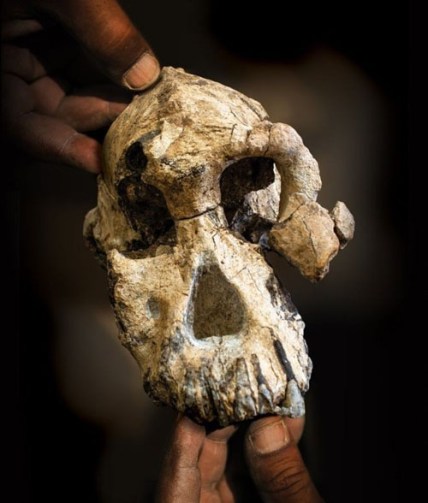
Ethiopian palaeoanthropologist Yohannes Haile-Selassie of the Cleveland Museum of Natural History, Ohio, USA has been involved in the search for early human ancestors in the Awash Valley of the Afar Depression in Ethiopia since 1990. The Middle Awash Project, founded by his mentor Tim White, has been enormously successful over the years. That is because most members from the top down are persistent, inured to heat and sharp sighted. Haile-Selassie is a case in point. In 2016 near a place called Miro Dora, he and a local worker independently spotted two parts of what turned out to be a near-complete cranium of an australopithecine (Au. anamensis) (Haile-Selassie, Y. et al. 2019. A 3.8-million-year-old hominin cranium from Woranso-Mille, Ethiopia. Nature, v. 572, published online; DOI: 10.1038/s41586-019-1513-8). When it was dated at about 3.8 Ma, using the 40Ar/39Ar method and magnetic reversal stratigraphy (Saylor, B.Z. and 13 others 2019. Age and context of mid-Pliocene hominin cranium from Woranso-Mille, Ethiopia. Nature, v. 572, published online; DOI: 10.1038/s41586-019-1514-7), his find caused quite a stir.
anamensis
The near-complete cranium of an Au. anamensis found in the Afar Depression of NE Ethiopia. Note the lateral fflattening caused by sedimentary burial. (Credit: Cleveland Museum of Natural History)

Fragmentary hominin fossils, including a complete lower jaw, found near Lake Turkana, Kenya in 1994 were sufficiently different from other, known australopithecines to warrant their recognition as a new species, Australopithecus anamensis. Seeming more ape-like than the famous ‘Lucy’ fossil Au. afarensis and also older – 3.9 to 4.2 Ma compared with 3.0 to 3.8 Ma for Lucy’s species –  Au anamensis  has long been regarded as a possible ancestor of afarensis, or even a more primitive member if the same species. The new, almost perfect cranium – except for some distortion during burial – cohabited the Afar Depression with Au. afarensis, for as long as 100 ka, and is sufficiently different to retain its species status. Because many palaeoanthropologists consider Au. afarensis to be early in the evolutionary line that lead to humans, the new find seems to throw a spanner in this linear hypothesis. However, there is another possibility that may resolve the issue.

During the Pliocene, Afar was a very diverse place with many volcanoes, lava flows and minor rift systems. It is possible that geographic complexity separated and isolated small groups allowing them to diverge genetically, in the manner of island faunas. Australopithecus afarensis may have arisen from such isolation, going on to outcompete its ‘parent’ species Au anamensis whose numbers progressively dwindled. Nevertheless, the emerging diversity of coexisting hominin populations in the Pliocene seriously challenges linear evolutionary hypotheses aimed at understanding the origin of our own genus (see Taking stock of hominid evolution February 2002 and Hominid evolution: a line or a bush? May 2006).

See also: Video of the discovery and summary of subsequent research

Barras, C. 2019. Rare 3.8-million-year-old skull recasts origins of iconic ‘Lucy’ fossil. Nature, v. 572, p. ; DOI: 10.1038/d41586-019-02573-w

Spoor, F. 2019. Elusive cranium of early hominin found. Nature, v. 572, p. ; DOI: 10.1038/d41586-019-02520-9


Symbolic art made by Denisovans (?)

The deep soil by a permanent spring in a vegetable allotment on the edge of the small town of Lingjing near Xuchang City in Henan Province, China has provided a wealth of stone artefacts and bone fragments to a depth of 10 m (see Denisovan(?) remains in the garden, March 2017). Optically stimulated luminescence (OSL) dating of mineral grains shows that the last time that the deepest soils were exposed to sunlight was between 78 to 123 ka. Long before the first arrival of anatomically modern humans (AMH) in China the site had been much as it is today, a human habitation site. Among the bones were fragments of the crania from five human individuals, perhaps either Homo erectus descended from the earliest arrivals in China or more recent Denisovans closely related to the Neanderthals of western Eurasia. Reconstruction of the two most complete crania hinted at the second possibility by resemblance to Neanderthal anatomy yet the complete lack of evidence that Neanderthals travelled so far to the east.

denisovan arft
Top: lines etched through ochre veneer on a rib bone from Lingjing, China; bottom: hashed lines carved on a faceted block of hematite from Blombos Cave (Credit: Li et al 2019; Fig. 3 and Chris Henshilwood)

So far there have been no reports of DNA from these enigmatic fossils, but some of the bones from the deepest layers show etched, roughly parallel lines (Li, Z et al. 2019. Engraved bones from the archaic hominin site of Lingjing, Henan Province. Antiquity, v. 370, p. 886-900; DOI: 10.15184/aqy.2019.81). Analysis shows that they were deliberately made after the bones had been defleshed: the fragments have thin veneers of red ochre through which the deep scratches reveal white bone. They are not cut marks, but the scratches on previously reddened bone suggest some form of design. This is by no means the earliest symbolic art, for shells associated with Eugene Dubois’s ~500 ka old ‘Pithecanthropus’ (Homo) erectus remains from Trinil, Java are similarly engraved (see Art from half a million years ago. December 2014). Yet the Lingjing engravings predate the oldest know symbolic art from the Blombos Cave of South Africa that was produced by AMH who lived in about 75 ka ago. Neanderthal artistic ability has shown up at many sites (see Human evolution and migrations, March 2011; May 2016; February 2018)

An ability to express mental concepts of some kind in a durable way now seems to have characterised at least four human species over the last half-million years.

See also: Schuster, R. 2019. Prehistoric Art or Doodle? 110,000-year-old Engraved Bones Create New Mystery (Haaretz, 31 July 2019); Denisovan(?) remains in a Chinese garden (Earth-logs, March 2017)

UK shale gas: fracking potential dramatically revised downwards

In 2013, much to the joy of the British government and the fracking industry, the British Geological Survey (BGS) declared that there was likely to be between 24 and 68 trillion m3 (TCM) of gas available to fracking ventures in the Carboniferous Bowland Shale, the most promising target in Britain. That is equivalent to up to about 90 years’ supply at the current UK demand for natural gas.  The BGS estimate was based on its huge archives of subsurface geology, including that of the Bowland Shale; they know where the rock is present and how much there is. But their calculations of potential gas reserves used data on the gas content of shales in the US where fracking has been booming for quite a while. Fracking depends on creating myriad cracks in a shale so that gas can escape what is an otherwise impermeable material.

Bowland Shale 1
Areas in Britain underlain by the Bowland Shale formation (credit: British Geological Survey)

How much gas might be available from a shale depends on its content of solid hydrocarbons (kerogen) and whether it has thermally matured and produced gas that remains locked within the rock. So a shale may be very rich in kerogen, but if it has not been heated to ‘maturity’ during burial it may contain no gas at all, and is therefore worthless for fracking. Likewise, a shale from which the gas has leaked away over millions of years. A reliable means of checking has only recently emerged. High-pressure water pyrolysis (HPWP) mimics the way in which oil and gas are generated during deep burial and then expelled as once deep rock is slowly uplifted (Whitelaw, P. et al. 2019. Shale gas reserve evaluation by laboratory pyrolysis and gas holding capacity consistent with field data. Nature Communications, v. 10, article 3659; DOI: 10.1038/s41467-019-11653-4). The authors from the University of Nottingham, BGS and a geochemical consulting company show that two samples of the Bowland Shale are much less promising than originally thought. Based on the HPWP results, it seems that the Bowland Shale as a whole may have gas reserves of only around 0.6 TCM of gas that may be recoverable from the estimated 4 TCM of gas that may reside in the shale formation as a whole. This is ‘considerably below 10 years supply at the current [UK] consumption’.

Unsurprisingly, the most prominent of the fracking companies, Cuadrilla, have dismissed the findings brusquely, despite having published analyses of other samples that consistent with results in this paper. Opinion in broader petroleum circles is that the only way of truly putting a number to potential reserves is to drill and frack many wells … The British government may well have a collective red face only a week after indicating that they were prepared to review regulation of fracking, which currently forces operations to stop if it causes seismic events above magnitude 0.5 on the Richter scale. A spokesperson for Greenpeace UK said that, ‘Fracking is our first post-truth industry, where there is no product, no profit and no prospect of either.’

See also: McGrath, M. 2019. Fracking: UK shale reserves may be smaller than previously estimated. (BBC News 20 August); Ambrose, J. 2019. Government’s shift to relax shale gas fracking safeguards condemned (Guardian 15 August); Fracking in the UK; will it happen? (Earth-logs June 2014)

Humans gorged on giant mole rats during Ethiopian glaciation

Until recently it was believed that humans only adapted to life at high elevations, such as those of the Tibetan Plateau, during the Holocene. Then it turned out that the DNA of modern Tibetans contains a mutated gene (EPAS1) that boosts haemoglobin production that underpins their comfortably living at above 4000 m. In quick succession it was discovered that modern humans were living in Tibet as early as 30 to 40 ka, the same gene was found in Denisovan DNA and then a jawbone of that earlier human emerged from a Tibetan cave. It has been estimated that ancestral Tibetans inherited the DNA segment from Denisovans at around 40 ka. The ancestral African homeland of our genus Homo has large highland tracts that rise above 4000 m, most notably Mount Kilimanjaro (5895 m, Tanzania), Mount Kenya (5199 m Kenya) and Mount Stanley (5109 m, Rwenzori, Uganda). Those three retain glaciers, albeit small ones. But during the last glacial maximum permanent ice fields also capped highland areas in Morocco, Ethiopia and South Africa. Today there are permanent or seasonal habitations above 4000 m in all these African settings because of warmer conditions, but DNA analyses of the inhabitants have yet to be tested for the EPAS1 genetic mutation.

erratic Bale
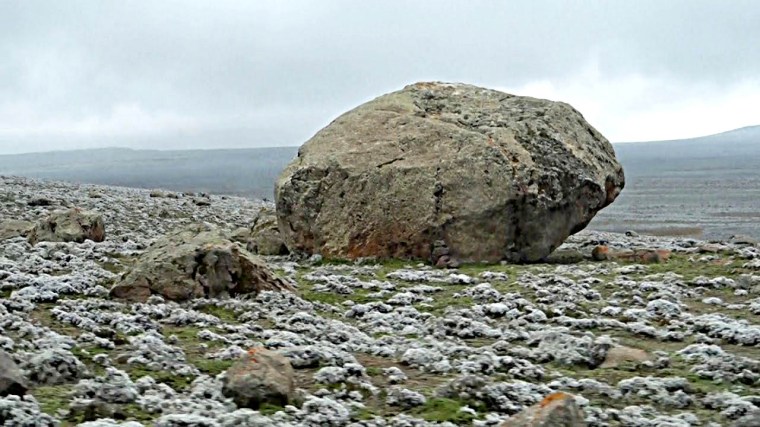
Glacial erratic in the Bale Mountains National Park, Ethiopia (credit: James Steamer)

Understandably, research into the former glaciation of highland areas in tropical Africa is a hot topic. One of the largest areas of glacial till and moraine in Africa lies on the >4000 m high Sanetti Plateau in the Bale Mountains of south-eastern Ethiopia. These mountains are the dissected remnants of a Miocene shield volcano and host a rich ecosystem; in fact the largest reserve of Afro-alpine flora and fauna. Like many mountains in tropical Africa, Bale helps rising moist air to condense as mists. The resulting rich ecology makes such mountain systems high-elevation ‘oases’ surrounded by semi-arid to arid savannah and desert. Because this was likely to have been equally true during the more arid conditions of the last glacial period areas such as Bale may have been refuges for humans during those times, despite the risk of altitude sickness (hypoxia). Aarchaeologist Götz Ossendorf of the University of Cologne, together with a large team from Germany, France, Ethiopia, Switzerland the USA, set out to test this hypothesis ( Ossendorf, G. and 21 others 2019. Middle Stone Age foragers resided in high elevations of the glaciated Bale Mountains, Ethiopia. Science, v. 365, p. 583–587; DOI: 10.1126/science.aaw8942).

Their main target was to excavate a rock shelter at around 3500 m, but outcrops of volcanic glass (obsidian) at 4200 m had clearly attracted human interest  as they are scattered with flaked tools and debitage from their manufacture. The upper sediment layers in the rock shelter yielded ashes, charcoal, a few pottery shards and a glass bead, together with evidence for herbivore droppings. Dates fall in the last 800 years; hardly surprising as the Bale Plateau is seasonally visited by local herders who use rock shelters as corrals for livestock. The lower levels, however, contain artefacts of the Middle Stone Age (MSA); the African terminology roughly equivalent to the Upper Palaeolithic in Eurasia. The MSA layer also contain coprolites, some of hyena in its upper parts but also massive amounts likely to be human that extend to the base of the cave sediments. Dated at 47 to 31 ka, the sediments bracket the age of maximum glacier extent.

giant_molerat
Alert giant mole rat in Ethiopia’s Bale Mountains (credit: M. Watson)

The lower cave sediments contain abundant animal bones and signs of several hearths. Some of the bones show signs of cooking from burn marks. Although several prey species occur, more than 90% of the bones are those of giant mole rats (Tachyoryctes macrocephalus). It is not difficult to conclude that the human population’s meat consumption was almost entirely of roasted mole rat. That is not surprising because the thin soils of the Bale Mountains support at least 29 mole rats per hectare, each adult weighing around a kilogram. Like the guinea pig (Cavia porcellus), which forms a major source of protein for people living today in the high Andes of Peru and Bolivia – an estimated 65 million being eaten annually by Peruvians, mole rats are extremely easy to catch; an attractive proposition for consumers surviving under the stress of hypoxia. They also reproduce at a phenomenal rate Today, Andean people domesticate guinea pigs for the table. Until other sites of human habitation during the Bale ‘ice age’ whether the MSA people lived permanently at high elevation or migrated there seasonally, to gorge on mole rats, cannot be resolved.

Metamorphic evidence of plate tectonic evolution

The essence of plate tectonics that dominates the Earth system today is the existence of subduction zones that carry old, cold oceanic lithosphere to great depths where they become denser by the conversion of the mineralogy of hydrated basalt to near-anhydrous eclogite. Such gravitational sinking imparts slab-pull force that is the largest contributor to surface plate motions. Unequivocally demonstrating the action of past plate tectonics is achieved from the striped magnetic patterns above yet-to-be-subducted oceanic lithosphere, the oldest being above the Jurassic remnant of the West Pacific. Beyond that geoscientists depend on a wide range of secondary evidence that suggest the drifting and collision of continents and island arcs, backed up by palaeomagnetic pole positions for various terranes that give some idea of the directions and magnitudes of horizontal motions.

Occasionally – the more so further back in time – metamorphic rocks (eclogites and blueschists) are found in linear belts at the surface, which show clear signs of low-temperature, high pressure metamorphism that created the density contrast necessary for subduction. Where such low T/P belts are paired with those in which the effects of high T/P metamorphism occurred they suggest distinctly different geothermal conditions: low T/P associated with the site of subduction of cold rock; high T/P with a zone of magmagenesis – at island- or continental arcs – induced by crustal thickening and flux of volatiles above deeper subduction. Such evidence of geothermal polarity suggests a destructive plate margin and also the direction of relative plate motions. The oldest known eclogites (~2.1 Ga) occur in the Democratic Republic of the Congo, but do they indicate the start of modern-style plate tectonics?

Interestingly, ‘data mining’ and the use of statistic may provide another approach to this question. Determination of the temperatures and pressures at which metamorphic rocks formed using the mineral assemblages in them and the partitioning of elements between various mineral pairs has built up a large database that spans the last 4 billion years of Earth history. Plotting each sample’s recorded pressure against temperature shows the T/P conditions relative to the thermal gradients under which their metamorphism took place. Robert Holder of Johns Hopkins University and colleagues from the USA, Australia and China used 564 such points to investigate the duration of paired metamorphism (Holder, R.M. et al. 2019. Metamorphism and the evolution of plate tectonics. Nature, v. 572, p. 378–381; DOI: 10.1038/s41586-019-1462-2).

The 109 samples from Jurassic and younger metamorphosed terranes that demonstrably formed in arc- and subduction settings form a benchmark against which samples from times devoid of primary evidence for tectonic style can be judged. The post-200 Ma data show a clear bimodal distribution in a histogram plot of frequency against thermal gradient, with peaks either side of a thermal gradient of 500°C GPa-1 (~17°C km-1); what one would expect for paired metamorphic belts. A simple bell-shaped or Gaussian distribution of temperatures would be expected from metamorphism under a similar geothermal gradient irrespective of tectonic setting.

Metc PvT
Pressure-temperature data from Jurassic and younger metamorphic rocks (a) pressure vs temperature plot; (b) Frequency distribution vs log thermal gradient. (Credit: Holder et al. 2019, Fig. 1)

Applying this approach to metamorphic rocks dated between 200 to 850 Ma; 850 to 1400 Ma; 1400 to 2200 Ma, and those older than 2200 Ma, Holder and colleagues found that the degree of bimodality decreased with age. Before 2200 Ma barely any samples fell outside a Gaussian distribution. Also, the average T/P of metamorphism decreased from the Palaeoproterozoic to the present. They interpret the trend towards increased bimodality and decreasing average T/P as an indicator that the Earth’s modern plate-tectonic regime has developed gradually since the end of the Archaean Eon (2500 Ma). Their findings also tally with the 2.1 Ga age of the oldest eclogites in the DRC.

Plate tectonics is primarily defined as the interaction between slabs of lithosphere that are rigid and brittle and move laterally above the ductile asthenosphere. Their motion rests metaphorically on the principle that ‘what comes up’ – mantle-derived magma – ‘must go down’ in the form of displaced older material that the mantle resorbs. That is more likely to be oceanic lithosphere whose bulk density is greater than that supporting the thick, low-density continental crust. Without the steeper subduction and slab pull conferred by the transformation of hydrated basalt to much denser eclogite, subduction would not result in low T/P metamorphism paired with that resulting from high T/P conditions in magmatic arcs. But, while ever lithosphere was rigid and brittle, plate tectonics would operate, albeit in forms different from that which formned terranes younger than the Jurassic