Earliest departure of modern humans from Africa

In June 2017 the likely age of the earliest anatomically modern humans (AMH) was pushed back to almost 300 ka with the dating of their remains found at Jebel Irhoud in Morocco. It seemed only a matter of time before their first departure from Africa would also be shown to be earlier than generally believed at between 90 to 120 ka measured from AMH remains in the Skhul and Qafzeh caves of Israel. Such an exodus may be reflected by dates (80 to 113 ka) from fragmentary and indeterminate human remains in China, but a more definite, far-travelled AMH presence in east Asia is, so far, limited to about 60 ka. Yet there is genetic evidence from Neanderthal DNA from Germany and Siberia for human-Neanderthal interbreeding at some time between 219 and 460 thousand years before present: a very hazy intimation but one that needs accounting for. The main phase of genetic introgression from Neanderthals into Homo sapiens has been estimated to have occurred at between 50 to 60 ka; more easily explained by the known AMH peregrination into Asia in that period.

Misliya Cave on Mount Carmel, Israel has now added to the Levantine AMH record. A partial upper jaw and some teeth provide morphological data that fall within the range of H. sapiens fossils, along with tools ascribed to the Levallois technology. This involved striking flakes from a prepared core – a tortoise-like bulge on the flake that detaches when struck properly to form a pre-sharpened flake, flat on one side and rounded on the other. This method was shared by both AMH and Neanderthals, and examples of the tools extend as far back as 500 ka in Africa and may have been invented by a common ancestor of both human groups. Levallois tools were found with the AMH fossils at Jebel Irhoud and also in the Levant at Tabun, dated at 190 to 260 ka, but with no associated fossil remains of their makers. Those at Mislya Cave yielded a mean age from the use of three different dating methods at least 177 ka ago, making the fossil jaw found with them the earliest direct sign of AMH outside Africa (Hershkovitz, I. and 34 others 2018. The earliest modern humans outside Africa. Science, v. 359, p. 456-459; doi: 10.1126/science.aap8369).

So, Mislya supports the genetic evidence of human-Neanderthal Introgression in Eurasia (see; Stringer, C & Galway-Witham, J. 2018. When did modern humans leave Africa? Science, v. 359, p. 389-390; doi: 10.1126/science.aas8954) and provides a spur to extend work in China and between Arabia and eastern Asia. For decades the anatomically modern human remains in the Levant have been sidelined, that near-Mediterranean area being widely regarded as a ‘boulevard of broken dreams’. That is, until Levalloisian tools dated at up to 125 ka were found in the United Arab Emirates and Arabia as a whole had been shown to have had a monsoonal climate during the glacial period that preceded the last, Eemian interglacial and in several later episodes. Once in the Levant, and provided they continually had a foothold there, AMH had many windows of opportunity to move further east without having to await falls in sea-level to open routes such as that across the Red Sea via Straits of Bab el Mandab.

Ice cliffs on Mars

An illustration of what Mars might have looked...
An illustration of what Mars might have looked like during an ice age between 2.1 million and 400,000 years ago, when Mars’s axial tilt is believed to have been much larger than today.  (credit: Wikipedia)

For Mars to support life and for life to have emerged there demand water that is readily accessible from the surface. There is evidence that in the distant past liquid water may have flowed across the Martian surface to erode river-like features, some associated with the vast canyon system of Valles Marineris. That feature is thought to have been initiated by tectonic forces and perhaps flowing magma, but it shows definite signs of water erosion. Water in great volume was released during the Noachian phase of Mars’s evolution possibly by major impacts 4100 to 3700 million years ago, during the interval known as the Late Heavy Bombardment). Large tracts of the Martian surface that are more muted than Valles Marineris show topographic features reminiscent of huge braided stream systems. Water may have covered vast, low-lying areas in the planet’s Northern Hemisphere to form an early ocean. Yet today the Red Planet seems extremely dry and its thin atmosphere shows only minute traces of water vapour – it is dominated by carbon dioxide. Results from various rovers deployed across its surface and from Mars orbiting satellites have, however, revealed signs of waterlain sediments and minerals that can only have formed by the breakdown of igneous rocks by water. Signs that liquid water continues to flow occasionally down steep slopes, such as rill-like features and ephemeral darkened patches, have been much disputed.

Mars does have an ice cap at its North Pole that waxes and wanes with its seasons, but rather than melting during Martian ‘summers’ the ice sublimates directly to water vapour. Conversely, the polar ices probably form from frost. Yet, astonishingly, there appear to be active glaciers complete with flow lines and moraines, but chances are that some of them are sediment flows ‘lubricated’ by frost binding together mineral particles and boulders that undergoes pressure-induced regelation. Data from orbiting neutron and gamma-ray spectrometers reveal that between 60°N and 60°S the top metre of Martian soil contains between 2 to 18% of ice, making it akin to terrestrial permafrost. So, contrary to its appearance Mars is rich in water, but almost exclusively in solid form. Until very recently, the bulk was thought to be as a matrix binding together sediments, accessible to future crewed mission in useful volumes only by surface mining. That somewhat pessimistic view has now changed dramatically.

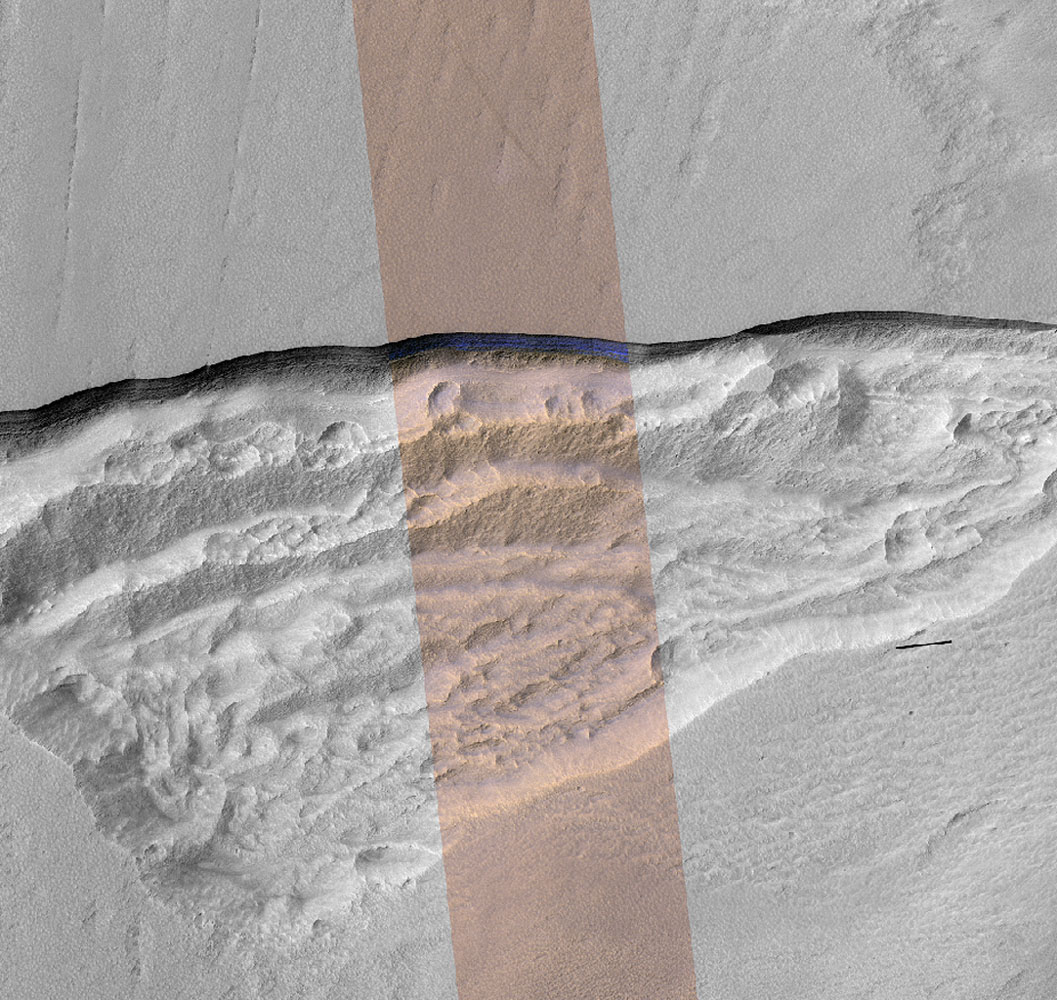
Monochrome HiRISE image of a cliff on Mars (the pinkish swath is a simulated natural colour image – see below). beneath the cliff is a zone of jumbled ground formed by cliff collapses. (credit: NASA)

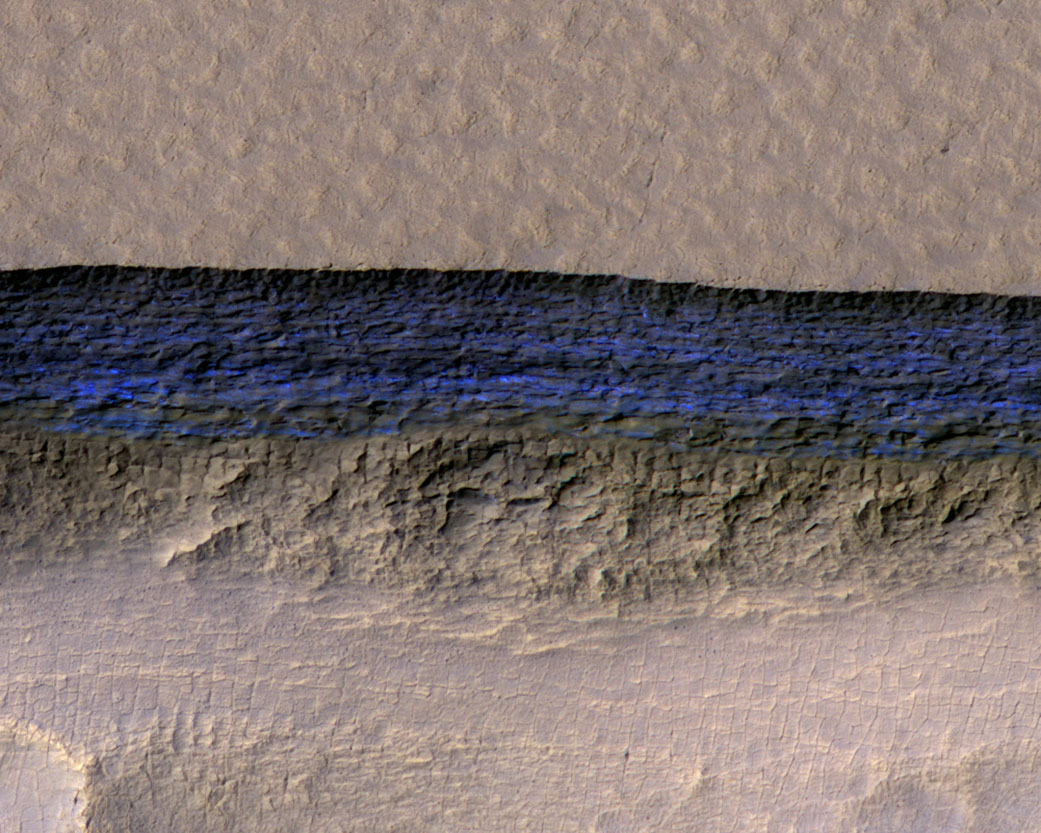
Careful study of fine resolution imagery from the HiRISE instrument on the Mars Reconnaissance Orbiter at latitudes a little less than 60° has centred on cliffs formed by recent erosion (Dundas, C.M and 11 others 2018. Exposed subsurface ice sheets in the Martian mid-latitudes. Science, v. 359, p. 199-201; doi: 10.1126/science.aao1619). Colin Dundas of the US Geological Survey, Flagstaff, Arizona, and US colleagues used the multispectral capacities of HiRISE data to study the composition of sedimentary layers exposed in the cliffs. In eight cases, the cliffs contained layered, almost pure blue ice tens of metres thick and only a few metres below the surface. The cliffs seem to have formed as ice has sublimated where exposed, thereby undermining to sedimentary cover. Below the cliffs are jumbled zones of collapsed material. Being so close to the surface and underlain by apparently ice-free sediments, the layered ice sheets must be geologically quite young.

Simulated natural-colour HiRISE image of a Martian cliff showing nearly pure water ice in blues. Note the layered structure that may represent seasonal variations during the period of ice formation (credit: NASA)

Unlike the Earth, whose axial tilt is stabilised to a large degree by the Moon’s gravity, Mars’s two tiny moons have little effect of this kind. So Mars’s axis wobbles between its current 25° tilt to as much as 45°. This results in large climatic shifts, of which there have been an estimated forty over the last 5 million years. At high tilts solar energy heats up the poles and releases water vapour by accelerated sublimation to be laid down at lower latitudes as frost or snow. Mars’s present tilt suggests that it is experiencing a cold episode so that wind blown dust has covered and preserved mid-latitude ice sheets over tens of thousand years. Nearly pure ice is easier to exploit than permafrost layers. Yet optimism among enthusiasts for a crewed Mars mission and eventual colonisation is tempered by the latitudes of the discoveries. While ready supplies of water from ice and CO2 from the Martian atmosphere give the ingredients for oxygen, methane through catalysis of CO2 and hydrogen, agricultural photosynthesis and all kinds of other useful chemistry, low latitudes offer the most assured solar energy supplies. Latitudes around 55° are frigid and dark during Martian winters; perhaps totally inhospitable. So the remote-sensing search is likely to continue in cliffs closer to the ‘tropics’ of Mars.

Fish influence mountain ranges

When asked if he would like water in his whisky W.C Fields famously remarked that he didn’t drink water because fish procreate in it (his actual words were somewhat racier). Migratory salmon do so in their millions with a great deal of energy, specifically in the gravel beds of high-energy streams. Before spawning, females lash the stream bed with their tails to create a pit or redd in the gravel, in which they lay their eggs to be fertilised  by males. Then she fills-in the redd with more gravel excavated from upstream. Salmon spawning grounds are thus easily recognised as pale patches of freshly overturned gravel on a stream bed that also contain lower amounts of fine sediment and are thereby loosened. As well as discouraging bibulous old men from diluting their liquor, it occurred to Alexander Fremier of Washington State University and other American colleagues that here was a noteworthy example of an active part of the biosphere physically intervening in the rock cycle. Not that it comes even close to what humans have become capable of since the Industrial Revolution, but it might be an object lesson in the fragility of what are otherwise the robust processes of erosion. Moreover, since salmon emerged at some time in the past, their actions might help demonstrate that evolutionary events – speciation, adaptive radiations, mass extinctions etc – play a role in transforming geological processes.

Pacific salmon are semelparous or "big ba...
Pacific Sock-eye salmon that die shortly after spawning (credit: Wikipedia)

Fremier and colleagues (Fremier, A.K. et al. 2017. Sex that moves mountains: The influence of spawning fish on river profiles over geologic timescales. Geomorphology online publication; doi.org/10.1016/j.geomorph.2017.09.033) modeled the consequences of salmon spawning habits for the critical stress needed to set grains in motion, theoretically and in a flume tank. Based on a significant reduction of the critical stress, models for the evolution on various river profiles in the vicinity of salmon spawning grounds suggest that river beds may cut deeper at rates up to 30% faster than they would in the absence of salmon. Were salmon to be reduced or extirpated through dam construction or overfishing then sedimentation in channels would increase. In some areas of extensive farming of salmon in offshore pens, escape and colonization of rivers would eventually change sedimentation and erosion patterns. The findings vary from species to species, but salmon may have had a significant effect on generally rugged landscapes following their appearance in local ecosystems.

The terrestrial-marine-terrestrial migratory habits of salmon, including the return of adults to their birth rivers to spawn, are uncommon if not unique. Their forbears must have evolved to this behaviour at some time in the geological past, separately in the case of North Atlantic and North Pacific species. The authors suggest that adaptive radiation of salmon may have been favoured by orogenic events in western North America around 100 Ma ago that created the system of fast flowing rivers that salmon favour. In turn, salmon may have significantly influenced Western Cordillera landscapes of Alaska, Canada and the conterminous Unites States. A nice example of the inseparability of cause and effect on the scale of the Earth System.

Sunrise Girl-Child: the first American colonist

Thanks to a variety of archaeological finds of tools and animal bones bearing cut marks, together with precise dating, it now seems clear that the Americas began to be colonised as early as the Last Glacial Maximum from tangible evidence from Bluefish Cave in the Yukon territory of Canada and as early as 15.5 ka close to the southern tip of South America in Chile. Although confirmation remains to be found, there is even a possibility that pre-sapiens people had arrived far earlier. Advances in analysis of ancient genetic material help understand the divergence of early colonisers. Y-chromosome DNA from living indigenous men suggests that all early Americans stemmed from 4 separate colonising populations who may have entered by crossing the Beringia land bridge, exposed as a result of glacial fall in global sea level, to follow different routes, including along the Pacific coast. A possible common ancestor of all native Americans emerged in 2013 from the mitochondrial and Y-chromosome DNA of the skeleton of a young man from near Lake Baikal in Siberia who lived about 24 ka ago. At the very start of 2018 an online paper in Nature took the story even further.

This image was first published in the 1 st (18...
The diversity of Native American people. (credit: Wikipedia from a 19th century Norwegian painting)

The remains of a ~6-week-old girl recovered from a site at Upward Sun River in Alaska – called ‘Xach’itee’aanenh t’eede gay’, or ‘sunrise girl-child’ by indigenous Alaskans – dated at 11.5 ka, has yielded a precise genome (Moreno-Mayar, J. and 17 others 2018. Terminal Pleistocene Alaskan genome reveals first founding population of Native Americans. Nature; doi:10.1038/nature25173).  The baby girl’s DNA shows that the group to which she belonged was ancestral to contemporary and fossilised ancient Native Americans. She was probably a member of a founding population of ‘Beringians’. At the end of the last glacial epoch (11.5 ka) a separate branch of Native Americans was already established in unglaciated North America further south. That group had split into two further groups sometime between 17.5 to 14.6 ka, who became ancestors of most of the indigenous people of the Americas. The ‘Beringian’ people were therefore probably stranded in the far north by the difficulties of crossing the vast North American ice sheet. Probing deeper into time, using demographic modelling, suggests that the founding population of all Native Americans, including the ‘Beringians’, split from East Asians around 36 ka ago. Gene flow among them and with East Asians persisted until about 25 thousand years ago, with some admixture with ancient northern Eurasians up to 20 ka. It seems that the ‘Beringians’, of whom little ‘sunrise girl-child’ was a late member, became isolated genetically between 22-18 ka.

The ancestral mixture of both East Asian and northern Eurasians that led to the founders of the whole panoply of geographically isolated Native Americans is remarkable. It shows just how far human groups moved and mingled during the run-up to the Last Glacial Maximum, which made the far north just about uninhabitable – or so it has been assumed. For a small ethnically mixed group to survive such conditions for so long suggests considerable ingenuity in living off the land.

http://www.bbc.co.uk/news/science-environment-42555577