Earliest hominin occupation of Sulawesi and crossing of an ocean barrier

Regular readers of Earth-logs will recall that the islands of Indonesia were reached by the archaic humans Homo erectus and H. floresiensis at least a million years ago. Anatomical comparison of their remains suggest that the diminutive H. floresiensis probably evolved from H. erectus under the stress of being stranded on the small, resource-poor island of Flores: a human example of island dwarfism. In fact there are anatomically modern humans (AMH) living on Flores that seem to have evolved dwarfism in the same way since AMH first arrived there between 50 and 5 ka. Incidentally, H. erectus fossils and artefacts were found by Eugene Dubois in the late 19th century at a famous site near Trinil in Java. In 2014, turned out that H. erectus had produced the earliest known art – zig-zag patterns on freshwater clam shells – between 540 and 430 ka ago. The episodic falls in global sea level due to massive accumulations of ice on land during successive Pleistocene glacial episodes aided migration by producing connections between the islands of SE Asia. They created a huge area of low-lying dryland known as ‘Sundaland’. The islands’ colonisation by H. erectus was made easy, perhaps inevitable.

The interconnection of SE Asian islands to form Sundaland (yellow) when sea level was 120 m lower than today. Even at that extreme the island of Sulawesi remained isolated by deep ocean water. Credit: based on Hakim et al Fig 1.

However, Flores and islands further east are separated from those to the west by a narrow but very deep strait. It channels powerful currents that are hazardous to small-boat crossings even today. Most palaeoanthropologists consider the colonisation of Flores by H. erectus most likely to have resulted by accident, reckoning that they were incapable of planning a crossing and building suitable craft. For AMH to have reached New Guinea and Australia around 60 ka ago, they must have developed sturdy craft and sea-faring skills. This paradigm suggests that the evolution of AMH, and thus their eventual occupation of all continents except Antarctica, must have involved a revolutionary ‘leap’ in their cognitive ability just before they left Africa. That view has been popularised by the presenter (Ella Al-Shamahi) of the 2025 BBC Television series Human – now on BBC iPlayer (requires viewers to create a free account) – in its second episode Into the Unknown. [The idea of a cognitive leap that ushered in the almost worldwide migration of anatomically modern humans was launched in 1995 by controversial anthropologist Chris Knight of University College London].
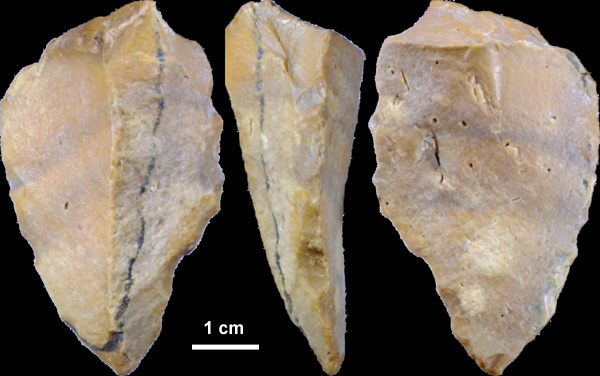
Flaked artefact, about the length of a human thumb, made of chert from excavations at Calio on Sulawesi, dated at 1.02 Ma. Credit: based on Hakim et al Fig 2

The large and peculiarly-shaped island of Sulawesi, also part of Indonesia, is notable for being the location of the earliest known figurative art; a cave painting of a Sulawesi warty pig, dated to at least 45.5 ka ago. Indonesian and Australian archaeologists working at a site near Calio in northern Sulawesi unearthed stone artefacts deep in river-terrace gravels that contain fossils of extinct pigs and dwarf elephants (Hakim, B. and 26 others 2025. Hominins on Sulawesi during the Early Pleistocene. Nature, v. 644;DOI: 10.1038/s41586-025-09348-6). The tools were struck from pebbles of hard fine-grained rocks by flaking to produce sharp edges. A combination of dating techniques – palaeomagnetism, uranium-series and electron-spin resonance – on the terrace sediments and fossils in them yielded ages ranging from 1.04 to 1.48 Ma; far older than the earliest known presence of AMH on the island (73–63 ka). The dates for an early human presence on Sulawesi tally with those from Flores. The tool makers were probably H. erectus. To reach the island from Sundaland at a time when global sea level was 120 m lower than at present would have required crossing more than 50 km of open water. It seems unlikely that such a journey could have been accidental. The migrants would have needed seaworthy craft; possibly rafts. Clearly the AMH crossings to New Guinea around 60 thousand years ago would have been far more daunting. Both land masses would have been below the horizon of any point of departure from the Indonesian archipelago, even with island ‘hopping’. Yet the Sulawesi discovery, combined with the plethora of islands both large and small, suggests that the earlier non-AMH inhabitants of Indonesia potentially could have spread further at times of very low sea level.

See also: Brumm, A. t al. 2025. This stone tool is over 1 million years old. How did its maker get to Sulawesi without a boat? The Conversation, 6 August 2025

‘Earliest’ figurative art now spans Eurasia

The first generally recognised piece of artwork is abstract in the extreme: a worked piece of hematite with a complex linear pattern etched into it. It comes from Blombos Cave  in South Africa, together with similarly engraved bone, shell ornaments and advances in stone tool kits.

Image copyright held by author, Chris Henshilw...
Artifacts from Blombos Cave, South Africa (credit: Wikipedia; copyright held by Chris Henshilwood)

Dated at 100 ka, the Blombos culture is regarded by many palaeoanthropologists as the start of the ‘First Human Revolution’. Yet most believe that such a massive cultural shift only properly manifested itself around 40 ka in Europe shortly after its colonisation by anatomically modern humans. It was then that lifelike pictures of animals began to appear on the walls of caves, such as those discovered in Chauvet Cave in France and radiocarbon dated to between 35.5 to 38.8 ka.

Drawing of horses in the Chauvet cave.
Drawing of horses in the Chauvet cave. (credit: Wikipedia)

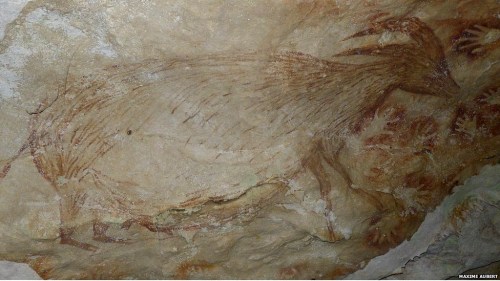
Such a Eurocentric view is based on the lack of evidence for precedent art of this kind from elsewhere. The adage that 'absence of evidence is not evidence of absence' - attributed to Carl Sagan - recently popped up with sophisticated dating of cave art in the Indonesian island of Sulawesi. The cave-riddled limestones of southern Sulawesi have long been known for artwork on the roofs of caves and in some of their darker recesses, including sketches of local animals, humans and a great many stencils made by blowing a spray of pigment over a hand placed on a rock face. The pictures were thought to be relatively recent.

Painting of a dwarf water buffalo and stencils of human hands from a cave in SW Sulawesi (credit: Maxim Aubert, Griffith University, Australia)

A joint Australian-Indonesian  group of Archaeologists used a specialist technique to date them (Aubert, M. and 9 others 2014. Pleistocene cave art from Sulawesi, Indonesia. Nature, v. 514, p. 223-227. See also Roebroeks, W. 2014. Art on the move. Nature (News & Views), v. 514, p. 170-171). Like many paintings in limestone caves, with time they become coated with calcite film deposited from water flowing over the rock surface, known as flowstone or speleothem. It is possible to date the film layers  using the uranium-series method to derive a maximum age for the encased pigment from speleothem beneath it and a minimum age from the layer immediately overlaying it. One of the hand stencils proved to be the oldest found anywhere, with a minimum age of 39.9 ka, while sketches of animals ranged from 35.4 to 35.7 ka. To see more images and view an interactive video about the Sulawesi finds click here.
The discovery by Maxime Auberts and his colleagues has set the cat among the pigeons as regards the origin of visual art. The paintings’ roughly coincident age with the earliest in Europe raises three possibilities: the artistic muse struck simultaneously with people widely separated since their ancestors’ emergence from Africa; somehow the skills were quickly carried a third of the way around the world from one place to the other; the original migrants from Africa took artistic ability of this kind with them to Eurasia, perhaps as early as 125 ka ago.
Three points need to be considered: whether in Europe or eastern Indonesia, cave art is preserved either on the roofs or in the deep recesses of caves, where it is more likely to survive then in more exposed sites; preservation by speleothem enhances longevity and the oldest works are in limestone caves; many more archaeologists have researched caves in Europe than in the far larger areas of Asia and Africa. A view worth considering is that art may have begun outdoors, in a well-lit site on whatever ‘canvas’ presented itself. The artists’ choice of cave walls in Europe and Indonesia may have resulted from the need for shelter from rain and/or cold, whereas much of Africa and Australia poses little need for ‘interior design’. Besides, what if art began on the most easily available canvas of all – human skin! My guess is that the record will widen in space and deepen in time.
See also here