Sagduction of greenstone belts and formation of Archaean continental crust

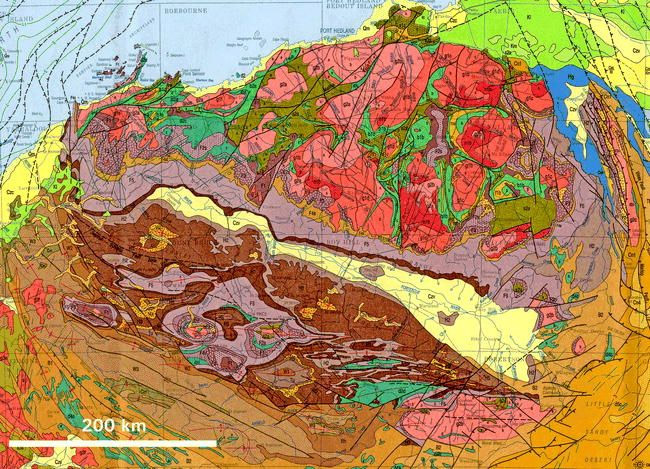
Simplified geological map of the Archaean Yilgarn Craton in Western Australia. Credit: Geological Survey of Western Australia

Every ancient craton seen from space shows patterns that are unique to Archaean continental crust: elongated, ‘canoe-shaped’ greenstone belts enveloped by granitic gneisses, both of which are punctured by domes of younger, less deformed granites. The Yilgarn Craton of Western Australia is a typical granite-greenstone terrain. Greenstone belts contain lavas of ultramafic, basaltic and andesitic compositions, which in undeformed settings show the typical pillow structures formed by submarine volcanic extrusion. There are also layered mafic to ultramafic complexes, formed by fractional crystallisation, minor sedimentary sequences and occasionally more felsic lavas and ashes. The enveloping grey gneisses are dominantly highly deformed tonalite-trondhjemite-granodiorite (TTG) composition that suggest that they formed from large volumes of sodium-rich, silicic magmas, probably generated at depth by partial melting of hydrated basaltic rocks.

The heat producing radioactive isotopes of potassium, uranium and thorium in both the Archaean mantle and crust would have been more abundant before 2.5 Ga ago, because they decay over time. Consequently the Earth’s interior would have then generated more heat than now, gradually to escape by thermal conduction towards the cooler surface. The presence of pillow lavas and detrital sediments in greenstone belts indicate that surface temperatures during the Archaean Eon were below the boiling point of water; in fact probably much the same as in the tropics at present. Indeed there is evidence that Earth was then a water world. It may even have been so during the Hadean, as revealed by the oxygen-isotope data in 4.4 Ga zircon grains. The broad conclusion from such findings is that the Archaean geothermal gradient was much steeper; there would have been a greater temperature increase with depth than now and new crust would have cooled more slowly. Subduction of cool lithosphere would have been less likely than in later times, especially as higher mantle heat production would have generated new crust more quickly. Another likely possibility is that far more heat would have been moved by convection: there would have been more mantle-penetrating plumes and they would have been larger. Large mantle plumes of the Phanerozoic have generated vast ocean floor plateaus, such as the Kerguelen and Ontong Java Plateau.

A group of geoscience researchers at The University of Hong Kong and international colleagues recently completed a geological and geochemical study of the North China Craton, analysing their data in the light of recently emerging views on Archaean processes (Dingyi Zhao et al, A two-stage mantle plume-sagduction origin of Archean continental crust revealed by water and oxygen isotopes of TTGs, Science Advances, v. 11, article eadr9513  ; DOI: 10.1126/sciadv.adr9513).They found compelling evidence that ~2.5 Ga-old Neoarchaean TTG gneisses in the North China granite-greenstone terrain formed by partial melting of an earlier mafic-ultramafic greenstone crust with high water content. They consider this to support a two-stage model for the generation of the North China Craton’s crust above a vast mantle plume. The first stage at around 2.7 Ga was the arrival of the plume at the base of the lithosphere, which partially melted as a result of the decompression of the rising ultramafic plume. The resulting mafic magma created an oceanic plateau partly by underplating the older lithosphere, intruding it and erupting onto the older ocean floor. This created the precursors of the craton’s greenstones, the upper part of which interacted directly with seawater to become hydrothermally altered. They underwent minor partial melting to produce small TTG intrusions. A second plume arriving at ~2.5 Ga resulted in sinking of the greenstones under their own weight to mix or ‘hybridise’ with the re-heated lower crust. This caused the greenstones substantially to partially melt and so generate voluminous TTG magmas that rose as the greenstones subsided. . It seems likely that this dynamic, hot environment deformed the TTGs as they rose to create the grey gneisses so typical of Archaean granite-greenstone terranes. [Note: The key evidence for Dingyi Zhao et al.’s conclusions is that the two TTG pulses yielded the 2.7 and 2.5 Ga ages, and show significantly different oxygen isotope data (δ18O)].
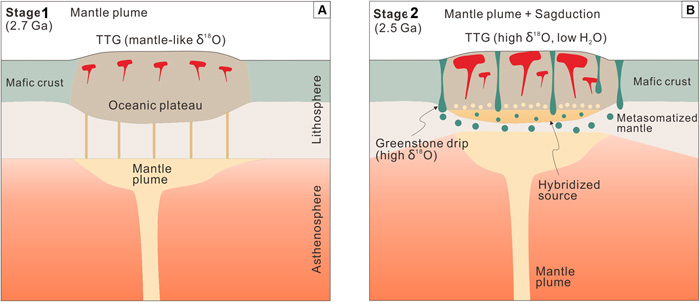
Two stages of TTG gneiss formation in the North China Craton and the sinking (sagduction) of greenstone belts in the second phase. Credit: Dingyi Zhao et al., Fig 4)

Such a petrogenetic scenario, termed sagduction by Dingyi Zhao and colleagues, also helps explain the unique keel-like nature of greenstone belts, and abundant evidence of vertical tectonics in many Archaean terrains (see: Vertical tectonics and formation of Archaean crust; January 2002), Their model is not entirely new, but is better supported by data than earlier, more speculative ideas. That such processes have been recognised in the Neoarchaean – the North China Craton is one of the youngest granite-greenstone terrains – may well apply to far older Archaean continental crust generation. It is perhaps the last of a series of such events that began in the Hadean, as summarised in the previous Earth-logs post.

News about when subduction began

Tangible signs of past subduction take the form of rocks whose mineralogy shows that they have been metamorphosed under conditions of high pressure and low temperature, and then returned to the surface somehow. Ocean-crust basaltic rocks become blueschist and eclogite. The latter is denser than mantle peridotite so that oceanic lithosphere can sink and be recycled. That provides the slab-pull force, which is the major driver of plate tectonics. Unfortunately, neither blueschists nor eclogites are found in metamorphic complexes older than about 800 Ma. This absence of direct proof of subduction and thus modern style plate tectonics has resulted in lively discussion and research seeking indirect evidence for when it did begin, the progress of which since 2000 you can follow through the index for annual logs about tectonics. An interesting new approach emerged in 2017 that sought a general theory for the evolution of silicate planets, which involves the concept of ‘lid tectonics’. A planet in a stagnant-lid phase has a lithosphere that is weak as a result of high temperatures: indeed so weak and warm that subduction was impossible. Stagnant-lid tectonics does not recycle crustal material back to its source in the mantle and it simply builds up the lithosphere. Once planetary heat production wanes below a threshold level that permits a rigid lithosphere, parts of the lid can be driven into the mantle. The beginnings of this mobile-lid phase and thus plate tectonics of some kind involves surface materials in mantle convection: the may be recycled.

Cartoon of possible Hadean stagnant lid tectonics, dominated by mantle plumes. (Credit: Bédard, J.H. 2018, Fig 3B, DOI: 10.1016/j.gsf.2017.01.005)

A group of geochemists from China, Canada and Australia have sought evidence for recycled crustal rocks from silicon and oxygen isotopes in the oldest large Archaean terrane, the  4.0 Ga old Acasta Gneiss Complex in northern Canada (Zhang, Q. and 10 others 2023. No evidence of supracrustal recycling in Si-O isotopes of Earth’s oldest rocks 4 Ga ago. Science Advances, v.9, article eadf0693; DOI: 10.1126/sciadv.adf0693). Silicon has three stable isotopes 28Si, 29Si, and 30Si. As happens with a number of elements, various geochemical processes are able to selectively change the relative proportions of such isotopes: a process known as isotope fractionation. As regards silicon isotopes used to chart lithosphere recycling, the basic steps are as follows: Organisms that now remove silicon from solution in seawater to form their hard parts and accumulate in death as fine sediments like flint had not evolved in the Archaean. Because of that reasonable supposition it has been suggested that seawater during the Archaean contained far more dissolved silicon than it does now. Such a rich source of Si would have entered Archaean oceanic crust and ocean-floor sediments to precipitate silica ‘cement’. The heaviest isotope 30Si would have left solution more easily than the lighter two. Should such silicified lithosphere have descended to depths in the mantle where it could partially melt the anomalously high 30Si would be transferred to the resulting magmas.

Proportions of 30Si in zircons, quartz and whole rock for Acasta gneisses (coloured), other Archaean areas (grey) and Jack Hills zircons (open circles. Vertical lines are error bars. (Credit: simplified from Zhang et al. Fig 1)

Stable-isotope analyses by Zhang et al. revealed that zircon and quartz grains and bulk rock samples from the Acasta gneisses, with undisturbed U-Pb ages, contain 30Si in about the same proportions relative to silicon’s other stable isotopes as do samples of the mantle. So it seems that the dominant trondhjemite-tonalite-granodiorite (TTG) rocks that make up the oldest Acasta gneisses were formed by partial melting of a source that did not contain rocks from the ocean crust. Yet the Acasta Gneiss Complex also contains younger granitic rocks (3.75 to 3.50 Ga) and they are significantly more enriched in 30Si, as expected from a deep source that contained formerly oceanic rocks. A similar ‘heavy’ silicon-isotope signature is also found in samples from other Archaean terranes that are less than 3.8 Ga old. Thus a major shift from stagnant-lid tectonics to the mobile-lid form may have occurred at the end of the Hadean. But apart from the Acasta Gneiss Complex only one other, much smaller Hadean terrane has been discovered, the 4.2 Ga Nuvvuagittuq Greenstone Belt. It occupies a mere 20 km2 on the eastern shore of Hudson Bay in Canada, and appears to be a sample of Hadean oceanic crust. It does include TTG gneisses, but they are about 3.8 Ga old and contain isotopically heavy silicon. So it seems unlikely that testing this hypothesis with silicon-isotope data from other Hadean gneissic terranes will be possible for quite a while, if at all.

Did giant impacts trigger formation of the bulk of continental crust?

Earth is the only one of the rocky Inner Planets that has substantial continental crust, the rest being largely basaltic worlds. That explains a lot. For a start, it means that almost 30 percent of its surface area stands well above the average level of the basaltic ocean basins – more than 5 km – because of the difference in density between continental and oceanic lithosphere. Without continents and the inability of subduction to draw them back  into the mantle  Earth would remain a water-world as it is thought to have been during the Hadean and early Archaean Eons. The complex processes involved in geochemical differentiation and the repeated reworking of the continents through continual tectonic and sedimentary processes has further enriched parts of them in all manner of useful elements and chemical compounds. And, of course, the land has had a huge biosphere since the Devonian period that subsequently helped to draw down CO­2 well as evolving us.

It has been estimated that during the Archaean (4.0 to 2.5 Ga) around 75% of continental crust formed. Much of this Archaean crust is made up of sodium-rich granitoids: grey tonalite-trondhjemite-granodiorite (TTG) gneisses in the main. Their patterns of trace elements strongly suggest that their parent magmas formed by partial melting at shallow depths (25 to 50 km). Their source was probably basalts altered by hydrothermal fluids to amphibolites, unlike the post-Archaean dominance of melting associated with subducted slabs of lithosphere. Yet most of the discourse on early continents has centred on when plate tectonics began and when they became strong enough to avoid disruption into subductible ‘chunks’. Yet 10 years ago geochemists at the University of St Andrews in Scotland used hafnium and oxygen isotopes in Archaean zircons to suggest that the first continents grew very quickly in the Hadean and early Archaean at around 3.0 km3 yr-1, slowing to an average of 0.8 km3 yr-1 after 3.5 Ga. In 2017 Geochemists working on one of the oldest cratons in the Pilbara region of Western Australia developed a new, multistage model for early crust formation that did not have a subduction component. They proposed that high degrees of mantle melting first produced a mafic-ultramafic crust of komatiites, which became the source for a 3.5 Ga mafic magma with a geochemistry similar to those of modern island-arc basalts. If a crust of that composition attained a thickness greater than 25 km and was itself partially melted at its base, theoretically it could have generated TTG magma and Archaean continental crust. Three members of that team from Curtin University, Western Australia, and others have now contributed to formulating a new possibility for early continent formation (Johnson, T.E. et al. 2022.  Giant impacts and the origin and evolution of continents. Nature, v. 608, p. 330–335; DOI: 10.1038/s41586-022-04956-y).

The distinctive Archaean granite-greenstone terrain of the Pilbara craton of Western Australia. TTG granites are shown in reds in the form of domes, which are enveloped by metamorphosed sediments and mafic-ultramafic volcanics in khaki and emerald green. Other colours signify post Archaean rocks. (Credit: Warren B. Hamilton; Earth’s first two billion years. GSA, 2007)

Tim Johnson and colleagues base their views on oxygen isotopes in Archaean zircon grains from the Pilbara. The zircons’ O-isotopes fall into three kinds of cluster: low 18O that indicate a hydrothermally altered source; intermediate 18O suggesting a mantle source; high 18O signifying contamination by metasedimentary and volcanic rocks. The first two alternate in the 3.6 to 3.4 Ga period; 4 clusters with mantle connotations occupy the 3.4 to 3.0 Ga range; a cluster with supracrustal contamination follows 3.0 Ga. This record can be reconciled agreeably with the geological and broad geochemical history of the Pilbara craton. But there is another connection: the Late Heavy Bombardment (LHB) recognised on most rocky bodies in the Solar System.

Bodies with much more sluggish internal processes than the Earth have preserved much of their earliest surfaces and the damage they have suffered since the Hadean. The Moon is the best example. Its earliest rocks in the lunar Highlands record a vast number of impact craters. Their relative ages, deduced from older ones being affected by later ones, backed up by radiometric ages of materials produced by impacts, such as melt spherules and basaltic magmas that flooded the lunar maria, revealed the time span of the LHB. The maria formed between 4.2 and 3.2 billion years ago and the damage done then is shown starkly by the dark maria that make up the ‘face’ of the Man in the Moon. The lunar bombardment was at a maximum between 4.1 and 3.8 Ga but continued until 3.5 Ga, dropping off sharply from its maximum effects. Earth preserves no tangible sign of the LHB, but because it is larger and more massive than the Moon, and both have always been in much the same orbit around the Sun, it must have been subject to impacts on a far grander scale. Projectiles carry kinetic energy that enables them to do geological work when they impact: 1/2 x mass x speed2. The minimum speed of an impact is the same as the target’s escape velocity – 2.4 km s-1 for the Moon and 11.2 km s-1 for the Earth. So the energy of an object hitting the Earth would be 20 times more than if it struck the lunar surface. Taking into account the Earth’s larger cross sectional area, the amount of geological work done here by the LHB would have been as much as 300 times greater than that on Earth’s battered satellite.

The Earth’s early geological history was rarely seen in that context before the 21st century, but that is the framework plausibly adopted by Johnson and colleagues. Archaean  sediments in South Africa contain several beds of impact spherules older than 3.2 Ga, as do those of the Pilbara. The LHB also left a geochemical imprint on Earth in the form of anomalous isotope proportions of tungsten in 3.8 Ga gneisses from West Greenland (See: Tungsten and Archaean heavy bombardment and Evidence builds for major impacts in Early Archaean; respectively, July and August 2002). Johnson et al. suggest a 3-stage process for the evolution of the Pilbara craton: First a giant impact akin to the lunar Maria that formed a nucleus of mafic-ultramafic crust from shallow melting of the mantle; its chemical fractionation to produce low-magnesium basalts; and in turn their melting to form TTG magmas and thus a continental nucleus. They conclude:

‘The search for evidence of the Late Heavy Bombardment on Earth has been a long one. However, all along it seems that the evidence was right beneath our feet.’

I agree wholeheartedly, but would add that, until quite recently, many scientists who referred to extraterrestrial influences over Earth history were either pilloried or lampooned by their peers as purveyors of ‘whizz-bang’ science. So, many ‘kept their powder dry’. The weight of evidence and a reversal of wider opinion over the last couple of decades has made such hypotheses acceptable. But it has also opened the door to less plausible notions, such as an impact cause for sudden climate change and even for mythological catastrophes such as the destruction of Sodom and Gomorrah!

See also: Timmer, J. 2022. Did giant impacts start plate tectonics? arsTechnica 11 August 2022.