Divining the possible climatic impacts of slowing North Atlantic current patterns

Meltwater channels and lake on the surface of the Greenland ice sheet

In August 2024 Earth-Logs reported on the fragile nature of thermohaline circulation of ocean water. The post focussed on the Atlantic Meridional Overturning Circulation (AMOC), whose fickle nature seems to have resulted in a succession of climatic blips during the last glacial-interglacial cycle since 100 ka ago. They took the form of warming-cooling cycles known as Dansgaard-Oeschger events, when the poleward movement of warm surface water in the North Atlantic Ocean was disrupted. An operating AMOC normally drags northwards warm water from lower latitudes, which is more saline as a result of evaporation from the ocean surface there. Though it gradually cools in its journey it remains warmer and less dense than the surrounding surface water through which it passes: it effectively ‘floats’. But as the north-bound, more saline stream steadily loses energy its density increases. Eventually the density equals and then exceeds that of high-latitude surface water, at around 60° to 70°N, and sinks. Under these conditions the AMOC is self-sustaining and serves to warm the surrounding land masses by influencing climate. This is especially the case for the branch of the AMOC known as the Gulf Stream that today swings eastwards to ameliorate the climate of NW Europe and Scandinavia as far as Norway’s North Cape and into the eastern Arctic Ocean.

The suspected driving forces for the Dansgaard-Oeschger events are sudden massive increases in the supply of freshwater into the Atlantic at high northern latitudes, which dilute surface waters and lower their density. So it becomes more difficult for surface water to become denser on being cooled so that it can sink to the ocean floor. The AMOC may weaken and shut down as a result and so too its warming effect at high latitudes. It also has a major effect on atmospheric circulation and moisture content: a truly complicated climatic phenomenon. Indeed, like the Pacific El Niño-Southern Oscillation (ENSO), major changes in AMOC may have global climatic implications.  QIyun Ma of the Alfred Wegner Institute in Bremerhaven, Germany and colleagues from Germany, China and Romania have modelled how the various possible locations of fresh water input may affect AMOC (Ma, Q. et al. 2024. Revisiting climate impacts of an AMOC slowdown: dependence on freshwater locations in the North Atlantic. Science Advances, v. 10, article eadr3243; DOI: 10.1126/sciadv.adr3243). They refer to such sudden inputs as ‘hosing’!
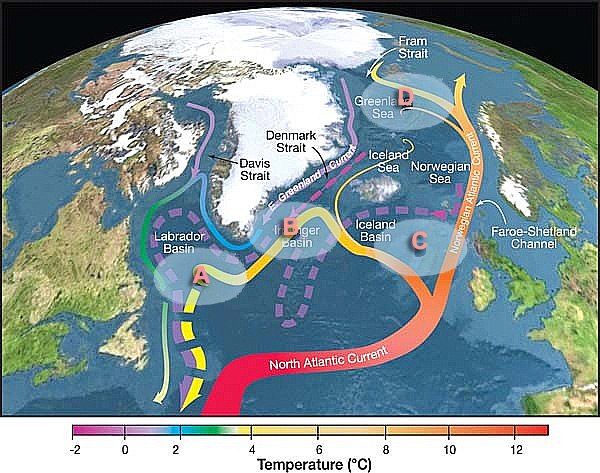
Location of the 4 regions in the northern North Atlantic used by Ma et al. in their modelling of AMOC: A Labrador Sea; B Irminger Basin; C NE Atlantic; D Nordic Seas. Colour chart refers to current temperature. Solid line – surface currents, dashed line – deep currents

First, the likely consequences under current climatic conditions of such ‘hosings’ and AMOC collapses are: a rapid expansion of the Arctic Ocean sea ice; delayed onset of summer ice-free conditions; southward shift of the Intertropical Convergence Zone (ITCZ) –  a roughly equatorial band of low pressure where the NE and SE trade winds converge, and the rough location of the sometimes windless Doldrums. There have been several attempts to model the general climatic effects of an AMOC slowdown. Ma et al. take matters a step further by using the Alfred Wegener Institute Climate Model (AWI-CM3) to address what may happen following ‘hosing’ in four regions of the North Atlantic: the Labrador Sea (between Labrador and West Greenland); the Irminger Basin (SE of East Greenland, SW of Iceland); the Nordic Seas (north of Iceland; and the Greenland-Iceland-Norwegian seas) and the NE Atlantic (between Iceland, Britain and western Norway).

Prolonged freshwater flow into the Irminger Basin has the most pronounced effect on AMOC weakening, largely due to a U-bend in the AMOC where the surface current changes from northward to south-westward flow parallel to the East Greenland Current. The latter carries meltwater from the Greenland ice sheet whose low density keeps it near the surface. In turn, this strengthens NE and SW winds over the Labrador Sea and Nordic Seas respectively, which slow this part of the AMOC. In turn that complex system slows the entire AMOC further south. Since 2010 an average 270 billion tonnes of ice has melted in Greenland each year. This results in an annual 0.74 mm rise in global sea level, so the melted glacial ice is not being replenished. When sea ice forms it does not take up salt and is just as fresh as glacial ice. Annual melting of sea ice therefore temporarily adds fresh water to surface waters of the Arctic Ocean, but the extent of winter sea ice is rapidly shrinking. So, it too adds to freshening and lowering the density of the ocean-surface layer. The whole polar ocean ‘drains’ southwards by surface currents, mainly along the east coast of Greenland potentially to mix with branches of the AMOC. At present they sink with cooled more saline water to move at depth. To melting can be added calving of Greenlandic glaciers to form icebergs that surface currents transport southwards. A single glacier (Zachariae Isstrom) in NE Greenland lost 160 billion tonnes of ice between 1999 and 2022. Satellite monitoring of the Greenland glaciers suggests that a trillion tonnes have been lost through iceberg formation during the first quarter of the 21st century. Accompanying the Dansgaard-Oeschger events of the last 100 ka were iceberg ‘armadas’ (Heinrich events) that deposited gravel in ocean-floor sediments as far south as Portugal.

 The modelling done by Ma et al. also addresses possible wider implications of their ‘hosing’ experiments to the global climate. The authors caution that this aspect is an ‘exploration’ rather than prediction. Globally increased duration of ‘cold extremes’ and dry spells, and the intensity of precipitation may ensue from downturns and potential collapse of AMOC. Europe seems to be most at risk. Ma et al. plea for expanded observational and modelling studies focused on the Irminger Basin because it may play a critical role in understanding the mechanisms and future strength of the AMOC.

 See also: Yirka, R. 2024. Greenland’s meltwater will slow Atlantic circulation, climate model suggests. Phys Org, 21 November 2024

Sudden climate change: a warning from 8 millennia ago

Mesolithic hunter-gatherers in Britain must have had a very hard time around 8.2 thousand years age. The whole area around the North Atlantic experienced sudden climatic cooling of around 3.3°C together with drought that lasted about 70 years. To make things worse shortly afterwards, coasts around the North were devastated by a tsunami generated by a submarine landslide off western Norway. That event exceeded the maximum coast ‘run up’ of both the 26 December 2004 Indian Ocean tsunami and that in NW Japan on 11 March 2011. Doggerland, then in the central North Sea was devastated by a catastrophic event of a few days duration. It littered the seabed with the bones of its megafauna and even Mesolithic tools recovered by trawlers from its surviving relic the shallow Dogger Bank. It seems the tsunami arrived just as climate was warming back to ‘normal’ Holocene conditions: for many foragers, surely, a last straw.

The cooling episode has been attributed to perturbation of the Atlantic Meridional Overturning Circulation (AMOC) as a result of meltwater discharge during the deglaciation of the Laurentide Ice Sheet (see: Just when you think it’s going to turn out alright… November 2009).The event may have unfolded in a similar fashion to the trigger for the Younger Dryas and the succession of warming-cooling episodes known as Dansgaard-Oeschger events that interrupted the otherwise relentless global cooling towards the last glacial maximum (see: Review of thermohaline circulation; February 2002). The physics that set off such climatic ‘hiccups’ is that freshening of surface seawater reduces its density, so that it cannot sink to be replaced by denser saline water ‘dragged’ northwards from warmer latitudes. That currently takes the form of the Gulf Stream with its warming influence, particularly in the eastern North Atlantic and even beyond Norway’s North Cape, responsible for much warmer winters than at similar latitudes on the western side. The culprit  had long been suggested to be the drainage of a huge lake dammed by the ice sheet that covered most of eastern Canada during late stages of deglaciation. Seemingly the best candidate was Lake Agassiz trapped by the early Holocene ice front in Manitoba – the largest proglacial lake known anywhere.

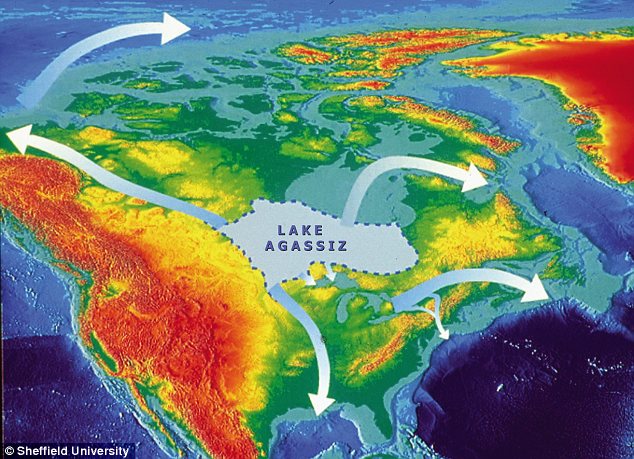
Colour coded topographic elevation of North America showing the maximum extent of Lake Agassiz and four possible routes for its drainage: north-west to the Arctic Ocean via the Mackenzie River; south to the Gulf of Mexico via the Mississippi valley; east to the North Atlantic via the Great Lakes and St Laurence River; north to the North Atlantic via Hudson Bay. (Credit: ©Sheffield University)

The present landforms of central Canada show evidence for several outflow directions at different times, Including to the northwest to reach the Arctic Ocean at the onset of the Younger Dryas. Until recently there was little detailed evidence for the flow volume and timing of its drainage around 8 to 9 ka. Providing the details in the context of the short-lived event around 8.2 ka requires accurate data over a mere 200 years able to reveal a change in sea level to a precision of better than a few tens of centimetre. Any site on the shores of the North Atlantic would do, provided it satisfies these criteria. Geographers from universities in York, Leeds, Sheffield and Oxford, UK selected the small estuary of the River Ythan in NE Scotland. There, a continuous sand unit just above fine-grained intertidal tidal muds marks the knife-sharp time datum of the Storegga tsunami (Rush, G. et al. 2023. The magnitude and source of meltwater forcing of the 8.2 ka climate event constrained by relative sea-level data from eastern Scotland. Quaternary Science Advances, v. 12, article 100119; DOI: 10.1016/j.qsa.2023.100119).

Cores of the intertidal sediments from beneath the present Ythan salt marsh contain plant remains that yielded precise radiocarbon dates at several stratigraphic levels from which to derive an age-depth model for the age range of interest. The buried sediments are also rich in marine microfossils (foraminifera and diatoms) that thrive in estuaries at a variety of depths.  These enabled fluctuations in relative sea level during the build-up of the intertidal sediments to be constrained at unprecedented resolution and precision for a three thousand year period from 9.5 to 6.5 ka. The authors show that there were two episodes of rapid sea-level rise over that time: between 8.53 and 8.37 ka (~2.4 m at 13 mm yr-1) and 8.37 to 8.24 ka (~ 0.6 m at 4 mm yr-1) – these would have been global increases in sea level.

Despite its vast size, it turns out that Lake Agassiz would have been unable to result in sea-level rises of that magnitude so quickly merely through outflow. Rush et al. suggest that the huge  and rapid addition of fresh water to the North Atlantic involved flow of lake water towards Hudson Bay, beneath the ice sheet, causing it to collapse and melt, followed by completion of Lake Agassiz’s emptying in the second stage. It took a long drawn-out ‘freshening’ of the North Atlantic surface water ultimately to shut down the Atlantic Meridional Overturning Circulation, thereby depriving high latitudes of its east-side warming effect by the Gulf Stream.

Sea level has been rising since the early 20th century mainly through the melting of Greenland’s ice cap together with a substantial amount of thermal expansion while global climate has been warming. Between 1901 and 2018 the rise has amounted to 15 to 25 cm at a rate of 1 to 2 mm yr-1. The AMOC is possibly weaker now than at any time during the last millennium (Zhu, C. et al. 2023. Likely accelerated weakening of Atlantic overturning circulation emerges in optimal salinity fingerprint. Nature Communications, v. 14, article 1245; DOI: 10.1038/s41467-023-36288-4). Yet increases in freshening of the northernmost parts of the North Atlantic are now being added to by annual increases in the melting of polar sea ice, which is salt-free. The AMOC may be approaching a tipping point, because warming is accelerating over Greenland at around 1.5°C each year: faster than most of the rest of the world. In 2021 it rained for the first time ever recorded at the ice cap’s summit (3.2 km above sea level). A ‘perturbation’ of the AMOC would add chaos to the dominantly linear view of global warming taken by climatologists. That could launch frigidity and drought at mid northern latitudes as it did eight millennia ago: the opposite of what is currently feared.

See also: Unlocking Ancient Climate Secrets – Melting Ice Likely Triggered Climate Change Over 8,000 Years Ago. Scitechdaily 16 September 2023.

Risks of sudden changes linked to climate

The Earth system comprises a host of dynamic, interwoven components or subsystems. They involve processes deep within Earth’s interior, at its surface and in the atmosphere. Such processes combine inorganic chemistry, biology and physics. To describe them properly would require a multi-volume book; indeed an entire library, but even that would be even more incomplete than our understanding of human history and all the other social sciences. Cut to its fundamentals, Earth system science deals with – or tries to – a planetary engine. In it, the available energy from inside and from the Sun is continually shifted around to drive the bewildering variety, multiplicity of scales and variable paces of every process that makes our planet the most interesting thing in the entire universe. It has done so, with a variety of hiccups and monumental transformations, for some four and half billion years and looks likely to continue on its roiling way for about five billion more – with or without humanity. Though we occupy a tiny fraction of its history we have introduced a totally new subsystem that in several ways outpaces the speed and the magnitude of some chemical, physical and organic processes. For example: shifting mass (see the previous item, Sedimentary deposits of the ‘Anthropocene’); removing and modifying vegetation cover; emitting vast amounts of various compounds as a result of economic activity – the full list is huge. In such a complex natural system it is hardly surprising that rapidly increasing human activities in the last few centuries of our history have hitherto unforeseen effects on all the other components. The most rapidly fluctuating of the natural subsystems is that of climate, and it has been extraordinarily sensitive for the whole of Earth history.

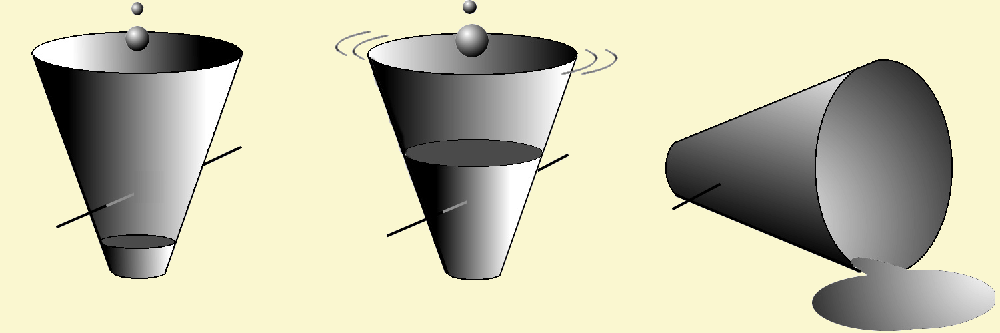
Cartoon metaphor for a ‘tipping point’ as water is added to a bucket pivoted on a horizontal axis. As water level rises to below the axis the bucket becomes increasingly stable. Once the level rises above this pivot instability sets in until the syetem suddenly collapses

Within any dynamic, multifaceted system-component each contributing process may change, and in doing so throw the others out of kilter: there are ‘tipping points’. Such phenomena can be crudely visualised as a pivoted bucket into which water drips and escapes. While the water level remains below the pivot, the system is stable. Once it rises above that axis instability sets in; an external push can, if strong enough, tip the bucket and drain it rapidly. The higher the level rises the less of a push is needed. If no powerful push upsets the system the bucket continues filling. Eventually a state is reached when even a tiny force is able to result in catastrophe. One much cited hypothesis invokes a tipping point in the global climate system that began to allow the minuscule effect on insolation from changes in the eccentricity of Earth’s orbit to impose its roughly 100 ka frequency on the ups and downs of continental ice volume during the last 800 ka. In a recent issue of Nature a group of climate scientists based in the UK, Sweden, Germany, Denmark, Australia and China published a Comment on several potential tipping points in the climate system (Lenton, T.M. et al. 2019. Climate tipping points — too risky to bet against. Nature, v. 575, p. 592-595; DO!: 10.1038/d41586-019-03595-0). They list what they consider to be the most vulnerable to catastrophic change: loss of ice from the Greenland and Antarctic ice sheets; melting of sea ice in the Arctic Ocean; loss of tropical and boreal forest; melting of permanently frozen ground at high northern latitudes; collapse of tropical coral reefs; ocean circulation in the North and South Atlantic.

The situation they describe makes dismal reading. The only certain aspect is the steadily mounting level of carbon dioxide in the atmosphere, which boosts the retention of solar heat by delaying the escape of long-wave, thermal radiation from the Earth’s surface to outer space through the greenhouse effect. An ‘emergency’ – and there can be little doubt that one of more are just around the corner – is the product of ‘risk’ and ‘urgency’. Risk is the probability of an event times the damage it may cause. Urgency is the product of reaction time following an alert divided by the time left to intervene before catastrophe strikes. Not a formula designed to make us confident of the ‘powers’ of science! As the commentary points out, whereas scientists are aware of and have some data on a whole series of tipping points, their understanding is insufficient to ‘put numbers on’ These vital parameters. And there may be other tipping points that they are yet to recognise.  Another complicating factor is that in a complex system catastrophe in one component can cascade through all the others: a tipping may set off a ‘domino effect’ on all the others. An example is the steady and rapid melting of boreal permafrost. Frozen ground contains methane in the solid form of gas hydrate, which will release this ‘super-greenhouse’ gas as melting progresses.   Science ‘knows of’ such potential feedback loops in a largely untried, theoretical sense, which is simply not enough.

A tipping point that has a direct bearing on those of us who live around the North Atlantic resides in the way that water circulates in that vast basin. ‘Everyone knows about’ the Gulf Stream that ships warm surface water from equatorial latitudes to beyond the North Cape of Norway. It keeps NW Europe, otherwise subject to extremely cold winter temperatures, in a more equable state. In fact this northward flow of surface water and heat exerts controls on aspects of climate of the whole basin, such as the tracking of tropical storms and hurricanes, and the distribution of available moisture and thus rain- and snowfall. But the Gulf Steam also transports extra salt into the Arctic Ocean in the form of warm, more briny surface water. Its relatively high temperature prevents it from sinking, by reducing its density. Once at high latitudes, cooling allows Gulf-Steam water to sink to the bottom of the ocean, there to flow slowly southwards. This thermohaline circulation effectively ‘drags’ the Gulf Stream into its well-known course. Should it stop then so would the warming influence and the control it exerts on storm tracks. It has stopped in the past; many times. The general global cooling during the 100 ka that preceded the last ice age witnessed a series of lesser climate events. Each began with a sudden global warming followed by slow but intense cooling, then another warming to terminate these stadials or Dansgaard-Oeschger cycles (see: Review of thermohaline circulation, Earth-logs February 2002). The warming into the Holocene interglacial since about 20 ka was interrupted by a millennium of glacial cold between 12.9 and 11.7 ka, known as the Younger Dryas (see: On the edge of chaos in the Younger Dryas, Earth-logs May 2009). A widely supported hypothesis is that both kinds of major hiccup reflected shuts-down of the Gulf Stream due to sudden influxes of fresh water into North Atlantic surface water that reduced its density and ability to sink. Masses of fresh water are now flowing into the Arctic Ocean from melting of the Greenland ice sheet and thinning of Arctic sea ice (also a source of fresh water). Should the Greenland ice sheet collapse then similar conditions for shut-down may arise – rapid regional cooling amidst global warming – and similar consequences in the Southern Hemisphere from the collapse of parts of the Antarctic ice sheets and ice shelves.  Lenton et al. note that North Atlantic thermohaline circulation has undergone a 15% slowdown since the mid-twentieth century…

See also: Carrington, D. 2019. Climate emergency: world ‘may have crossed tipping points’ (Guardian, 27 November 2019)