
Close to the core-mantle boundary (CMB) there are two extensive zones up to 10 km thick in the lower mantle. They have seismic-wave speeds that are much lower than expected at such depths: hence their being termed large low-velocity provinces (LLVPs). Seismic velocities being inversely proportional to the density of the material through which such waves travel, these zones have anomalously high density. The LLVPs have remained enigmatic since they were first discovered. Some have suggested that they are relics of dense subducted banded iron formations (see also: Curiously low-velocity material at the core-mantle boundary; March 2005) or simply piles of subducted slabs with an eclogite component that have gradually accumulated through Earth’s long history of plate tectonics. An alternative is that LLVPs may be connected to geochemical evidence for a heterogeneous lower mantle and perhaps are relics of Earth’s earliest history.

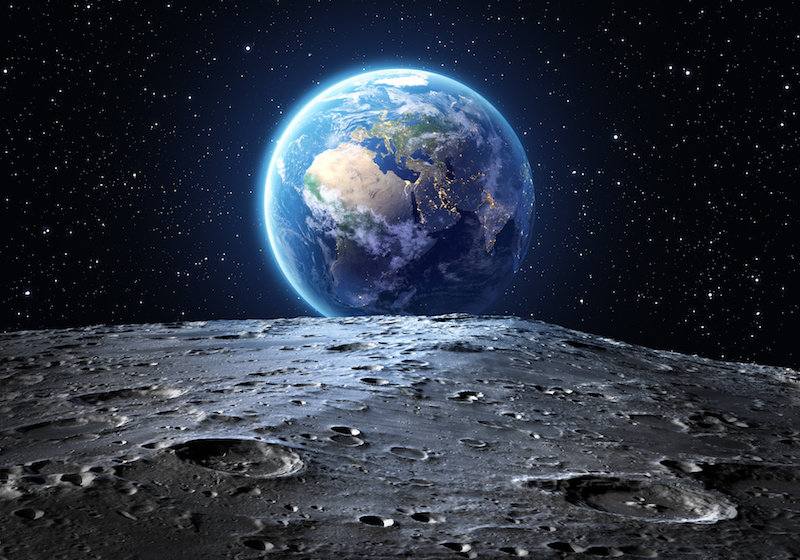
The Moon-forming event about 4,500 Ma ago (for more information search the Planetary Science annual logs index) that probably involved a collision between the proto-Earth and another, Mars-sized planet – dubbed ‘Theia’ – is an alternative explanation for LLVPs. Maybe they are chunks of that planet that became embedded in the early Earth’s mantle. Many geochemical approaches to such an obvious origin are inconclusive, however. The latest attempt to model the processes involved in such a planetary truck crash using computer simulation does suggest that LLVPs may indeed be relics of Theia material that sank through the molten mass that became Earth’s mantle after the collision (Yuan, Q. et al. 2023. Moon-forming impactor as a source of Earth’s basal mantle anomalies. Nature v. 623, p. 95–99; DOI: 10.1038/s41586-023-06589-1).
Qian Yuan of the California Institute of Technology, and colleagues from China, USA and the UK based their approach on geochemical anomalies in plume related ocean-island basalts. These included distinctly non-terrestrial isotopic proportions of the noble gases neon and xenon, similar to those in lunar basalts., which in turn are more iron-rich than most basalts and thus 2-3% denser. The initial assumption in their modelling was that during the collision fragments of Theia peppered the magma ocean that became Earth upper mantle. These were thoroughly mixed in this molten zone as it convected before solidifying. But melts derived from some of the fragments could have penetrated the solid mantle below 1400 km depth as blobs, to retain their chemically anomalous integrity. Being dense, the blobs could slowly sink to accumulate at the CMB to form the two LLVPs. An animation of the processes revealed by Yuan et al.’s modelling can be viewed here.
See also: Oza, A. 2023. Strange blobs in Earth’s mantle are relics of a massive collision. Nature v. 623; DOI: 10.1038/s41586-023-06589-1




 Earth-logs