
In early July 2026 I commented on a quite plausible hypothesis that energy from repeated impacts played the primary role in forming the first Hadean crust. That would also help explain why rocks from those early times are vanishingly rare: they may have been remelted and recrystallised numerous times. But there are Hadean zircon grains from the Archaean Jack Hills sandstone of Western Australia that have underpinned a cottage industry for some geochemists for three decades. Such grains must have crystallised from magma, and inherited trace elements from the igneous processes that formed them. An experiment to test the early impact-melt hypothesis appears in a new publication soon to appear in Nature (Szumila, I. and 11 others 2026. A missing continental impact melt sheet signal in the early Earth detrital zircon record. Nature Communications, In press. DOI: 10.1038/s41467-026-76529-w). Led by Ian Szumila of the Carnegie Institute, Washington DC a group of geochemists from the US, UK and Canada compared a range of elements in zircons from the well-established 1.85 Ga impact melt sheet at Sudbury – the largest of its kind preserved on Earth – with those from more typical, internal igneous processes. They used the data from these known settings to ‘train’ a machine-learning model that can be applied to ancient, detrital zircon grains: the ‘unknowns’ with ages between 3.2 to 4.3 Ga.
The Sudbury complex is made up of a basal sheet of mafic igneous rocks (norite and quartz gabbro) and an upper granitic (granophyre) sheet. Essentially, trace-element data from Sudbury zircons result from ‘exogenous’ melting triggered by a massive impact, whereas those formed by internal magmatic processes are of ‘endogenous’ origin. Finding statistically different geochemical features is, however, a tall order as earlier investigations demonstrate. One study comparing the titanium concentration in Sudbury and Hadean zircons found that crystallisation temperatures of those in the accredited impact melt sheet differed from those of Hadean age. This suggested impact melting was not a primary source for the Hadean crystals. Another based on mineral inclusions in the two populations of zircons did support Hadean impact melting, as did a repeat of the Ti approach to crystallisation temperatures. Szumila et al.’s approach using a more sophisticated comparison of a wider range of the zircons’ trace elements seeks to resolve the issue: their U/Yb, Th/U, Yb, and Gd/Yb ratios.
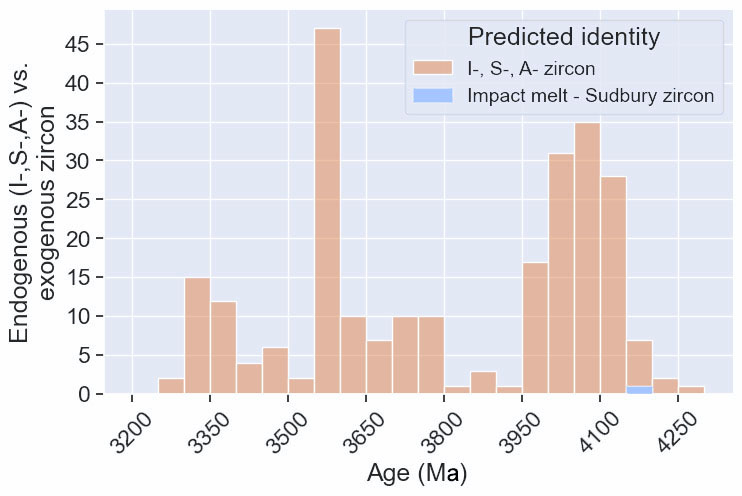
Of the 250 detrital zircon grains dated between 3200 to 4300 Ma-old only a single 4150 Ma-old grain was assigned to an exogenous/impact origin. Apparently, the repeated impact-melt hypothesis for the formation of Earth’s original, Hadean crust is not supported by this experiment. Maybe it did happen, indeed the lunar cratering proxy record for Hadean bombardment of the Earth is unchallengeable. Possibly repeated mega-impacts obliterated and churned up their predecessors’ legacy thereby thermally modifying the tiny zircon grains’ geochemistry before erosion freed them to early and repeatedly reworked sediments. Such a conclusion begs the question of whether or not sustained bombardment repeatedly heated surface water or even boiled it away episodically. On that hangs the vexed question of when self-reproducing organic chemistry was able to result in the earliest life forms: I doubt we will ever know when that fait accompli happened …
See also: Early Earth’s detrital zircons lack evidence of a continental impact melt sheet. Scienmag, 11 August 2026


