More dinosaur trackways from the Jurassic of the Isle of Skye, Scotland

The Isle of Skye off the northwestern coast of Scotland is one of several areas in Britain that are world-class geological gems. Except for the Cuillin Hills that require advanced mountaineering skills it is easy to explore and has become a major destination for both beginners and expert geoscientists of all kinds. Together with the adjacent Isle of Raasay the area is covered by a superb, free geological guidebook (Bell, B. 2024. The Geology of the Isles of Skye and Raasay. Geological Society of Glasgow) together with 60 standalone excursion guides, and even an introduction to Gaelic place names and pronunciation. It is freely available from https://www.skyegeology.com/
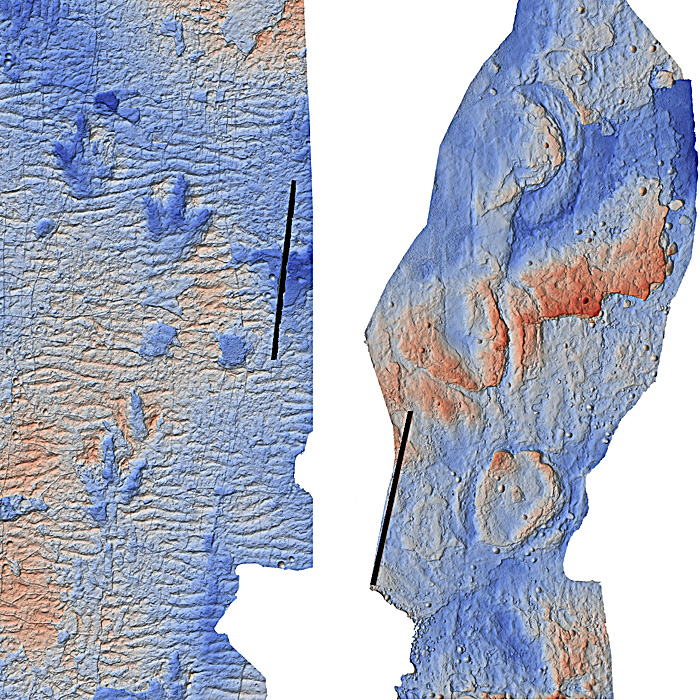
Fig Dinosaur trackways at Prince Charles’s Point on the Isle of Skye: Left carnivorous theropods; Right herbivorous sauropods. The black scales are 1 m long. The images are enhanced fine-scale elevation models of the exposed surfaces that were derived from vertical photographs. Credit: Blakesley et al., Figs 9 and 27.

Since 2018 Skye has also become a must-visit area for vertebrate palaeontologists. Beneath Palaeocene flood basalts is a sequence of Jurassic strata, both shallow marine and terrestrial. One formation, the Great Estuarine Group of Middle Jurassic (Bathonian, 174–164 Ma) age covers the time when meat-eating theropod- and herbivorous sauropod dinosaurs began to grow to colossal sizes from diminutive forebears. While other Jurassic sequences on Skye have notable marine faunas, its Bathonian strata have yielded a major surprise: some exposed bedding surfaces are liberally  dotted with trackways of the two best known groups of dinosaur. The first to be discovered were at Rubha Nam Brathairean (Brothers’ Point) suggesting a rich diversity of species that had wandered across a wide coastal plain, also including the somewhat bizarre Stegosaurus. The latest finds are from a rocky beach at Prince Charles’s Point where the Young Pretender to the British throne, Charles Edward Stuart, landed and hid during his flight from the disastrous Battle of Culloden (16 April 1746). It was only in the last year or so that palaeontologists from the universities of Edinburgh and Liverpool, and the Staffin Museum came across yet more footprints (131 tracks) left there by numerous dinosaurs in the rippled sands of a Bathonian lagoon (Blakesley, T. et al. 2025. A new Middle Jurassic lagoon margin assemblage of theropod and sauropod dinosaur trackways from the Isle of Skye, Scotland. PLOS One, v. 20, article e0319862; DOI: 10.1371/journal.pone.0319862.

The Prince Charles’s Point site is partly covered by large basalt boulders, which perhaps account for the excellent preservation of the bedding surfaces from wave action. Two kinds of footprint are preserved (see image): those made by three-toed feet and by elephant-like feet that ‘squidged-up’ sediment surrounding than. Respectively these are suggested to represent the hind limbs of bipedal carnivorous theropods and quadrupedal herbivorous sauropods. They show that individual dinosaurs moved in multiple directions, but there is no evidence for gregarious behaviour, such as parallel trackways of several animals. They occur on two adjacent bedding surfaces so represent a very short period of time, perhaps a few days. The authors suggest that several individual animals were milling around, with more sauropods than theropods. What such behaviour represents is unclear. The water in an estuarine lagoon would likely have been fresh or brackish. They may have been drinking or perhaps there was some plants or carcases worth eating ? That might explain both kinds of dinosaurs’ milling around. The sizes of both sauropod and theropod prints average about 0.5 m. The stride lengths of the theropods suggest that they were between 5 to 7 metres long with a hip height of around 1.85 m. Their footprints resemble those reconstructed from skeletal remains of Middle Jurassic Megalosaurus, the first dinosaur to be named (by William Buckland in 1827). The sauropods had estimated hip heights of around 2 m so they may have been similar in size (around 16 m) to the Middle Jurassic Cetiosaurus, the first sauropod to be named (by Richard Owen in 1842).

A fully revised edition of Steve Drury’s book Stepping Stones: The Making of Our Home World can now be downloaded as a free eBook

From small beginnings

Camarasaurus, Brachiosaurus, Giraffatitan, Euh...
Some really cool sauropods. Image via Wikipedia

The great vegetarian sauropod dinosaurs, such as Brachiosaurus, were the biggest animals to walk the Earth, weighing up to 100 tonnes, as long as 60 m from snout to the end of their tails and more than 10 m tall. So big, indeed, that even the largest contemporary predators would have been unable to get sufficient purchase with their jaws to do them much damage. This vast bulk, unlike even bigger modern whales, was unsupported by water and would have posed major problems had the sauropods not evolved very porous, low-density neck and tail bones and kept their heads small relative to the rest of their bodies. Such small heads needed to take in up to a tonne of vegetation each day to keep the monsters alive and  ambling. Their teeth are not those of a chewer, being peg- or spoon-like and pointed forwards; specialised for raking in leaves and twigs, swallowed unchewed in great gulps. Once that style of eating developed in their precursors, with no need for massive chewing muscles it became possible to evolve necks up to 15 m long with increasingly diminutive heads. Studies of large numbers of some species of sauropod precursors indicate that juveniles grew astonishingly quickly, essential if their initial vulnerability was to be outpaced; newly hatched they would have weighed little more than 10 kg. At the growth rates of modern reptiles, the largest sauropods would only have reached full size in about a century. The estimated growth rates suggest warm bloodedness, research suggesting that they maintained body temperatures up to 12°C higher than do alligators. Clearly, sauropod dinosaurs were highly specialised, and their evolution is now known to have been lengthy.

A major news feature in Nature (Heeren, F. 201. Rise of the titans. Nature, v. 475, p. 159-161) traces that evolution through several surprising stages. The earliest likely ancestors, which appear in the Late Triassic (~230 Ma), were about the size of a turkey and had teeth adapted for shredding fibrous plant material; other early dinosaurs show clear signs of a predatory lifestyle. There is a limit to the size of predators bound up with the energy balance between flesh consumption and the energy expended in casing down prey and killing them. The limits on the size of plant eaters are mechanical: how much they can stuff in and the strength of their bodies, especially legs. In a world dominated in numbers by predatory dinosaurs, the selection pressure for herbivores to outgrow them and become too big to bite would have been substantial.

Little Triassic Panphagia (‘eater of everything’) was also bipedal, but the fossil record of sauropod precursors clearly shows their growth to the order of 10 m by the Early Jurassic, but not yet a four-legged gait though they had evolved relatively short but sturdy legs, signs of mass-saving porous neck and tail bones, and jaws with a large gape suited to gulping rather than chewing. By the mid-Jurassic Period sauropods were big, strong and four-legged, and by the Cretaceous they reached unmatched dimensions with the titanosaurs. This evolutionary path was not the only one adopted for dinosaurian herbivory. The famous Iguanodon discovered in 1822 by Gideon Mantell in the Early Cretaceous of Sussex was a member of a bipedal group of herbivores, including the duck-billed dinosaurs, that spanned more or less the same time range as sauropods. Fredric Heeren’s article is accompanied by an on-line ‘tour’ of sauropod evolution (go.nature.com/c7zlct), while the American Museum of Natural History has a website for a major exhibition of sauropods (www.amnh.org/exhibitions/wld/ and http://www.youtube.com/AMNHorg ) that includes footage of  a full-scale animatronic Mamenchisaurus from China which breathes and moves, (Switek, B. 2011. Living it large: review of The World’s Largest Dinosaurs exhibition. Nature, v. 475, p. 172).