Advances in hominin evolution

For decades, most of the news concerning our deep ancestry emerged from discoveries in sub-Saharan Africa at sites in Zambia, Tanzania, Kenya, South Africa, Ethiopia. The first week of 2026 decisively shifted that focus northwards to Chad and Morocco in two separate publications.

In 2002 ago the world of palaeoanthropology was in turmoil following the first discovery of fragments of what was then thought to be a hominid, or great-ape, cranium in Chad dated at around 7 Ma ago (Brunet, M. and 37 others 2002. A new hominid from the Upper Miocene of Chad, central Africa. Nature, v. 4418, p. 145-151;DOI:10.1038/nature00879). When pieced together the cranium looked like a cross between that of a chimpanzee and an australopithecine. Some suggested that the creature may have been a ‘missing link’ between the hominids and hominins; perhaps the ultimate ancestor of humans. Sahelanthropus tchadensis (nicknamedToumaï­ or ‘hope of life’ in the local Goran language) was undoubtedly enigmatic. The ‘molecular-clock’ age estimate for the branching of hominins from a common ancestor with chimpanzees was, in 2002, judged to be two million years later the dating of Sahelanthropus, so controversy was inevitable. Another point of contention was the size of Sahelanthropus’s canine teeth: too large for australopithecines and humans, but more appropriate for a gorilla or chimp. Moreover, Toumaï­ showed no indisputable evidence for having been bipedal. The Chadian site subsequently yielded three lower jaw bones and a collection of teeth, a partial femur (leg bone) and three fragmentary ulnae (forearm bones). The finds suggested that as many as five individuals had been fossilised. The femur gave an unresolved hint of an upright gait, yet the ulnas suggested Toumaï­ might equally have been arboreal; as could also be said for the australopithecines.

Reconstructed skull of Sahelanthropus tchadensis. (Credit: Didier Descouens, University of Toulouse)

All the limb bones of Toumaï­have now been anatomically compared with those of hominins and apes (Williams S.A. et al. 2026. Earliest evidence of hominin bipedalism in Sahelanthropus tchadensis. Science Advances, v. 12, article eadv0130; DOI: 10.1126/sciadv.adv0130). Scott Williams of New York University and co-workers from other US institutions show that although the leg bones are much the same size as those of chimpanzees, their proportions were more like those of hominins. They also showed features around the knees and hips needed for bipedalism and an insertion point for a tendon for the gluteus maximus muscle (buttock) vital for sustained upright locomotion, similar to the femurs of Orrorin tugenensis (see: Orrorin walked the walk; May 2008) and Ardipithecus ramidus. Unfortunately, an intact Sahelanthropus cranium showing a foramen magnum – where the skull attaches to the spine – continues to elude field workers. Its position distinguishes upright gait definitively.

See also: This ancient fossil could rewrite the story of human originsScience Daily, January 3, 2026)

The second new advance concerns the joint ancestry of Neanderthals, Denisovans and anatomically modern humans (AMH), whose ancient genetics crudely suggest a last common ancestor living between 765 to 550 ka. This had previously been attributed to Homo antecessor found in the Gran Dolina cave at Atapuerca in northern Spain, roughly dated between 950 ka and 770 ka. (Incidentally, Gran Dolina has yielded plausible evidence of cannibalism). A novel possibility stems from hominin fossils excavated from a cave in raised-beach sediments near Casablanca in Morocco (Hublin, JJ. and 28 others, 2026  Early hominins from Morocco basal to the Homo sapiens lineageNature, v. 649 ; DOI: 10.1038/s41586-025-09914-y). The fossil-bearing sediments contain evidence for a shift in the Earth’s magnetic field (the Brunhes–Matuyama reversal) dated at 773 ka, much more precisely than the Atapuerca age span for H. antecessor. Jean-Jacques Hublin of CNRS in Paris and his multinational colleagues report that the fossils are similar in age to H. antecessor, yet are morphologically distinct, displaying a combination of primitive traits and of ‘derived features reminiscent of’ later Neanderthal, Denisovan and AMH fossils. The differences and shared features suggest that there may have been genetic exchanges between the Moroccan and Iberian population over a considerable period. The most obvious route would have been across the Straits of Gibraltar, but would have required some kind of water craft.  An important question is ‘which population gave rise to the other?’

Artistic reconstruction of a juvenile Homo antecessor, Based on skeletal remains from Gran Dolina Cave

Larger and more robust hominin remains in Algeria dated at 1,000 ka – H. heidelbergensis? – resemble those found near Casablanca. They may have evolved to the latter. Similar possible progenitors to Iberian Homo antecessor have yet to be found in Western Europe. Homo erectus appeared in Georgia and Romania between 2.0 and 1.9 Ma, but the intervening million years or more have yielded no credible European forebears of H. antecessor. For the moment, incursion of a North African population into Europe followed by sustained contact is Hublin et al’s favoured hypothesis, rather than a European origin for Homo antecessor. For Neanderthals and Denisovans to have originated from such an African group, as has been suggested, requires finds of African fossils with plausible resemblance to what are predominantly Eurasian groups. The Iberian population migrated far and wide in Western Europe, as witnessed by stone tools and footprints dating to between 950 to 850 ka in eastern England. So it is equally possible that the Iberian group were progenitors of Neanderthals and Denisovans in Eurasia itself. At least for the moment, ancient genomes of the two H. antecessor groups are unlikely to be found in either Iberian or African fossils of the same antiquity. But, as usual, that will not stifle debate: a resort to the adage ‘absence of evidence is not evidence of absence’ seems appropriate to several research teams!

The oldest anatomically modern human fossils dated at ~300 ka, were also discovered in Morocco (see: Origin of anatomically modern humans, June 2017). Their isolation in the NW corner of the African continent poses a similar conundrum, as since then such beings went on to occupy wide areas of sub-Saharan Africa and then the world.

The first Europeans at the Ukraine-Hungary border

Until this year, the earliest date recorded for the presence of humans in Europe came from the Sierra de Atapuerca in the Province of Burgos, northern Spain. The Sima del Elefante cave yielded a fossil mandible of a human dubbed Homo antecessor from which an age between 1.2 to 1.1 Ma was estimated from a combination of palaeomagnetism, cosmogenic nuclides and stratigraphy. Stone tools from the Vallonet Cave in southern France are around the same age. There is a time gap of about 200 ka before the next sign of human ventures into Europe, probably coinciding with an extreme ice age. They reappear in the form of stone tools and even footprints that they left between 1.0 to 0.78 Ma in ancient river sediments beneath the crumbling sea cliffs of Happisburgh in Norfolk, England. Although no human fossils were preserved, they too have been assigned to H. antecessor.

Topographic map of Europe (click to see full resolution in a new window). The Carpathian Mountains form an arc surrounding the Pannonian Basin (Hungarian Plains) just below centr. Korolevo and other Homo erectus and H. antecessor sites are marked by red spots (Credit: Wikipedia Commons)

In 1974 Soviet archaeologists discovered a site bearing stone tools by the River Tisza at Korolevo in the Carpathian Mountains close to the borders between Ukraine, Romania and Hungary. Korolevo lies at the northeastern edge of the Pannonian Basin that dominates modern Hungary. Whoever left the tools was on the westward route to a huge, fertile area whose game might support them and their descendants. The route along the Tisza leads to the River Danube and then to its headwaters far to the west. Going eastwards leads to the plains north of the Black Sea and eventually via Georgia to the Levant. On that route lies Dmanisi in Georgia, famous for the site where remains of the first hominins (H. erectus, dated at ~1.8 Ma) to leave Africa were found (see: Consider Homo erectus for what early humans achived). The tools from Korolevo are primitive, but have remained undated since 1974. 50 years on, Roman Garba of the Czech Academy of Sciences with colleagues from Czechia, Ukraine, Germany, Australia, South Africa and Denmark have finally resolved their antiquity (Garba, R. and 12 others 2024. East-to-west human dispersal into Europe 1.4 million years ago. Nature v. 627, p. 805–810; DOI: 10.1038/s41586-024-07151-3). Without fossils it is not possible to decide if the tool makers were H. erectus or H. antecessor.

The method used to date the site is based on radioactive 10Be and 26Al formed from oxygen and silicon in quartz grains by cosmic ray bombardment while the grains are at the surface. Since the half life of 26Al (0.7 Ma) is less than that of 10Be (1.4 Ma), after burial the 26Al/10Be ratio decreases and is a guide to the age of the sediment layer that contains the quartz grains. In this case the ag is quite precise (1.42 ± 0.28 Ma). The decreasing age of H. erectus or H. antecessor sites from the 1.8 Ma of Dmanisi in Georgia in the east, through 1.4 Ma (Korolevo) to 1.2 in Spain and France could mark the slow westward migration of the earliest Europeans. It is tempting to suggest possible routes as Garba et al. have. But such sparse and widely separated sites can yield very little certainty. Indeed, it is equally likely that each known site marks the destination of separate migrations at different times that ended in population collapse. The authors make an interesting point regarding the Korolevo population. They were there at a time when three successive interglacials were significantly warmer than the majority during the Early Pleistocene. Also glacial cycles then had ~41 ka time spans before the transition to 100 ka about 1 Ma ago. Unfortunately, no information about the ecosystem that the migrants exploited is available

See also: Prostak, S. 2024. 1.4-Million-Year-Old Stone Tools Found in Ukraine Document Earliest Hominin Occupation of Europe. Sci News, 7 March 2024. (includes map showing possible routes of early human dispersal)

A protein clue to H. antecessor’s role in human evolution

Homo_antecessor child
Forensic reconstruction of the remains of a Homo antecessor child from Gran Dolina Cave in northern Spain (credit Élisabeth Daynès, Museo de la Evolución, Burgos, Spain)

The older a fossil, no matter how well preserved it is, the less chance it has to contain enough undegraded DNA for it to be extracted and sequenced using the most advanced techniques. At present the oldest fossil DNA not to have passed its ‘sell-by’date is that of a 560 to 780 thousand year-old horse’s legbone found in Canadian permafrost. For human remains the oldest mtDNA is that of a ~430 ka individual from the Sima de los Huesos in northern Spain (see: Mitochondrial DNA from 400 thousand year old humans; Earth-logs December 2013). But there is another route to establishing genetic relatedness from the amino-acid sequences of proteins recovered from ancient individuals (see: Ancient proteins: keys to early human evolution?). Fossil teeth have proved to be good repositories of ancient protein and are the most commonly found hominin fossils.

A key species for unravelling the origins of the three most recent human groups (ourselves, Neanderthals and Denisovans) is thought to be Homo antecessor who inhabited the Gran Dolina Cave in the Atapuerca Mountains in northern Spain between about 1.2 Ma and 800 ka ago (see: Human evolution: bush or basketwork? Earth-logs, January 2014). Palaeoanthropologists excavated 170 skeletal fragments from six individuals in the most productive layer at Gran Dolina. Incomplete facial bones suggest a ‘modern-like’ face, although the remains as a whole are insufficient to reconstruct the oldest Europeans with sufficient detail to place them in anatomical relation to the younger groups. But there are several teeth. One of them, a permanent molar, has yielded informative proteins (Welker, F. and 26 others 2020. The dental proteome of Homo antecessor. Nature, v. 580, p. 235-238; DOI: 10.1038/s41586-020-2153-8) and has been dated to between 772 to 949 ka.

Amino acids in the dental proteins, sequenced using mass spectrometry, were compared with those of other hominins. Because protein sequences are coded by an animal’s genome they are a ‘proxy’ for DNA. The outcome is that the Gran Dolina proteins are roughly equally related to Denisovans, Neanderthals and ourselves, suggesting that, although the younger three groups are closely related, H. antecessor is an ‘outlier’. Being significantly older, it is likely to be the common ancestor of all three. Another species with close anatomical affinities is H. heidelbergensis (700 to 300 ka) found in Africa as well as in Europe. Its mtDNA (see: Mitochondrial DNA from 400 thousand year old humans; Earth-logs December 2013) matches that of Denisovans better than it does Neanderthals, yet without protein and full-genome analysis all that can be concluded is that it may be an intermediary between H. antecessor and the well known interbreeding triad of more recent times.

We are getting closer to a documented web of interrelationships between humans in general whose time span from 2 Ma ago is now well established. The remaining genetic link to be documented is that to H. erectus, the longest lived and most travelled of all ancient humans. Frido Welker and co-workers also had a shot at the proteomics of one of the first humans known to have migrated from Africa, using an isolated, presumably H. erectus, molar found at the 1.77 Ma site at Dmanisi in the Caucasus foothills of Georgia. Although inconclusive in placing that precociously intrepid group firmly in the human story, the fact that dental proteins were discovered is cause for optimism.

See also: Campbell, M. 2020. Protein analysis of 800,000-year-old human fossil clarifies dispute over ancestors (Technology Networks, 1 April 2020)

Traces of the most ancient Britons

Perhaps the most evocative traces of our ancestors are their footprints preserved in once soft muds or silts, none more so than the 3.6 Ma old hominin trackway at Laetoli in Tanzania, discovered by Mary Leakey and colleagues in 1978. Such records of living beings’ activities are by no means vanishingly rare. In 2003 footprints of Neanderthal children emerged in volcanic ash that had formed on the slopes of an Italian volcano. The fact that the tracks zig-zagged and included handprints seemed to suggest that the children were playing on a tempting slope of soft sediment, much as they do today (see The first volcanologists?   and Walking with the ancestors). The muddy sediments of the Severn and Mersey estuaries in England yield younger footprints of anatomically modern humans of all sizes every time tidal flows rip up the sedimentary layers. Now similar examples have been unearthed from 1.0 to 0.78 Ma old Pleistocene interglacial sediments at a coastal site in Norfolk, England, in which stone tools had been found in 2010 .

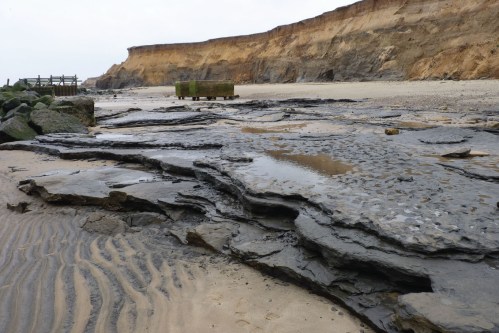
Coastal exposure of Pleistocene laminated sediments at Happisburgh (credit: Ashton et a. 2014 PLOS1)
Coastal exposure of Pleistocene laminated sediments at Happisburgh; the top surface exposes the hominin trackway  (credit: Ashton et al. 2014 PLOS1)

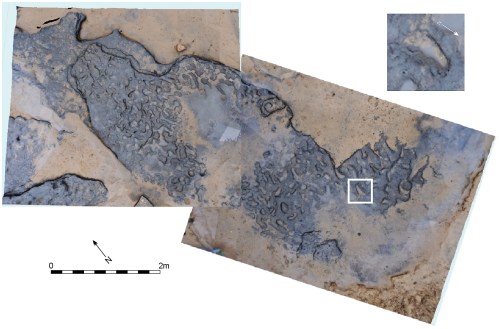
A team funded by the Pathways to Ancient Britain Project, involving scientists from a consortium of British museums and universities, rapidly conserved a 12 m2 surface of laminated sediments fortuitously exposed on the foreshore at Happisburgh (pronounced ‘Haze-burra’) by winter storms. It was covered in footprints (Ashton, N. and 11 others 2014. Hominin Footprints from Early Pleistocene Deposits at Happisburgh, UK. PLoS ONE v. 9: e88329. doi:10.1371/journal.pone.0088329). Analysis of the prints suggested a band of individuals who had tramped southwards across mudflats at the edge of an estuary. They were possibly members of an early human species, known as Homo antecessor, skeletal remains of whom are known from northern Spain. The Happisburgh individuals were of mixed size, probably including adults and juveniles: three footprint sets suggested 1.6 to 1.73 m stature; nine less than 1.4 m.

View from above of the well-trodden trackway at Happisburgh, with an enlarged example of one of the foot prints (credit: Ashton et al 2014 PLoS1)
View from above of the well-trodden trackway at Happisburgh, with an enlarged example of one of the foot prints (credit: Ashton et al. 2014 PLoS1)

From pollen samples, East Anglia during the interglacial had a cool climate with pine, spruce, birch and alder tree cover with patches of heath and grassland. That it had attracted early humans to travel so far north from the Mediterranean climate where skeletal remains are found, suggests that food resources were at least adequate. It is hard to imagine the band having been seasonal visitors from warmer climes further south. They must have been hardy, and from the stone tools we know they were well equipped and capable of killing sizeable prey animals, bones of which marked by clear cut marks being good evidence for their hunting skills.

Enhanced by Zemanta