The hand of Paranthropus boisei

One of the longest-lived hominin species that we know of was Paranthropus boisei, remains of which occur in East African sediments between 2.6 and 1.3 Ma. Others, including our own species, lasted nowhere near as long, except perhaps for Homo erectus who emerged around 1.9 Ma ago and is believed by some to have lingered on in Java until about 112 ka ago. However, when the unresolved muddle in the Middle Pleistocene of similar-looking hominin fossils is eventually unravelled – as now seems to be on the cards – that may limit the range of H. erectus to 1.9 -1.0 Ma. Paranthropoid remains are easily distinguished from those of their contemporary hominins – australopithecines and early species of Homo – being extremely robust compared with the ‘gracile’ members of the human line. They were also bipedal, but their fossil skulls are distinctive: massive teeth and jaws, and a bone crest on top of the cranium to which very powerful chewing muscles were attached. Once regarded as a sort of upright gorilla with vegetarian habits, evidence has accumulated since their first discovery that they may have been far more remarkable.

Reconstruction of a Paranthropus head (Credit: Jerry Humphrey, Pinterest)

The earliest paranthropoid was P. aethiopicus from Ethiopia, dated at around 2.7 to 2.3 Ma, and believed to be the common ancestor of P. boisei and P. robustus found in Tanzania and South Africa respectively. Stone and bone tools associated with paranthropoid remains have been found in South and East Africa, some of which show signs of having been burnt. The connection between paranthropoids and both tool- and fire-making is clearly impossible to verify with certainty, and so too for their known association with australopithecine remains – or even the earliest known humans (Homo habilis) for that matter. Palaeoanthropologists are not likely to find a near-complete skeleton of any of these candidates with a tool grasped in the remains of a hand! The issue can be partly resolved if it can be shown that a fossil hand was capable of making and using tools. The fabled ‘opposable thumb’ that is capable of touching the tips of all four fingers is essential for the necessary ‘precision grip’. Isolated, 2 Ma-old thumb bones probably able to do that were found in the famous Swartkrans Cave in South Africa, but with no clue as to which hominin species had yielded them. In fact had that matter been resolved there and then, it would be not take the hominin story very far, simply because evidence for tool use – tools and cut marks on bone – goes back as far as 3.3 Ma, again with more than one candidate for the usefully endowed hominin species.
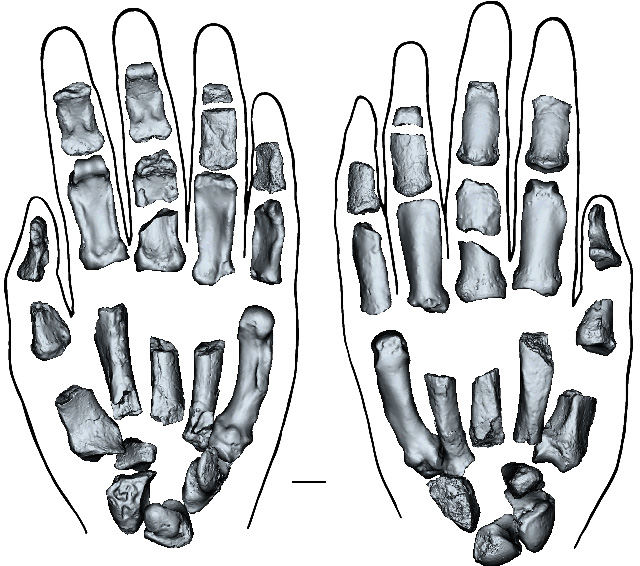
The left hand of Paranthropus boisei reconstructed from individual bones, palm-up on the left, palm down on the right. Credit: Mongle et al, Fig 3.

Remarkably, a group of scientists from the US, Canada, Australia, South Africa and Kenya have indeed unearthed from 1.5 Ma sediments on the shore of Lake Turkana in Kenya a near-complete left hand associated with cranial bones and teeth from Paranthropus boisei  (Mongle,C.S. and 29 others 2025. New fossils reveal the hand of Paranthropus boisei. Nature v. 647, p. 944–951; DOI: 10.1038/s41586-025-09594-8). It is clear that the P. boisei hand shared some of the manipulative capacity of modern human hands, though it bears some resemblance to gorilla hands. That hand was probably nimble enough to make and use simple stone tools. It would also have had a powerful grip, sufficient for climbing and wielding a large stick. Yet again, it does not indicate which species first adopted tool making and use.

There are several interesting possibilities. It may be that a form of convergent evolution enabled two separate genera to become capable of such skills and the intellect to put them to use: tools, however simple, confer enormous evolutionary advantages. Had the antecedents of humans – presumably a species of Australopithecus – been the first, paranthropoids may have observed and adopted tools or vice versa. Just as possible, the – as yet unknown – common ancestor of both may have made this fundamental leap, which would have benefitted both vegetarian and omnivorous descendants. In that case the physiology of each group may have diverged with their lifestyles. Eating roots and leaves requires considerably more physical effort than getting sufficient protein and fats partly by devouring flesh.

Australopithecus anamensis; a face to fit the name

Ethiopian palaeoanthropologist Yohannes Haile-Selassie of the Cleveland Museum of Natural History, Ohio, USA has been involved in the search for early human ancestors in the Awash Valley of the Afar Depression in Ethiopia since 1990. The Middle Awash Project, founded by his mentor Tim White, has been enormously successful over the years. That is because most members from the top down are persistent, inured to heat and sharp sighted. Haile-Selassie is a case in point. In 2016 near a place called Miro Dora, he and a local worker independently spotted two parts of what turned out to be a near-complete cranium of an australopithecine (Au. anamensis) (Haile-Selassie, Y. et al. 2019. A 3.8-million-year-old hominin cranium from Woranso-Mille, Ethiopia. Nature, v. 572, published online; DOI: 10.1038/s41586-019-1513-8). When it was dated at about 3.8 Ma, using the 40Ar/39Ar method and magnetic reversal stratigraphy (Saylor, B.Z. and 13 others 2019. Age and context of mid-Pliocene hominin cranium from Woranso-Mille, Ethiopia. Nature, v. 572, published online; DOI: 10.1038/s41586-019-1514-7), his find caused quite a stir.

anamensis
The near-complete cranium of an Au. anamensis found in the Afar Depression of NE Ethiopia. Note the lateral fflattening caused by sedimentary burial. (Credit: Cleveland Museum of Natural History)

Fragmentary hominin fossils, including a complete lower jaw, found near Lake Turkana, Kenya in 1994 were sufficiently different from other, known australopithecines to warrant their recognition as a new species, Australopithecus anamensis. Seeming more ape-like than the famous ‘Lucy’ fossil Au. afarensis and also older – 3.9 to 4.2 Ma compared with 3.0 to 3.8 Ma for Lucy’s species –  Au anamensis  has long been regarded as a possible ancestor of afarensis, or even a more primitive member if the same species. The new, almost perfect cranium – except for some distortion during burial – cohabited the Afar Depression with Au. afarensis, for as long as 100 ka, and is sufficiently different to retain its species status. Because many palaeoanthropologists consider Au. afarensis to be early in the evolutionary line that lead to humans, the new find seems to throw a spanner in this linear hypothesis. However, there is another possibility that may resolve the issue.

During the Pliocene, Afar was a very diverse place with many volcanoes, lava flows and minor rift systems. It is possible that geographic complexity separated and isolated small groups allowing them to diverge genetically, in the manner of island faunas. Australopithecus afarensis may have arisen from such isolation, going on to outcompete its ‘parent’ species Au anamensis whose numbers progressively dwindled. Nevertheless, the emerging diversity of coexisting hominin populations in the Pliocene seriously challenges linear evolutionary hypotheses aimed at understanding the origin of our own genus (see Taking stock of hominid evolution February 2002 and Hominid evolution: a line or a bush? May 2006).

See also: Video of the discovery and summary of subsequent research

Barras, C. 2019. Rare 3.8-million-year-old skull recasts origins of iconic ‘Lucy’ fossil. Nature, v. 572, p. ; DOI: 10.1038/d41586-019-02573-w

Spoor, F. 2019. Elusive cranium of early hominin found. Nature, v. 572, p. ; DOI: 10.1038/d41586-019-02520-9


Origin of anatomically modern humans

How evolution proceeds and species arise are affected by many different processes. But, if members of every generation of the clade that led from the probable common ancestor of ourselves, Neanderthals, Denisovans and other hominins of the last 700 ka or so – widely thought to have been Homo heidelbergensis­ – were found as perfectly preserved fossils they would show gradually shifting anatomical features that from time to time and place to place would diverge to lead to different species. If, also, every specimen was accurately dated then there would be the last part of the human evolutionary bush laid out in a 3-D graphic. That is never going to be possible, of course. Human fossils are rare and there are few of them that are well-preserved. So the field of human origins throws up surprises on a regular basis, and if palaeoanthropologists were more dogmatic than most of them actually are there would be equally regular, public displays of the eating of hats.

As regards early modern H. sapiens, fossils from a couple of sites in Ethiopia have been the oldest known, at between 160 to 195 ka, for the last 15 years. However, in the 1960s quarry workers at Jebel Irhoud in SW Morocco exposed the infill of a cave network in which were found numerous items of the Levallois stone-tool technology, some human bone fragments that included a brain case and many dismembered and cut bones of prey animals. Initially they were thought to date from about 40 ka and to represent an African form of Neanderthals. Subsequently, re-evaluation of the remains revealed a greater likelihood that they were from modern humans, but too young to be of great interest. An upgraded date of ~160 ka caused them to be considered  as peripheral to the core group of Ethiopian early modern humans. DNA analyses then suggested modern humans to have split from Neanderthals about 500 ka ago. Members of the French-Moroccan team that did the original work, accompanied by other scientists, recently re-excavated the site and exhumed a much richer fossil haul that pin-pointed an anatomically modern human (AMH) provenance, albeit with some archaic characteristics (Hublin, J.-J. and 10 others, 2017. New fossils from Jebel Irhoud, Morocco and the pan-African origin of Homo sapiens. Nature, v. 546, p. 289-294; doi:10.1038/nature22336), which can be referred to as ‘pre-modern’ H. sapiens. The bombshell stemming from their work was the precise dating of the fossils and their stratigraphic context by other members of the team (Richter, D. and 11 others. The age of the hominin fossils from Jebel Irhoud, Morocco, and the origins of the Middle Stone Age. Nature, v. 546, p. 293-296; doi:10.1038/nature22335), which yielded 315±34 ka from fire-heated flint fragments and 286±32 ka from a human tooth. Both dates are far older than the previously accepted maximum of 200 ka for AMH.

The early evolution of fully modern humans seems to have spanned the whole of Africa, rather than being set in an Ethiopian heartland, a view partly supported by a fragmentary 260 ka fossil from South Africa bearing close resemblance to the Moroccan individuals. Interestingly, Levallois stone tools, as their name suggests, are widespread in both Africa and Europe at around 300 ka, although that is not proof that AMH migrated out of Africa around 300 ka, for Neanderthals may also have been using a similar flint flaking method (another space to be watched).

See also:  Stringer C. & Galway-Witham, J., 2017. On the origin of our species.  Nature, v. 546, p. 212-215; doi:10.1038/nature 546212a.

You can find more information on migration of modern humans here.

Australopithecus sediba: is she or is she not a human ancestor?

English: Malapa Hominin 1 (MH1) left, Lucy (AL...
Australopithecus sediba 1 (MH1) left, Au. afarensis( AL 288-Lucy) centre and Au. sediba 2 (MH2) right. (credit: L. R. Berger, University of the Witwatersrand, via Wikipedia)

The remarkable find of two well-preserved skeletons of a 2 Ma hominin in a South African cave in 2008 and publication of their preliminary analysis in 2011  seemed set to shake up human origins research. There was a more or less complete hand – indeed an entire arm and shoulder – a lower leg with ankle bones, a near-complete head and lots more besides. Most was from one female individual, but significant bits from two others that allowed a well-supported reconstruction of the new species Au. sediba. The discoverer, Lee Berger of The University of the Witwatersrand, South Africa (well he initiated the dig, but his young son found the first critical material) is so excited 5 years on that he uses hip-hop phraseology, she ‘got swag’, presumably assuming that means pretty cool (Gibbons, A. 2013. A human smile and funny walk for Australopithecus sediba. Science, v. 340, p. 132-133), but on the street there are other meanings and attitudes towards the phrase and unwary use is not advised.

More details now have emerged in a special issue  of Science introduced by Berger  in less fulsome language (Berger, L.R. 2013. The mosaic nature of Australopithecus sediba. Science, v. 340, p. 163). As the title suggests, the surprise lies in almost every critical part of the species. Although the spine shows curvature (lordosis) needed for an animal evolved from a quadruped to bipedality in order to balance when upright, the ankle bone is unlike the flat-based human one, being pointed as is that of chimpanzees. As a result walking would have involved an unusual and perhaps unsteady gait; the individuals did fall over into a death pit and one commentator thought the gait might have seemed ‘provocative’. An unusual knee bone is thought to be an evolved countermeasure to such exaggerated mincing.  Despite the very human-like hand, extremely long arms and shoulders remarkably like those of the favoured jacket of a star of the BBC series The Dragons’Den point to habitual clambering in trees. Authors of a report on dentition suggest a close similarity to that of the Au. africanus, living at the same time and also found in the same system of fossil-rich caves north-west of Johannesburg, South Africa. Controversially, the tooth team suggests a closer similarity of both to early Homo species than to earlier australopithecines in East Africa, which would shift the focus of human origins to southern Africa. Counter to that view is a find of 400 ka-older, putative human remains in Ethiopia. Yet they take the form of a lower jaw that resembles that of Au. sediba.

The emerging, more detailed picture is not tidy, as suspected from early examination of the Malapa hominins. One thing is for sure, the South African caves are being swarmed over, which paid dividends in 2011 just 15 km from the Malapa cave with another embarrassment of riches at Sterkfonein in the form of abundant foot bones of a currently un-named species of roughly the same age. Things are beginning to take on an element of national pride, with ‘The Birthplace’ at stake: Kenya, Tanzania, Ethiopia or South Africa?