The prospect of climate chaos following major volcano eruptions

It hardly needs saying that volcanoes present a major hazard to people living in close proximity. The inhabitants of the Roman cities of Herculaneum and Pompeii in the shadow of Vesuvius were snuffed out by an incandescent pyroclastic during the 79 CE eruption of the volcano. Since December 2023 long-lasting eruptions from the Sundhnúksgígar crater row on the Reykjanes Penisula of Iceland have driven the inhabitants of nearby Grindavík from their homes, but no injuries or fatalities have been reported. Far worse was the 1815 eruption of Tambora on Sumbawa, Indonesia, when at least 71,000 people perished. But that event had much wider consequences, which lasted into 1817 at least. As well as an ash cloud the huge plume from Tambora injected 28 million tons of sulfur dioxide into the stratosphere. In the form of sulfuric acid aerosols, this reflected so much solar energy back into space that the Northern Hemisphere cooled by 1° C, making 1816 ‘the year without a summer’. Crop failures in Europe and North America doubled grain prices, leading to widespread social unrest and economic depression. That year also saw unusual weather in India culminate in a cholera outbreak, which spread to unleash the 1817 global pandemic. Tambora is implicated in a global death toll in the tens of millions. Thanks to the record of sulfur in Greenland ice cores it has proved possible to link past volcanic action to historic famines and epidemics, such as the Plague of Justinian in 541 CE. If they emit large amounts of sulfur gases volcanic eruptions can result in sudden global climatic downturns.

The ash plume towering above Pinatubo volcano in the Philippines on 12 June 1991, which rose to 40 km (Credit: Karin Jackson U.S. Air Force)

With this in mind Markus Stoffel, Christophe Corona and Scott St. George of the University of Geneva, Switzerland, CNRS, Grenoble France and global insurance brokers WTW, London, respectively, have published a Comment in Nature warning of this kind of global hazard (Stoffel, M., Corona, C. & St. George, S. 2024.  The next massive volcano eruption will cause climate chaos — we are unprepared. Nature v. 635, p. 286-289; DOI: 10.1038/d41586-024-03680-z). The crux of their argument is that there has been nothing approaching the scale of Tambora for the last two centuries. The 1991 eruption of Pinatubo fed the stratosphere with just over a quarter of Tambora’s complement of SO2, and decreased global temperatures by around 0.6°C during 1991-2. Should one so-called Decade Volcanoes – those located in densely populated areas, such as Vesuvius – erupt within the next five years actuaries at Lloyd’s of London estimate economic impacts of US$ 3 trillion in the first year and US$1.5 trillion over the following years. But that is based on just the local risk of ash falls, lava and pyroclastic flows, mud slides and lateral collapse, not global climatic effects. So, a Tambora-sized or larger event is not countenanced by the world’s most famous insurance underwriter: probably because its economic impact is incalculable. Yet the chances of such a repeat certainly are conceivable. A 60 ka record of sulfate in the Greenland ice cores allows the probability of eruptions on the scale of Tambora to be estimated. The data suggest that there is a one-in-six chance that one will occur somewhere during the 21st century, but not necessarily at a site judged by volcanologists to be precarious . Nobody expected the eruption from the Pacific Ocean floor of the Hunga Tonga-Hunga Ha’apai volcano on January 15, 2022: the largest in the last 30 years.

The authors insist that climate-changing eruptions now need to be viewed in the context of anthropogenic global warming. Superficially, it might seem that a few volcanic winters and years without a summer could be a welcome, albeit short-term, solution. However, Stoffel, Corona and St. George suggest that the interaction of a volcano-induced global cooling with climatic processes would probably be very complex. Global warming heats the lower atmosphere and cools the stratosphere. Such steady changes will affect the height to which explosive volcanic plumes may reach. Atmospheric circulation patterns are changing dramatically as the weather of 2024 seems to show. The same may be said for ocean currents that are changing as sea-surface temperatures increase. Superimposing volcano-induced cooling of the sea surface adds an element of chaos to what is already worrying. What if a volcanic winter coincided with an el Niño event? The Intergovernmental Panel on Climate Change that projects climate changes is ‘flying blind’ as regards volcanic cooling. Another issue is that our knowledge of the effects in 1815 of Tambora concerned a very different world from ours: a global population then that was eight times smaller than now; very different patterns of agriculture and habitation; a world with industrial production on a tiny proportion of the continental surface. Stoffel, Corona and St. George urge the IPCC to shed light on this major blind spot. Climate modellers need to explore the truly worst-case scenarios since a massive volcanic eruption is bound to happen one day. Unlike global warming from greenhouse-gas emission, there is absolutely nothing that can be done to avert another Tambora.

Turmoil in Roman Republic followed Alaskan volcanic eruption

That activities in the global political-economic system are now dramatically forcing change in natural systems is clear to all but the most obdurate. In turn, those changes increase the likelihood of a negative rebound on humanity from the natural world. In the first case, data from ice cores suggests that an anthropogenic influence on climate may have started with the spread of farming in Neolithic times. Metal pollution of soils had an even earlier start, first locally in Neanderthal hearths whose remains meet the present-day standards for contaminated soil, and more extensively once Bronze Age smelting of copper began. Global spread of anomalously high metal concentrations in atmospheric dusts shows up as ‘spikes’ in lead within Greenland ice cores during the period from 1100 BCE to 800 CE. This would have resulted mainly from ‘booms and busts’ in silver extraction from lead ores and the smelting of lead itself. In turn, that may reflect vagaries in the world economy of those times

Precise dating by counting annual ice layers reveals connections of Pb peaks and troughs with major historic events, beginning with the spread of Phoenician mining and then by Carthaginians and Romans, especially in the Iberian Peninsula. Lead reaches a sustained peak during the acme of the Roman Republic from 400 to 125 BC to collapse during widespread internal conflict during the Crisis of the Republic. That was resolved by the accession of Octavian/Augustus as Emperor in 31 BCE and his establishment of Pax Romana across an expanded empire. Lead levels rose to the highest of Classical Antiquity during the 1st and early 2nd centuries CE. Collapse following the devastating Antonine smallpox pandemic (165 to 193 CE) saw the ice-core records’ reflecting stagnation of coinage activity at low levels for some 400 years, during which the Empire contracted and changed focus from Rome to Constantinople. Only during the Early Medieval period did levels rise slowly to the previous peak.

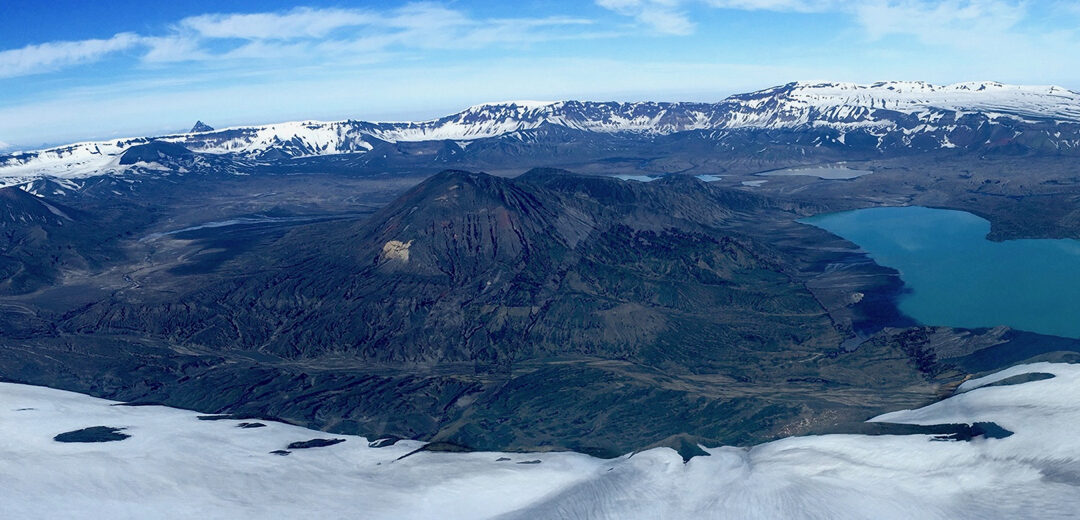
The Okmok caldera on the Aleutian island of Umnak (Credit: Desert Research Institute, Reno, Nevada USA)

Earth-logs has previously summarised how natural events, mainly volcanic eruptions, had a profound influence in prehistory. The gigantic eruption of Toba in Sumatra (~73 ka ago) may have had a major influence on modern-humans migrating from Africa to Eurasia. The beginning of the end for Roman hegemony in the Eastern Mediterranean was the Plague of Justinian (541–549 CE), during which between 25 to 50 million people died of bubonic plague across the Eastern Empire. This dreadful event followed the onset of famine from Ireland to China, which was preceded by signs of climatic cooling from tree-ring records, and also with a peak of volcanogenic sulfate ions in the Greenland and Antarctic ice caps around 534 CE. Regional weakening of the populace by cold winters and food shortages, also preceded the Black Death of the mid-14th century. In the case of the Plague of Justinian, it seems massive volcanism resulted in global cooling over a protracted period, although the actual volcanoes have yet to be tracked down. Cooling marked the start of a century of further economic turmoil reflected by lead levels in ice cores (see above). Its historical context is the Early Medieval equivalent of world war between the Eastern Roman Empire, the Sassanid Empire of Persia and, eventually, the dramatic appearance on the scene of Islam and the Arabian, Syrian and Iraqi forces that it inspired (see: Holland, T. 2013. In the Shadow of the Sword: The battle for Global Empire and the End of the Ancient World. Abacus, London)

An equally instructive case of massive volcanism underlying social, political and economic turmoil has emerged from the geochemical records in five Greenlandic ice cores and one from the Siberian island of Severnaya Zemlya (McConnell, J.R. and 19 others 2020. Extreme climate after massive eruption of Alaska’s Okmok volcano in 43 BCE and effects on the late Roman Republic and Ptolemaic Kingdom. Proceedings of the National Academy of Sciences, recent article (22 June 2020); DOI: 10.1073/pnas.2002722117). In this case the focus was on ice layers in all six cores that contain sulfate spikes and, more importantly, abundant volcanic dust, specifically shards of igneous glass. Using layer counting, all six show major volcanism in the years 45 to 43 BCE. The Ides (15th) of March 44 BCE famously marked the assassination of Julius Caesar, two years after the Roman Republic’s Senate appointed him Dictator, following four years of civil war. This was in the later stages of the period of economic decline signified by the fall in ice-core levels of Pb (see above). The Roman commentator Servius reported “…after Caesar had been killed in the Senate on the day before, the sun’s light failed from the sixth hour until nightfall.” Other sources report similar daytime dimming, and unusually cold weather and famine in 43 and 42 BCE.

As well as pinning down the date and duration of the volcanic dust layers precisely (to the nearest month using laser scanning of the ice cores’ opacity), Joseph McConnell and the team members from the US, UK, Switzerland, Germany and Denmark also chemically analysed the minute glass shards from one of the Greenlandic ice cores. This has enabled them to identify a single volcano from 6 possible candidates for the eruption responsible for the cold snap: Okmok, an active, 8 km wide caldera in the Aleutian Islands of Alaska. Previous data suggest that its last major eruption was 2050 years ago and blasted out between 10 to 100 km3 of debris, including ash. Okmok is an appropriate candidate for a natural contributor to profound historic change in the Roman hegemony. The authors also use their ice-core data to model Okmok’s potential for climate change: it had a global reach in terms of temperature and precipitation anomalies. Historians may yet find further correlations of Okmok with events in other polities that kept annual records, such as China.

See also: Eruption of Alaska’s Okmok volcano linked to period of extreme cold in ancient Rome (Science Daily, 22 June 2020); Kornei, K. 2020. Ancient Rome was teetering. Then a volcano erupted 6,000 miles away. (New York Times, 22 June 2020)