A sign of life on another planet? Should we be excited?

Judging by the coverage in the media, there is huge excitement about a possible sign of life on a very distant planet. It emerged from a Letter to The Astrophysical Journal posted by a British-US team of astronomers led by Nikku Madhusudhan that was publicised by the Cambridge University Press Office (Madhusudhan, N.et al. 2025. New Constraints on DMS and DMDS in the Atmosphere of K2-18 b from JWST MIRI. The Astrophysical Journal, v. 983, article adc1c8; DOI: 10.3847/2041-8213/adc1c8). K2-18 b is a planet a bit smaller than Neptune that orbits a red dwarf star (K2-18) about 124 light years away. The planet was discovered by NASA’s now-defunct Kepler space telescope tasked with the search for planets orbiting other stars. An infrared spectrometer on the Hubble Space Telescope revealed in 2019 that the atmosphere of K2-18 b contained water vapour, making the planet a target for further study as it may possess oceans. The more sophisticated James Webb Space Telescope IR spectrometer was trained on it a year later to reveal methane and CO2: yet more reason to investigate more deeply, for water and carbon compounds imply both habitability and the potential for life forms being there.

The latest results suggest that that the atmosphere of K2-18 b may contain simple carbon-sulfur gases: dimethyl sulfide ((CH3)2S) and dimethyl disulfide (CH3SSCH3). Bingo! for exobiologists, because on Earth both DMS and DMDS are only produced by algae and bacteria. Indeed they are responsible for the odour of the seaside. They became prominent in 1987 when biogeochemist James Lovelock fitted them into his Gaia Hypothesis. He recognised that they encourage cloud formation and thus increase Earth’s reflectivity (albedo) and also yield sulfuric acid aerosols in the stratosphere when they oxidise: that too increases albedo. DMS generates a cooling feedback loop to counter the warming feedback of greenhouse emissions. That is an idea of planetary self-regulation not much mentioned nowadays. Such gases were proposed by Carl Sagan as unique molecular indicators that could be used to search for extraterrestrial life.
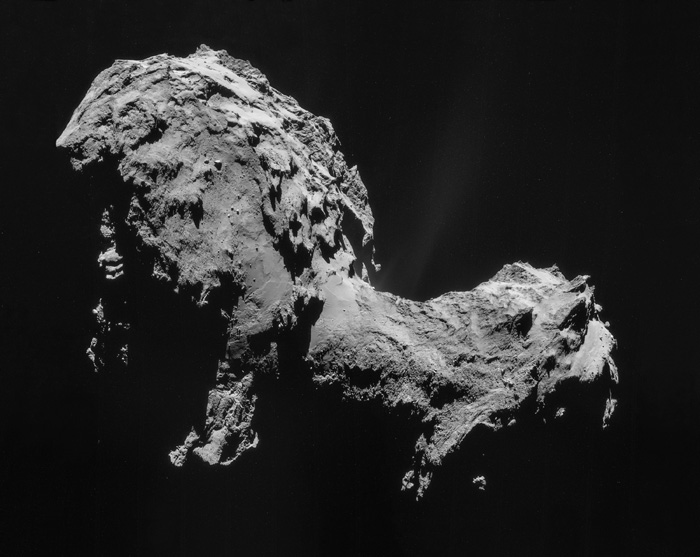
The coma of Comet Churyumov-Gerasimenko yielded both dimethyl sulfide and amino acids to the mass spectrometer carried by ESA’s Rosetta. Credit: ESA.

The discovery of possible DMS and DMDS in K2-18 b’s atmosphere is, of course, currently under intense scientific scrutiny. For a start, the statistics inherent in Madhusudhan et al.’s methodology (3σ or 99.7% probability) fall short of the ‘gold standard’ for discoveries in physics (5σ or 99.99999% probability). Moreover, there’s also a chance that exotic, inorganic chemical processes could also create the gases, such as lightning in an atmosphere containing C, H and S. But this is not the first time that DMS has been discovered in an extraterrestrial body. Comets, having formed in the infancy of the Solar System much further from the Sun than any planets, are unlikely to be ‘teeming with life’. The European Space Agency’s Rosetta spacecraft chased comet 67P/Churyumov-Gerasimenko for 2 years, directly sampling dust and gas that it shed while moving closer to the Sun. A single day’s data from Rosetta’s mass spectrometer showed up DMS, and also amino acids. Both could have formed in comets or interstellar dust clouds by chemistry driven by radiation, possibly to contaminate planetary atmospheres. Almost certainly, further remote sensing of K2-18 b will end up with five-sigma precision and some will say, ‘Yes, there is life beyond Earth!’ and celebrate wildly. But that does not constitute proof, even by the ‘weight of evidence’ criterion of some judiciaries. To me such a conclusion would be unseemly romanticism. Yet such is the vastness of the material universe and the sheer abundance of the elements C H O N and P that make up most living matter that life elsewhere, indeed everywhere, (but not life as we know it) is a near certainty. The issue of intelligent lifeforms ‘out there’ is, however, somewhat less likely to be resolved . . .

New ideas on evolution of the Solar System

The Kepler Space Telescope launched in 2009 was designed to detect and measure planetary bodies orbiting other stars. It was hoped that it would help slake the growing thirst for signs of alien but Earth-like worlds, extraterrestrial life and communications from other sentient beings. Results from the Kepler mission have, however, fostered a growing awareness that all is not well with the simple, Laplacian formation of planetary systems. For a start not one of the thousands of exoplanets revealed by Kepler is in a planetary system resembling the Solar System, let along sharing crucial attributes with the Earth. Giant planets occur around only a tenth of the stars observed, and even fewer in stable, near-circular orbits. Although it is early days in the quest for Earth- and Solar System look-alikes, some unexpected contrasts with the Solar System are emerging. For instance, many of the systems have far more mass in close orbit around their star, including gas giants with orbital periods of only a few days and giant rocky planets. Such configurations defy the accepted model for the Solar System where an outward increase in the proportion of volatiles and ices was thought to be the universal rule. Could these ‘hot Jupiters’ have formed further out and then somehow been dragged into scorching proximity to their star? Answers to this and other questions have been sought from computer simulations of the evolution of nebulas. Inevitably, the software has been applied to that of the Solar System, and the results are, quite literally, turning ideas about its early development inside out (Batygin, K., Laughlin, G. & Morbidelli, A., 2016. Born of chaos. Scientific American, v. 314(May 2016),  p. 20-29).

An artist's impression of a protoplanetary disk
An artist’s impression of a protoplanetary disk (credit: Wikipedia)

It seems that at some stage in its growth from the protoplanetary disk the gravitational influence of a planet creates mass perturbations in the remainder of the disk. These feed back to the planet itself, to others and different parts of the disk to create complex and continuously evolving motions; individual planets may migrate inwards, outwards or escape their star’s influence altogether in a chaotic, unpredictable dance. Ultimately, some balance emerges, although that may involve the star engulfing entire worlds and other bodies ending up in interstellar space. It may also end up with worlds dominated by ‘refractory’ materials – i.e. rocky planets like Earth – orbiting further from their star than those composed of ‘volatiles’. In the case of the early Solar System the modelling revealed  Jupiter and Saturn drifting inwards and dragging planetesimals, dust, ice and gas with them to create a gap in the protoplanetary disk. Within about half a million years the two giant planets became locked in their present orbital resonance, which changed the distribution of angular momentum between them and reversed their motion to outward. The clearing of mass neatly explains the asteroid belt and Mars’s otherwise inexplicably small size.

One of the characteristics emerging from Kepler’s discoveries is that ‘super Earths’ orbit close to their star in other systems. Had they existed in the early Solar System the inward drive of Jupiter and Saturn and their ‘bow wave’ of smaller bodies would have had consequences. Swarms of matter from the ‘bow wave’ captured and dissipated angular momentum from the super Earths and dissipated it within a few hundred thousand years, thereby pushing them into death spirals to be consumed by the Sun. This explains what by comparison with Kepler data is a mass deficit in the inner Solar System. The rocky planets – Mercury, Venus, Earth and Mars – accreted from the leftovers, perhaps over far longer periods than previously thought.

Intense bombardment of the Moon and the Earth took place during the first half billion years after they had formed, rising to a crescendo in its later stages. Formation of the mare basins brought it to a sudden close at 3.8 Ga, which coincides with the earliest evidence for life on Earth. Lunar evidence indicates that this Late Heavy Bombardment spanned 4.1 to 3.8 Ga. Previously explained by a variety of unsatisfying hypotheses it forms part of the new grand modelling of jostling among the giant planets. Once Jupiter and Saturn together with Uranus and Neptune had stabilised, temporarily, they accumulated lesser orbital perturbations from an outlying disk of evolving dust and planetesimals throughout the Hadean Eon. Ultimately, around 4.1 Ga, the giant planets shifted out of resonance, pushing Jupiter slightly inwards to its current orbit and thrusting the other 3 further outwards. Incidentally, this may have flung another giant planet out of solar orbit to the void. Over about 300 million years they restabilised their orbits through gravitational interaction with the Kuiper belt but at the expense of destabilising the icy bodies within it. Some fled inwards as a barrage of impactors, possibly to deliver much of the water in Earth’s oceans. By 3.8 Ga the giants had settled into their modern orbital set-up; hopefully for the last time.