The onset of weathering in the late Archaean and stabilisation of the continents

Distribution of exposed Archaean cratons. The blue Proterozoic areas may, in part be underlain by cratons. (Credit: Groves, D.I. & Santosh, M. DOI:10.1016/j.gr.2020.06.008)

About 50% of continental crust is of Archaean age (2.5 to 4.0 Ga) in huge blocks above lithosphere more than 150 km thick. Younger continental lithosphere is significantly thinner – as low as 40 km. Since the end of the Archaean Eon these blocks have remained tectonically stable and only show signs of extensional, brittle fracture that have been exploited by basaltic dyke swarms. Such crystalline monstrosities have remained rigid for 2.5 billion years. They are termed cratons from the Greek word κράτο (kratos) for ‘might’ or ‘strength’. Numbers of cratons have been pushed together by later tectonics to form continental ‘cores’, separated from one another by highly deformed ‘mobile belts’ formed by younger collisional orogenies. Africa and South America have 4 cratons each, Eurasia 6 or 7, the other continents all have one

Considering how much cratons have been stressed by later tectonic forces, their implacable rigidity might seem surprising. This rigidity is thought to be due to cratons’ unusually low amounts of the main heat-producing elements (HPE) potassium, uranium and thorium, the decay of whose radioactive isotopes produces surface heat flow. Cratons have the lowest surface heat flow on the planet, so in bulk they must have low HPE content. This stems from the nature of cratons’ deepest parts: almost anhydrous, once igneous rocks of intermediate average composition known as granulites. They formed by metamorphism of earlier crustal rocks at depths of up to 70km, which drove out most of their original HPEs and water. The upper cratonic crust has much the same complement of HPEs as that of more recent continental crust. This bulk depletion of cratons has maintained unusually low temperatures in their deep continental crust. That has been immune from partial melting and thus ductile deformation since it formed.
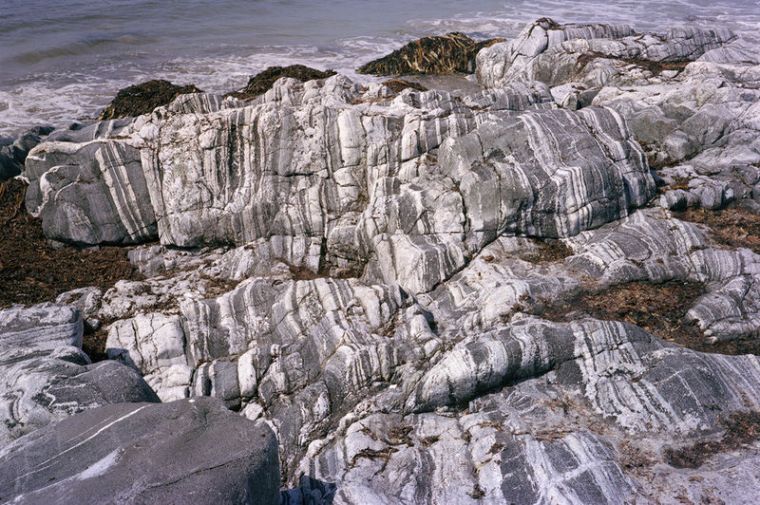
Three billion year-old TTG gneiss in the Outer Hebrides, Scotland. (Credit: British Geological Survey)

Jesse Reimink and Andrew Smye of Pennsylvania State University, USA have considered the geochemistry and history of the world’s cratons to address the long-standing issue of their stability and longevity (Reimink, J.R. & Smye, A.J. 2024. Subaerial weathering drove stabilization of continents. Nature, v. 629, online article; DOI: 10.1038/s41586-024-07307-1). Their main focus is on how the Archaean lower crust lost most of it HPEs, and where they went. During much of the Archaean continental crust formed by partial melting of hydrated basaltic rocks at shallow depths. That generated sodium-rich silicic magmas from which the dominant grey tonalite-trondhjemite-granodiorite (TTG) gneisses of Archaean crust formed by extreme ductile deformation. Though TTGs originally contained sufficient heat-producing capacity to make them ductile during the early Archaean there is little evidence that they underwent extensive partial melting themselves. But they did after 3.0 Ga to produce swarms of granite plutons in the upper Archaean crust.

Complementing the late-Archaean granite ‘swarm’ are deep-crustal granulites with low HPE contents, which mainly formed around the same time. The granulites contain highly metamorphosed sedimentary rocks, which seem to have been sliced into the Archaean crust during its ductile deformation phase. Some of them have compositions that suggest that they are derived from clay-rich shales, their proportion reaching about 30% of all granulite-facies metasediments. Clay minerals are the products of chemical weathering of silicon- and aluminium-rich igneous rocks exposed to the atmosphere. When they form, they host K, U and Th. Also, their composition and high initial water contents are conducive to partial melting under high-temperature conditions, to become a source of granitic magmas. Crustal weathering is key to Reimink and Smye’s hypothesis for the development of cratons in the late Archaean.

There is growing evidence that high Archaean heat flow through oceanic lithosphere – the mantle contained more undecayed HPE isotopes than now – reduced its density. As a result Archaean oceanic basins were considerably shallower than they became in later times. Because of the lower volume of the basins during the Archaean, seawater extended across much of the continental surface. For most of the Archaean Eon Earth was a ‘waterworld’, with little subaerial weathering of its TTG upper crust. As the volume of exposed continental crust increased so did surface weathering to form clay minerals that selectively absorbed HPEs. Over time shales became tectonically incorporated deep into the thickening Archaean continental crust to form a zone with increased heat producing capacity and a higher water content. Once deep enough and heated by their own content of HPE they began partially melting to yield voluminous granitic magmas to which they contributed their load of HPEs. Being lower in density than the bulk of TTG crust the granite melts would have risen to reach the upper crust. They also took in HPEs from the deep TTG crust itself. According to Reimink and Smye this would have concentrated continental heat production in the upper crust, leaving the deeper crust drier, less able to melt and assume ductile properties, and thus to create the cratons.

The authors believe that such a redistribution of heat production in the ancient continental crust did not need any major change in global tectonics. All it required was decreasing oceanic heat flow to create deeper and more voluminous ocean basins, allowing more continental surface to emerge above sea level and dynamic burial of sedimentary products of subaerial weathering. They conclude: “The geological record can then be cast in terms of a pre-emergence (TTG-dominated) and post-emergence (granite-dominated) planet.” That seems very neat … but it seems unlikely that samples can be drilled from the depths where the ‘action’ took place. Geologists depend on exposures of Archaean middle to deep crust brought to the surface by fortuitous later tectonics.

‘Mud, mud, glorious mud’

Earth is a water world, which is one reason why we are here. But when it comes to sedimentary rocks, mud is Number 1. Earth’s oceans and seas hide vast amounts of mud that have accumulated on their floors since Pangaea began to split apart about 200 Ma ago during the Early Jurassic. Half the sedimentary record on the continents since 4 billion years ago is made of mudstones. They are the ultimate products of the weathering of crystalline igneous rocks, whose main minerals – feldspars, pyroxenes, amphiboles, olivines and micas, with the exception of quartz – are all prone to breakdown by the action of the weakly acidic properties of rainwater and the CO2 dissolved in it. Aside from more resistant quartz grains, the main solid products of weathering are clay minerals (hydrated aluminosilicates) and iron oxides and hydroxides. Except for silicon, aluminium and ferric iron, most metals end up in solution and ultimately the oceans.  As well as being a natural product of weathering, mud is today generated by several large industries, and humans have been dabbling in natural muds since the invention of pottery some 25 thousand years ago.  On 21 August 2020 the journal Science devoted 18 pages to a Special Issue on mud, with seven reviews (Malakoff, D. 2020. Mud. Science, v. 369, p. 894-895; DOI: 10.1126/science.369.6506.894).

Mud carnival in Brazil (Credit: africanews.com)

The rate at which mud accumulates as sediment depends on the rate at which erosion takes place, as well as on weathering. Once arable farming had spread widely, deforestation and tilling the soil sparked an increase in soil erosion and therefore in the transportation and deposition of muddy sediment. The spurt becomes noticeable in the sedimentary record of river deltas, such as that of the Nile, about 5000 years ago. But human influences have also had negative effects, particularly through dams. Harnessing stream flow to power mills and forges generally required dams and leats. During medieval times water power exploded in Europe and has since spread exponentially through every continent except Antarctica, with a similar growth in the capacity of reservoirs. As well as damming drainage these efforts also capture mud and other sediments. A study of drainage basins in north-east USA, along which mill dams quickly spread following European colonisation in the 17th century, revealed their major effects on valley geomorphology and hydrology (see: Watermills and meanders; March 2008). Up to 5 metres of sediment build-up changed stream flow to an extent that this now almost vanished industry has stoked-up the chances of major flooding downstream and a host of other environmental changes. The authors of the study are acknowledged in one Mud article (Voosen, P. 2020. A muddy legacy. Science, v. 369, p. 898-901; DOI: 10.1126/science.369.6506.898) because they have since demonstrated that the effects in Pennsylania are reversible if the ‘legacy’ sediment is removed. The same cannot be expected for truly vast reservoirs once they eventually fill with muds to become useless. While big dams continue to function, alluvium downstream is being starved of fresh mud that over millennia made it highly and continuously productive for arable farming, as in the case of Egypt, the lower Colorado River delta and the lower Yangtze flood plain below China’s Three Gorges Dam.

Mud poses extreme risk when set in motion. Unlike sand, clay deposits saturated with water are thixotropic – when static they appear solid and stable but as soon as they begin to move en masse they behave as a viscous fluid. Once mudflows slow they solidify again, burying and trapping whatever and whomever they have carried off. This is a major threat from the storage of industrially created muds in tailings ponds, exemplified by a disaster at a Brazilian mine in 2019, first at the site itself and then as the mud entered a river system and eventually reached the sea. Warren Cornwall explains how these failures happen and may be prevented (Cornwall, W. 2020. A dam big problem.  Science, v. 369, p. 906-909; DOI: 10.1126/science.369.6506.906). Another article in the Mud special issue considers waste from aluminium plants (Service, R.F. 2020. Red alert. Science, v. 369, p. 910-911; DOI: 10.1126/science.369.6506.910). The main ore for aluminium is bauxite, which is the product of extreme chemical weathering in the tropics. The metal is smelted from aluminium hydroxides formed when silica is leached out of clay minerals, but this has to be separated from clay minerals and iron oxides that form a high proportion of commercial bauxites, and which are disposed of in tailings dams. The retaining dam of such a waste pond in Hungary gave way in 2010, the thixotropic red clay burying a town downstream to kill 10 people. This mud was highly alkaline and inflicted severe burns on 150 survivors. Service also points out a more positive aspect of clay-rich mud: it can absorb CO2 bubbled through it to form various, non-toxic carbonates and help draw down the greenhouse gas.

Muddy sediments are chemically complex, partly because their very low permeability hinders oxygenated water from entering them: they maintain highly reducing conditions. Because of this, oxidising bacteria are excluded, so that much of the organic matter deposited in the muds remains as carbonaceous particles. They store carbon extracted from the atmosphere by surface plankton whose remains sink to the ocean floor. Consequently, many mudrocks are potential source rocks for petroleum. Although they do not support oxygen-demanding animals, they are colonised by bacteria of many different kinds. Some – methanogens – break down organic molecules to produce methane. The metabolism of others depends on sulfate ions in the trapped water, which they reduce to sulfide ions and thus hydrogen sulfide gas: most muds stink. Some of the H2S reacts with metal ions, to precipitate sulfide minerals, the most common being pyrite (FeS2). In fact a significant proportion of the world’s copper, zinc and lead resources reside in sulfide-rich mudstones: essential to the economies of Zambia and the Democratic Republic of Congo. But there are some strange features of mud-loving bacteria that are only just emerging. The latest is the discovery of bacteria that build chains up to 5 cm long that conduct electricity (Pennisi, E. 2020. The mud is electric. Science, v. 369, p. 902-905; DOI: 10.1126/science.369.6506.902). The bacterial ‘nanowires’ sprout from minute pyrite grains, and transfer electrons released by oxidation of organic compounds, effectively to catalyse sulfide-producing reduction reactions. NB Oxygen is not necessary for oxidation as its chemistry involves the loss of electrons, while reduction involves a gain of electrons, expressed by the acronym OILRIG (oxidation is loss, reduction is gain). It seems such electrical bacteria are part of a hitherto unsuspected chemical ecosystem that helps hold the mud together as well as participating in a host of geochemical cycles. They may spur an entirely new field of nano-technology, extending, bizarrely, to an ability to generate electricity from moisture in the air.

If you wish to read these reviews in full, you might try using their DOIs at Sci Hub.

Are Martian clays magmatic in origin?

593496main pia14840 full Curiosity Touching Do...
Artist’s Concept of Curiosity’s touchdown(credit: Wikipedia)

The remote detection of spectral features in the infrared that suggest abundant clay minerals on the surface of Mars is the basis for a widely-held view that Mars may once have had moist climatic conditions that encouraged life to form (see The Martian ‘sexy beast’ in September 2012  EPN). The presence of clays, along with suggestive landforms, has also been used to speculate that Mars once harboured long-lived lakes and perhaps even a huge ocean on its northern hemisphere, between 3.7 to 4.1 Ga. It was the clays that pitched the recently arrived Curiosity (aka Mars Exploration)Rover at the Gale crater and its central Aeolis Mons. The latter, also known as Mount Sharp, preserves about 5 km of layered rocks, the lowest of which are clay-rich and hypothesised to be sediments laid down in a lake that filled the crater. Provided Curiosity operates according to plan, we will know soon enough whether or not the layered rocks of Mount Sharp are indeed sediments, but a soon-to-be-published article suggests another explanation than weathering for the production of abundant clay minerals on Mars (Meunier, A. et al. 2012. Magmatic precipitation as a possible origin of Noachian clays on Mars. Nature Geoscience, published online 9 September 2012; DOI: 10.1038/NGEO1572).

Focusing the 100-millimeter Mastcam [detail]
Layered rocks on the flanks of Mount Sharp in Gale crater from Curiosity’s Mastcam (NASA Goddard via Flickr)
The French-US team provides evidence from terrestrial lavas that abundant iron- and magnesium-rich clays, known as smectites, may form at a late stage during crystallization of magma. If magma contains water – and most magmas do – as more and more anhydrous silicates crystallise during cooling water builds up in the remaining liquid. Once silicate crystallisation is complete there remains a watery fluid capable of reacting with some of the silicates to form clay minerals; a process often referred to as pneumatolysis. How much clay is formed depends on the initial water content of the magma. Pneumatolysisoperates on hot lava, whereas weathering occurs at ambient temperature provided the climate is able to support liquid water at the surface. Mars is currently far too cold for that, and ideas of a wet surface environment earlier in the planet’s history demand an explanation for a much warmer climate. Clay minerals do not appear to be present in Mars’s younger rocks, so Meunier and colleagues suggest that as the planet’s mantle evolved early water-rich magmas were gradually replaced by ones with less water: interior Mars was gradually de-gassed and its magmas lost the ability to alter minerals that crystallised from them.

Now, clay minerals are extremely resistant to change except through high-temperature metamorphism. Once formed they can be blown around – Mars has probably always been a very windy place – to end up in aeolian sediments that are plentiful on Mars.  Also, if occasionally water flowed on the surface perhaps by subsurface water venting suddenly, fine-grained pneumatolytic clays would easily be picked up, concentrated as flow speed lessened and deposited in waterlain sedimentary layers.  A dilemma that faces the Curiosity science team is what significance to assign to clays in sediment layers, when they no longer provide unequivocal evidence of weathering.  But will the resistant layers on Mount Sharp turn out to be pneumatolytically altered lava flows?
Note added 28 September 2012: The first scientific triumph of the Curiosity Rover is imagery of sediments in what had been suggested to be an alluvial fan washed into Gale crater. They show gravels with rounded pebbles.