Bone tools widened hominins foraging options 1.5 Ma ago

Hominins have been making and using stone tools since at least 3.4 Ma, as shown by cut marks on bones and stone artefacts themselves. I use the sack term ‘hominin’ because the likely makers and users of the oldest tools are either australopithecines or paranthropoids, there being no fossils designates to the genus Homo of late-Pliocene age. So it might seem  un-newsworthy to report that the oldest tools deliberately made from bone are now known to occur in 1.5 Ma old sediments from the famous sedimentary sequence at Olduvai Gorge in Tanzania (de la Torre, I and 8 others2025. Systematic bone tool production at 1.5 million years ago. Nature, v. 639; DOI: 10.1038/s41586-025-08652-5). To be clear, there is abundant evidence that hominins had used bones, especially sturdy long bones, for digging perhaps, much earlier in hominin history. Again, paranthropoids have been implicated in their use. The bones found at Olduvai actually show signs of manufacture into useful objects prior to their use: they show clear signs of knapping to produce points and blades. The bones are among the sturdiest known from the Pleistocene, being from elephants and hippos. Before de la Torre and colleagues found what is essentially a bone-tool factory, it was thought that systematic use of bones in such a sophisticated manner only arose between 400 to 250 ka ago among early Homo in Europe. Sadly, fossils of whoever made the tools were not found at the site. Once again, paranthropoids as well as early Homo  are known to have cohabited the area at that time.
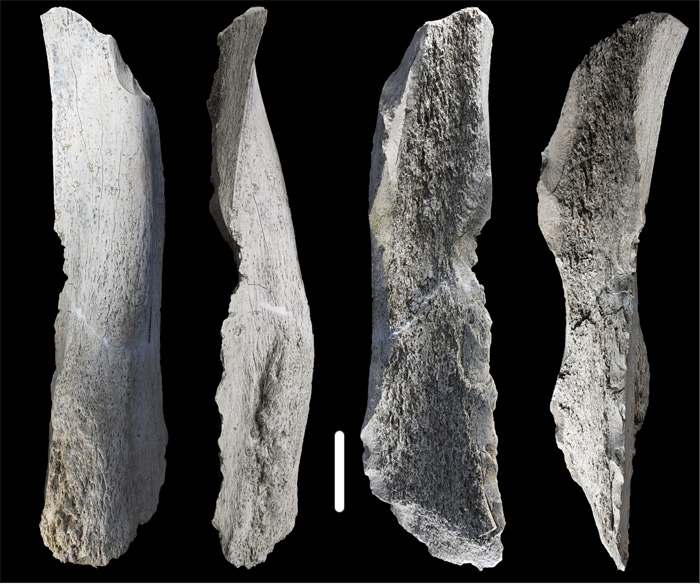
‘Front, back and side’ views of a 1.5 Ma old tool made from an elephant humerus – its upper foreleg. The scale bar represents 5 cm. (Credit: de la Torre et al.; Fig 3a)

Bifacial Acheulean stone artefacts first appear in the rock record about 300 ka before these bone tools were made. So one idea that the authors put forward is that the same kind of stone knapping technique was transferred to the more abundant massive bones of the East African Pleistocene megafauna (in the absence or rarity of suitable blocks of stone?). But it remains unclear whether or not such tools were simply selected from very large bones smashed to get at their nutritious marrow. The first possibility implies a cultural shift, whereas the latter points simply to expedience. The authors are at pains to point out that the curious million-year gap in the record of bone tools may be ascribed either to the disappearance of bone technology or simply to archaeologists who worked elsewhere having not regarding bone fragments as the products of skills. That applies equally to earlier times, when bones were indeed used, though with not so much in the way of a ‘mental template’. As de la Torre et al. conclude ‘Future research needs to investigate whether similar bone tools were already produced in earlier times, persisted during the Acheulean and eventually evolved into Middle Pleistocene bone bifaces similar in shape, size and technology to their stone counterparts’.

Early origins of meat and two veg

Barbecue chef at festival
(Photo credit: Wikipedia)

When and how humans acquired fire on demand and began to cook has long engaged story tellers and historians. Entertaining tales are those of the titan Prometheus, who stole fire from  Zeus and then had his liver eaten by  an eagle (http://en.wikipedia.org/wiki/Prometheus ), and of Bo-bo, who accidentally discovered the barbecue approach to the meat of pigs (http://www.amazingribs.com/BBQ_articles/dissertation_on_roast_pork.html). Despite the secretive pleasures of some French and Ethiopian gourmets, raw flesh is not widely appreciated, although a rare steak comes pretty close. There is nothing wrong with it apart from its usually being tough and prone to deliver spectacular evacuations. Cooking  unfolds the proteins in meat making them easier to digest and therefore portions of cooked meat deliver higher nutrition than they would direct from the carcase. Likewise, cooking some vegetables, especially various tubers, breaks down their chemistry to more easily digested and more palatable materials: think ‘potato’ in this context. In fact many potentially nutritious tubers are positively toxic if not processed and cooked, classic examples being cassava and wild yams.

While some anthropologists consider a change in hominin habits to eating meat per se, probably originally as carrion, as the necessary step to a leap in nutrition from which an enlarged brain developed, others favour the harnessing of fire and the invention of cooking that released greater proportions of proteins and carbohydrates from available foodstuffs. Since hominins evolved in distinctly seasonal savannas and open woodland, the shortage of game and directly edible above-ground plant parts in the dry season suggests indirectly that our early ancestors had two possible survival paths open to them: powerful jaws and complex digestive tracts to survive on woody stems or digging up tubers. Respectively, the anatomy and tooth-wear patterns of paranthropoids and early Homo to some extent support such a dichotomy that arose from the australopithecines after about 2 Ma ago. Both succeeded and cohabited roughly the same ranges in eastern Africa for as long as a million years.

So pinning down the origin of controlled use of fire is a major goal of Pleistocene archaeology to settle the issue of nutrition and brain growth. Also, it would help explain how hominins were able to diffuse far beyond their home ranges to northern latitudes sufficiently high to place fire as an essential source of warmth at night and in winters. Yet, evidence for habitual use of fire is younger than 400 thousand years among H. heidelbergensis, H. neanderthalensis and H. sapiens, literally leaving the wide roaming H. erectus to shiver as far as scientific proof of hearth and home is concerned. There have been claims of early charring, burnt bones and ashes but until recently such evidence has been ambiguous, largely because fire can start easily and naturally in tinder-rich conditions. There are now, however, advanced microscopic, chemical and physical techniques for estimating temperatures to which bones have been subjected and detecting changes in materials caused by fire, which can be applied to minute samples from sites once occupied by earlier people. One test site for the methods has been the Wonderwerk Cave in South Africa  that is known from Acheulean tools and cut bone to have been occupied as long ago as 1.1 Ma. They gave a positive result for the use of fire by the earliest cave occupants (Berna, F, et al. 2012. Microstratigraphic evidence of in situ fire in the Acheulean strata of Wonderwerk Cave, Northern Cape province, South Africa.  Proceedings of the National Academy of Science USA, www.pnas.org/cgi/doi/10.1073/pnas.1117620109 – open access). The same methods had previously been used to establish controlled human use of fire around 400 ka in once occupied caves in Israel, but at Wonderwerk almost triple the age of earliest known use. But they have refuted similar claims from the famous Zhoukoudian site of ‘Peking Man’ (Asian H. erectus) (http://www.unesco.org/ext/field/beijing/whc/pkm-site.htm).

A useful adage is that ‘the absence of evidence is not evidence of absence’, and it is early days for the routine archaological use of micromorphology, Fourier transform infrared (FTIR) spectroscopy in the search for human embers. In drylands naturally started fires, either as a result of lightning or spontaneous combustion, are so common that hominins would have been well aware of them, their dangers and perhaps their advantages as regards a free barbecue. Possibly Bo-bo’s salivating at the aroma of roast pig from the wreckage of his father house that he had razed to the ground though sheer stupidity would have struck some early hominins as a useful connection between a lucky feast and the still glowing embers of a bush fire. With care, embers can survive for long enough to be carried and used to start controlled fire; a fact not lost on many surviving fully human foragers, and also kids on a South Yorkshire council estate eager for the delights of roasting some ‘borrowed’ potatoes.