Reconstruction of H. erectus face. Image via Wikipedia
The elegant pear-shaped, double edged tool, known as the Acheulean ‘hand-axe’ is an icon for the distant past of humans. It appears in the record as a sharp contrast to the earlier crude cutting tools made of broken and sharpened pebbles, known generally as Oldowan, that around 2.5 Ma marked the appearance of some hominin species with the wit to exploit the inorganic world and begin manufacture. There can be little doubt that the visualisation of a useful shape within a formless block of stone and the dexterity to realise it as a tool marked a major change in human cognitive ability.
Friedrich Engels’s notion in The Part Played by Labour in the Transition from Ape to Man (1876), encouraged by Darwin’s The Descent of Man(1871),that the road to modern humans began with walking on two legs, thereby freeing the hands for work and tool making has been central to discussion of human evolution for more than a century. The ‘descent from the trees’ that bipedalism signifies has long been supposed to stem from the replacement of tropical forests in East Africa by open woodland or savannah, but evidence to support that environmental change has been difficult to glean from the fossil record since the Late Miocene. Even in terrestrial sediments plant remains are rare, so that much has rested on animal fossils in relation to the habitats of their living descendants: opinion is divided.
There is a round-about means of resolving this central issue: using the carbon-isotope record in fossil soils that depends on the fractionation effects of broadly different kinds of plants that once grew in the soils and the signature of that fractionation in carbonate nodules that formed in the soils. The d13C value (crudely the difference between the 13C/12C ratio of a sample and that of a carbon-rich standard) found in C4 plants (many grasses) is -16 to -10 ‰ whereas that in C3 plants (including almost all trees) it is much more depleted in the heavier 13C isotope (-33 to -24‰). Exchange of carbon between living and dead organic matter, and carbonates that are precipitated from soil waters through the intermediary of gases in the soil should leave a d13C signature in the carbonates that reflects the overall proportions of different photosynthetic plant groups living at the time the soil formed. The approach was developed in the early 1990s by Thure Cerling and Jay Quade of the US universities of Utah and Arizona respectively.
After a long gestation period, involving calibration using soils from different modern ecosystems, the soil C-isotope method has been applied painstakingly to palaeosols in which African hominin remains have turned-up (Cerling, T.E. and 9 others 2011. Woody cover and hominin environments in the past 6 million years. Nature, v. 476, p. 51-56). All the famous hominin sites from the Awash and Omo Valleys of Ethiopia and around Lake Turkana in Kenya, figure in this important study, in which the authors devise a proxy for ‘palaeo-shade’ based on their carbonate d13C data from 76 modern tropical soils: a good ‘straight-line’ plot of d13C against the fraction of woody cover at the different calibration sites. Applying the proxy to their 1300 samples of palaeosols they show convincingly that since about 6 Ma tree cover rarely rose above 40% in the homelands of all the East African hominins. From the times of Ardepithecus ramidus (~4 Ma) at Aramis in Ethiopia, through those of ‘Selam’ and ‘Lucy’, the 2.5 Ma first stone tools at Gona, the times when Africa was dominated by Homo erectus(1.8 to 1 Ma) to perhaps the first signs of modern human cranial remains (those with chins!) around 1 Ma, all hominins strode through open, grassy environments. One can imagine pleasured nods from the shades of Darwin and Engels now their prescience has finally been confirmed.
Australopithecus africanus from Sterkfontein cave, South Africa. Image via Wikipedia
Strontium isotopes and australopithecine habits
Viewers of Channel 4’s Time Team will be used to seeing eating habits and places of habitation being derived from strontium isotopic analyses of the teeth of modern humans found by archaeologists. The methods enabled scientists to work out where ‘Ötzi the Iceman’, whose mummified remains were found on the alpine border of Austria and Italy, hailed from: it was most likely to have been the South Tyrol province of Italy. Other isotopes (nitrogen and carbon) shows that he was predominantly vegetarian; i.e. he was neither a hunter, nor an especially privileged member of Tyrolean Chalcolithic society.
The same methods offer insights into the life styles of far earlier hominins and has recently been used on teeth of australopithecines (Australopithecus africanusandParanthropus robustus) found in the famous Sterkfontein and Swartkrans caves South Africa (Copeland, S.R. et al. 2011. Strontium isotope evidence for landscape use by early hominins. Nature, v. 474, p. 76-78). The caves formed in Precambrian dolomites and it was expected that all the teeth would show signs that the individuals from whose jaws they were collected lived their entire lives in a small tract of dolomites (~30 km2) surrounding the caves. For large individuals that was indeed the case, but teeth from smaller fossils show 87Sr/86Sr ratios that are significantly different from those characteristic of local rocks and soils. That suggests the smaller individuals came from further afield than the restricted tract of carbonate strata. Although pelvic remains are normally the best guide to the sex of primate fossils, they are less frequently found than those of crania and dentition. Size variations of adults in a primate species, however, may indicate sexual dimorphism – larger males than females – and this is well-accepted for australopithecines. The implication is that for both species males had small home ranges on the dolomites, or that they preferred that tract. Yet females had dispersed from their parental groups and moved into the area.
Most living primates do not show this kind of sexual dispersion pattern, termed male philopatry, it being common among modern humans, chimpanzees and bonobos. In the case of the australopithecines that were being studied, both were diminutive creatures living in open savannah with risks of predation from a range of large carnivores. Perhaps the bands living in the dolomite area had better refuges in caves than those elsewhere, and therefore able to attract females.
Arctic Neanderthals
A Mousterian stone point, possibly for a spear. Image via Wikipedia
The last Neanderthals known to have been alive were close to the southernmost limit of Europe, in caves on the Rock of Gibraltar at about 24 ka, shortly before the last glacial maximum. Their remains have been found in a >6000 km west-east zone at temperate latitudes, south of 50°N, which extended from western Europe to the Denisova cave in the Altai republic of Russia (50°N, 87°E). This suggests that they subsisted in deciduous woodland and temperate steppe, diffusing southwards as conditions cooled during 2 or 3 past glacial periods. Consequently, sites at higher northern latitudes that preserve only cultural remains – Palaeolithic tools – have hitherto been regarded as signs of fully modern human occupation; it takes considerable skill to distinguish Neanderthal from early modern human artefacts, which are very similar during the time of overlapping occupation (~40-30 ka). A site in northern Siberia at Byzovaya in the Polar Urals, close to the Arctic circle, is a case in point. A French, Norwegian and Russian team of archaeologists re-examined the site (Slimak, L. et al. 2011. Late Mousterian persistence near the Arctic Circle. Science, v. 332, p. 841-845) and dated it to between 31-34 ka. They also analysed a suite of stone tools, finding that they are directly comparable with Mousterian (Middle Palaeolithic) implements from western Europe rather than products of modern human’s industry of similar antiquity. At that time high-latitude climate was well on its way to frigid, dry conditions (there were no substantial continental ice sheets in northern Russia). The animal remains found at the site were dominated by those of mammoth, with minor proportions of other cold-steppe large mammals, such as woolly rhino, musk ox, horse and bear.
A notable feature of the results is that they suggest that Neanderthals, or others people with a Mousterian culture, were occupying this bleak terrain at roughly the same time as modern humans, who left considerably richer suites of artefacts, including tools, ornaments and figurines carved from bone and ivory, but were after more or less the same prey species. Both groups clearly were able to cope with and thrive on the harsh conditions, until recently only within the scope of highly specialised cultures such as the Innuit and original Siberian peoples. The dating shows that whoever produced and used the Mousterian tools not only shared the terrane with modern humans, but lingered until well after the previously accepted time (~37 ka) of the Neanderthals’ demise except for a few refuges in the Iberian Peninsula and Balkans. Despite the occupation of northern Siberia by different cultural groups, until their bones are found who they were is not certain. Denisova Cave showed that Neanderthals and the genetically different Denisovans co-occupied temperate central Siberia (see Other rich hominin pickings in the May 2010 issue of EPN) so there are currently two options.
For decades palaeoanthropologists studying the Americas were dominated by a single idea; that nobody entered the continents before those people who used the elegant fluted spear blades first found near Clovis, New Mexico in the 1930s. These were eventually dated at a maximum age of around 13 ka before the present. One reason for accepting the Clovis people as the first Americans, apart from the lack of conclusive evidence for any earlier occupation, was the fact that glaciers blocked the route from the Bering land bridge of the last Ice age until about 13 ka. But migration may have been possible as far back as 30 ka along the Pacific coast after people crossed the Beringia flatlands exposed by fallen sea-level . There have been suggestions of pre-Clovis sites, but none have carried the weight of evidence to shift the majority from their position. This now has to change because of very high-quality evidence from a site in Texas (Waters, M.R.and 12 others 2011. The Buttermilk Creek complex and the origins of Clovis at the Debra L. Friedkin site, Texas. Science, v. 331, p. 1599-1603). The site in question is in sediments that lie beneath those containing Clovis style tools. In fact it has yielded more than 15 thousand items that are well made, but bear little comparison with the iconic Clovis tools. Almost 50 optically stimulated luminescence (OSL, based on time of burial after exposure to sunlight) dates show a clear increase in age with depth in the excavations, some reaching back as far as 33 ka. The authors favour a conservative approach and restrict their estimated ages to those artefacts found in a well defined stratigraphic horizon, which span the range 13.2 to 15.5 ka. The Clovis-first case seems to be closed, but a new phase in North America aimed at pushing back the time of first human colonising will undoubtedly begin now.
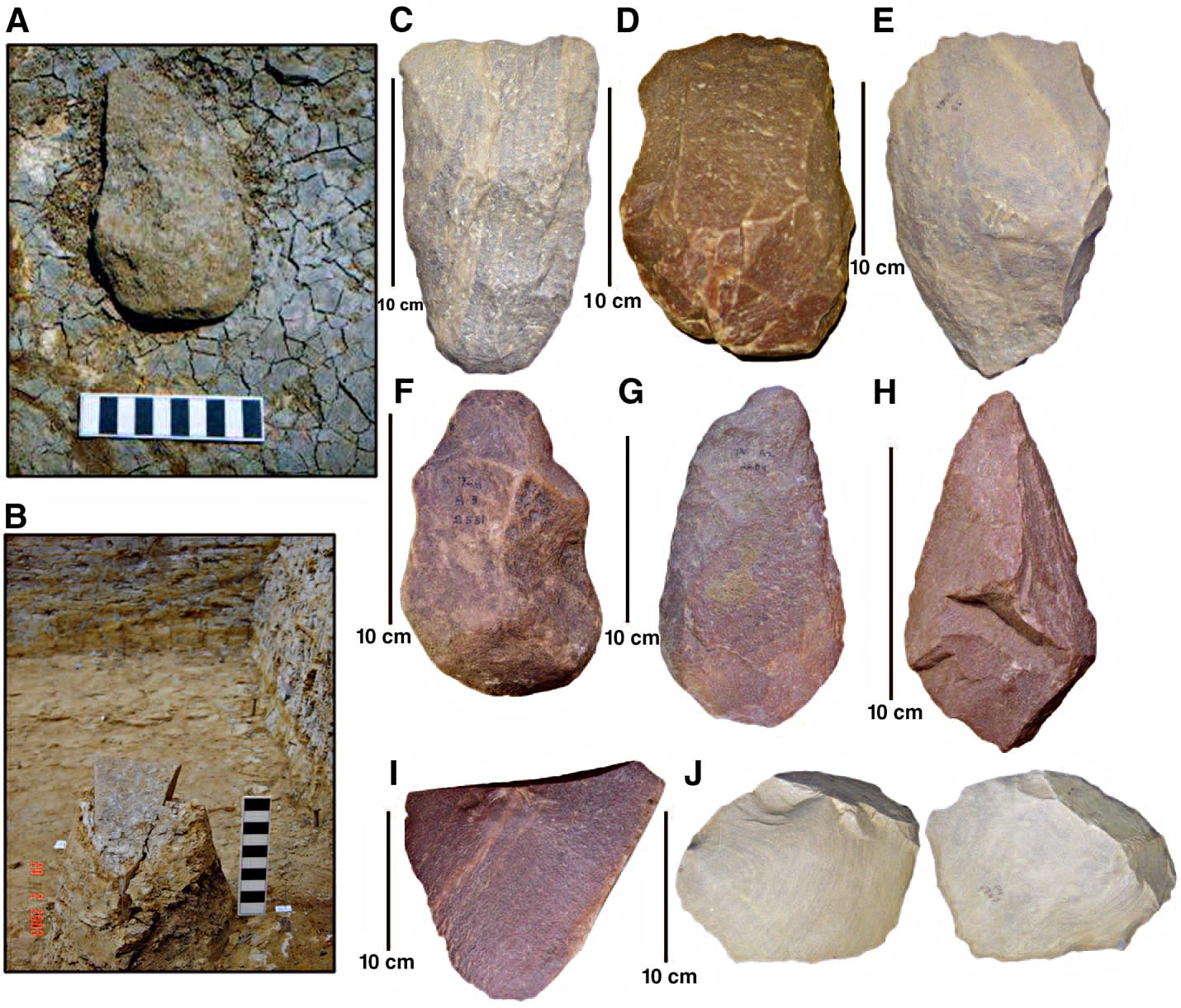
Assorted tools, including biface ‘hand axes, from Attirampakkam. Figure 2 Pappu et al 2011, with kind permission of the authors.
One of the most familiar icons of archaeology, the biface or Acheulean ‘hand axe’ was invented in Africa, presumably by H. ergaster, about 1.6 Ma ago and apart from in the Middle East, where it first occurs around 1.4 Ma, elsewhere it seemed to have been a late arrival in the artefact record. Human colonisation of Asia began as early as 1.8 Ma ago, so in its absence those early arrivals have been assumed not to have brought the Acheulean technology but used less elegant tools similar to the earliest Oldowan edged pebbles. Although parts of Asia were occupied by H. erectus until as recently as ~20 ka, they are believed not to have managed the biface breakthrough. It has been widely accepted that abundant biface tools in India date from about 500 ka ago, presumed to have been brought by H. heidelbergensis migrants.An object lesson in the way that new techniques rather than new archaeological sites can dramatically change such long-held notions has emerged from excavations at Attirampakkam about 30 km NW of Chennai (Madras) in South India (Pappu, S. et al. 2011. Early Pleistocene presence of Acheulian hominins in South India. Science, v. 331, p. 1596-1599). This was the site where Palaeolithic tools were first unearthed in the sub-continent by Robert Bruce Foote in 1863. The Indo-French research team used the cosmogenic isotope- and magnetostratigraphic dating methods to estimate when the tools were buried and discovered a much earlier age than expected, between 1.0 to 1.5 Ma. That throws into question the assumption of younger ages in general for the Acheulean technology in India, but more important, suggests that there was an eastward wave of migration from Africa shortly after the invention of biface tools. A wave of re-evaluation of the somewhat confusing Asian record of early humans seems on the cards.
See also: Dennell, R. 2011. Earlier Acheulian arrival in South Asia. Science, v. 331, p. 1532-1533
A widely accepted view of the departure from Africa of anatomically modern humans to colonise the rest of the habitable world is that it involved them crossing the Straits of Bab el Mandab in the southern Red Sea and following coastlines around Arabia and thence to the rest of Eurasia. That crossing would have become possible when sea level had fallen by more than 80m to expose much of the shelf between southern Eritrea and Yemen; a level that was reached during a glacial stadial from 60 to 70 ka as climate cooled erratically to reach the last glacial maximum. That hypothesis focused archaeologists on the narrow coastal fringe of Arabia in the search for remnants of human occupation. Indeed there have been discoveries of Palaeolithic stone tools in caves and rock shelters in southern and central Oman, and lately in the United Arab Emirates close to the Straits of Hormuz at the outlet of the Persian Gulf (Armitage, S.J. et al. 2011. The southern route ‘out of Africa’: evidence for an early expansion of modern humans into Arabia. Science, v. 331, p. 453-456). The trouble is that optically stimulated luminescence (OSL) dating of the UAE site (Jebel Faya) yielded ages of around 125, 95 and 40 ka for the tool-bearing layers; during the last (Eemian) interglacial, the early cooling in the succeeding glacial epoch and just before the last glacial maximum, respectively. For the two oldest ages sea level would have been high and the Bab el Mandab as wide as it is nowadays.
Armitage et al. focus on the stone tool kits at the site, finding them substantially different from any known Palaeolithic artifacts. The oldest tools are about the same age as those found at sites in the Levant (occupations at ~120 and 80 ka), but unlike them. The best match is with coeval tools from E and NE Africa. Accepting that view could point to a much earlier migration from Africa than currently accepted: probably during the previous glacial maximum (130-140 ka) as proposed by Armitage et al. when crossing the Red Sea would have been even easier because sea level had by then fallen 120 m. Alternatively, the anatomically modern human sites of the Levant may represent ‘waypoints’ along a northerly exodus. That has some geographic support as the narrow Nile flood plain would have provided continuous subsistence for gatherer hunters moving along it throughout even the most arid times. Yet before the hyperarid, and probably impassable desert would have separated the Levant from the Tigris Euphrates plains en route eastwards. Yet there is no evidence, other than their morphology, that the Jebel Faya tools were made by modern humans; skeletal remains are yet to be found and the tools could have been made by more archaic humans from a much earlier diaspora. Until tangible evidence of their association with anatomically modern humans emerges from Jebel Faya or other old Arabian sites, Neanderthals or, quite conceivably, H. erectus remain candidates. Perhaps, however, Jebel Faya presents a sign of a soon-to-come shift in ideas about human migration.
Morocco at the opposite side of the African continent also hosts a potentially revolutionizing discovery at the Grotte des Contrabandiers on the Atlantic coast (Balter, M. 2011. Was North Africa the launch pad for modern human migrations? Science, v. 331, p. 20-23). The cave revealed 108 ka remains of an 8 year-old child. Like other human fossils in Morocco and across North Africa, the child has much larger teeth than other contemporary Africans; a trait shared with some of the earliest anatomically modern human fossils outside the continent, including those found in the Levant. Merely following the Mediterranean coast would have brought migrants of this group into the Levant. Indeed there are old sites all along the Maghreb shore and in the Saharan interior that yield tool kits similar to those of the Grotte des Contrabandiers, which interestingly include triangular blades that may have been arrowheads or spear points. This surprisingly advanced culture, which also contains shell ornaments, has yielded ages up to 145ka. More archaic human remains on the Atlantic coast date to 160 ka suggest that modern-human occupation of North Africa may have been almost as prolonged as that of Ethiopia.
So, there are now two candidate groups of modern humans for populating the rest of the world: those of NE Africa (Nile to Levant and/or via Bab el Mandab to Yemen) and those of North Africa. Using records of past sea level and climate there is scope for hypothesizing multiple migrations. Since early migrants entered unknown territories they did not set out purposively to colonise them. But provided there were navigable and survivable routes simple diffusion could take people far and wide in radiometrically brief periods (order of 1-5 ka) as they followed similarly migrating prey species. As regards sea-level, it was low enough for the Bab el Mandab crossing (and that of the Straits of Hormuz) to be feasible during several stadials of the 240-130 ka glacial, and seashore resources would have sustained migrants hugging the coast during the aridity that accompanies low global mean surface temperatures. The desert stretching from northern Syria to Aqaba on the Red Sea, is passable now during periods of high rainfall, as it would have been during the Eemian interglacial. Yet there is every reason to believe it would have become far more arid in colder global climates; a major barrier to migration.
That humans reached India before crossing the Bab el Mandab was probably not feasible because of high sea level has been suggested from stone tools that occur below a 74 ka volcanic ash layer in Andhra Pradesh, India. The tools lie above sediments with a 77 ka date, and have Middle Palaeolithic characteristics, although that alone does not necessarily signify that they were made by modern humans. If they were then that suggests a route from the Levant eastwards. The search is on for anatomically human remains in Arabia and also in India, although whether they have been preserved in the acid tropical soils of southern India is less likely than in more arid regions.
See also: Petraglia, M.D. 2011. Trailblazers across Arabia. Nature, v. 470, p. 50-51
Anyone who has followed British TV series featuring the survival specialist Ray Mears will be well aware of the wealth of wild foods available from plants even in cold climes: Mears is famous for persuading his camera crews to try what he eats when ‘out bush’. Surviving gatherer-hunters, such as the native people of Australia, have encyclopaedic knowledge of what is edible and how to find plant victuals, and we can surmise that such skills date back to the earliest hominins. Neanderthals have been widely regarded as being exclusive meat eaters – the Innuit of Greenland can subsist on a meat- and fish-only diet, showing that it is a perfectly wholesome strategy – but new evidence reveals that they also ate a wide variety of vegetables, and cooked them. Neanderthals suffered from plaque (calculus) and that dental biofilm preserves traces of their diet (Henry, A. G. et al. 2010. Microfossils in calculus demonstrate consumption of plants and cooked foods in Neanderthal diets (Shanidar III, Iraq; Spy I and II, Belgium), Proceedings of the National Academy of Sciences, doi/10.1073/pnas.1016868108). Teeth from the famous Neanderthal sites of Shanidar in Iraq and Spy in Belgium had substantial plaque deposits. The authors found a wide variety of starch grains and silica-bearing hard parts that are characteristic of a wide range of plants (phytoliths) embedded in the plaques. Food plants included grasses, such as wild barley and sorghum; starchy roots, such as water lily; date palm, and a wide variety of starch grains and phytoliths that proved difficult to link to specific plants. Clearly, Neanderthals were not exclusively hunters of large and small game. The exclusively hunting hypothesis arose from analysis of fossilized fecal matter preserved with Neanderthal remains in occupation sites dating to the onset of frigid conditions in Europe, and in any case only shows what their producer’s last few meals contained. We can expect a closer look at teeth of other hominins from now on, as mineralized plaque is almost as indestructible as teeth themselves.
Neanderthals definitely did hunt, and evidence is that they were able regularly to bring down enormous beasts such as elephants and rhinoceroses. The question is, did they have to chase their prey animals so that they weakened through heat exhaustion before the kill, as in the case of the San hunters of SW Africa? To do that they would have had to be endurance runners. Comparing their ankle bones with those of modern humans suggests they were not very athletic in this way. (Raichlen, S.A. et al. 2011. Calcaneus length determines running economy: Implications for endurance running performance in modern humans and Neandertals. Journal of Human Evolution, v. 60, p. 299-308). Running well and keeping it up over long distances depends to a large extent on the efficiency of the Achilles tendon, the largest in the whole body: it literally puts a ‘spring in the step’ and couples muscle power to the role of feet in running. The calcaneus bone in the ankle provides leverage from the elastic storage of power in the Achilles, so its length is a guide to running efficiency. Neanderthals had a longer calcaneus than modern humans and probably had to spend considerably more muscular energy in keeping up with prey; they would have tired more quickly. The authors put this down to an evolutionary adaptation in cold climes to the lesser chance of prey animals succumbing to heat exhaustion. That would also perhaps explain evidence from other parts of Neanderthal skeletons for severe injuries, probably caused during hunting. They probably used ambush techniques and close-quarters stabbing with spears; a very risky strategy with unexhausted big game.
Interestingly, close on the heels of the Neanderthal Achilles tendon work a newly discovered foot bone of Australopithecus afarensis (Ward, C.V. et al. 2011. Complete fourth metatarsal and arches in the foot of Australopithecus afarensis. Science, v. 331, p. 750-753) shows that, like us, it had arches whereas modern apes do not. This seems to settle a lengthy debate about how australopithecines walked – they are long acknowledged to have been at least part bipedal. The 4th metatarsal is crucial: in apes its shape gives the flexibility needed to negotiate and grip branches, whilst in Homo sp. it endows the foot with the rigidity and stability to balance, absorb shock and use the toes efficiently in walking. This is pretty fundamental stuff en route to ‘proper’ humans, yet skull morphology dominates discussion of hominin anatomical relationships: the earliest tools (~3.4 Ma; see Another big surprise in EPN of September 2010) are a million years older than the earliest human, H. habilis. But they overlap in age with and occur in the same area as Australopithecus afarensis. So, should these beings actually be renamed H. afarensis?
Tantalising glimpses suggesting that Neanderthals were not brutes, such as possible shell jewellery, use of pigments and scattering of flowers at burials, has been accumulating for years. The latest has been unearthed from a cave in the north of Italy, in association with Levallois tools that are distinctive of Neanderthals (Peresani, M. et al. 2011. Late Neandertals and the intentional removal of feathers as evidenced from bird bone taphonomy at Fumane Cave 44 ky B.P., Italy. Proceedings of the National Academy of Sciences, doi:10.1073/pnas.1016212108). Wing bones of vultures, eagles, owls, crows and various other birds show grooves and scratches suggesting that the long flight feathers had been carefully removed: there isn’t much meat on a wing. Since fletched arrows are believed not to have been invented until much later times, it seems pretty certain that the feathers were aimed at personal adornment, or even clothing. The evidence is very convincing and so helps confirm earlier suspicions of feather-use from wing bones found at a variety of Neanderthal sites. Some hollow bird bones are also suspected of having been used as whistles. Given the recent genetic evidence of their sexual interaction with anatomically modern humans, gradual build-up of signs of a rich cultural life make the Neanderthals significantly more attractive than the famous view of geneticist Steve Jones in 1994 that ‘If you met an unwashed Cro Magnon dressed in a business suit on the Underground, you would probably change seats. If you met a similarly garbed Neanderthal, you would undoubtedly change trains’.
The notion that Neanderthals were dim and brutish compared with us continues to be undermined, but although their brain capacity was as large and in some cases distinctly larger than that of fully modern humans, its shape was significantly different; longer towards the rear than our more rounded brain. Studies of a Neanderthal baby and three children reveal that just after birth the Neanderthal brain was virtually identical to that of fully modern babies, i.e. elongate, but remains so in childhood through to maturity, whereas modern children’s brains develop towards the roundness of adults. Consequently, there must have been differences in the parts of the brain from which aspects of behaviour stem: Neanderthals almost certainly behaved differently from us both in childhood and as adults (Harvati, K. et al. 2010. Evolution of middle-late Pleistocene human cranio-facial form: a 3-D approach. Journal of Human Evolution, v. 59, p. 445-464. See also: Gibbons, A. 2010. Neandertal brain growth shows a head start for moderns. Science, v. 330, p. 900-901).
The now widely accepted hypothesis that modern humans did not begin to leave Africa to colonise Eurasia until about 60 ka may be under threat from reports of what seem to be fully modern human remains in China dated to ~105 ka (Liu, W. et al. 2010. Human remains from Zhirendong, South China, and modern human emergence in East Asia. Proceedings of the National Academy of the US, v. 107, p. 19201-19206). The dating appears to be sound, being based on the uranium-series (230Th) method applied to flowstone that rests on top of the sedimentary layer containing the remains in Zhirendong cave. The precipitated calcite layer completely sealed in the fossils as soon as it began to form about 105 ka ago, indicating that they are older still. Whether or not the remains are of fully modern humans is uncertain. Had they been found in Europe there would be little doubt about their affinities, the only other contemporary hominins being the Neanderthals. The problem in South China is that it was inhabited by H. erectus and the finds may be from ‘late’ members of that archaic species which arrived more than a million years earlier than fully modern humans. Judging by the DNA evidence for three interfertile hominin genetic groups cohabiting Eurasia, there is a host of possibilities for the Zhirendong fossils. One line of evidence that does not rule out that they are fully modern is the occurrence of stone tools more advanced than used by Asian H. erectus beneath the 74 ka Toba volcanic ash in India. It seems inevitable that these remains will be tried for DNA sequencing
See also: Dennell, R. 2010. Early Homo sapiens in China. Nature, v. 468, 512-513
It is well accepted that as with all forms of life the twists and turns in hominin evolution was surely tuned by changes in their environments. But that is not just linked to the immediate milieu of individuals: environments change on all scales up to that of the entire planet and reflect physical as well as biological processes. The largest scales are generally assumed to be the province of climate change, yet animals also occupy a landscape subject to geophysical forces such as tectonics and erosion. Geoffrey Bailey and Geoffrey King of the University of York, UK and the Institute de Physique du Globe in Paris, France have championed the view that water supplies and topography, for example, are just as influential over hominin evolution as interspecies competition and changing vegetation patterns for almost two decades. They have now put their ideas to rigorous tests (Bailey, G.N.& King, G.C., 2010 (in press) Dynamic landscapes and human dispersal patterns: Tectonics, coastlines, and the reconstruction of human habitats. Quaternary Science Reviews doi:10.1016/j.quascirev.2010.06.019). This fascinating and well illustrated paper correlates known hominin sites in Africa with variations in topography and its roughness, derived from global elevation data from the Shuttle Radar Topography Mission (SRTM), active seismicity, Neogene uplift and volcanicity.
Afar Depression: a cradle of human evolution
They concentrate on the rich palaeoanthropological pickings of the Afar Depression and the Sterkfontein area of South Africa, applying their ideas and findings to the eastern coast of the Red Sea at the recently discovered Palaeolithic site of Harat Al Birk south of Jeddah, and the Red Sea islands that would have been connected to either side of the Red Sea during the last glacial maximum because of a 130 m lower sea level. This application is vital for directing searches for new site that relate to the pathways out of Africa for early modern humans. Though a largely empirical study, it forms a link between human evolution and geological and landscape change that is not yet widely grasped and linked to climate studies.
See also: Marshall, M. 2010. Evolution by shake, rattle and roll. New Scientist, v. 208 (13 November 2010), p. 8-9.
The Pleistocene of East Anglia in England is a rich source of the high-latitude flora and fauna from early interglacials of the 1 Ma long series of 100 ka climate cycles. Eyed by archaeologists for decades as a potential source of human remains, a coastal site at Pakefield in Suffolk finally yielded stone tools in 2005 (see Earliest tourism in northern Europe in EPN January 2006). The enclosing sediments, to widespread excitement, turned out to be around 700 ka old, establishing the earliest known human colonisation at that latitude (52ºN). At that time East Anglia was connected to Europe during both glacial and interglacial periods, and was crossed by a now-vanished river system draining the Midlands and Wales into the proto-North Sea. Stone artifacts have now emerged from similar interglacial terrestrial sediments on the shore below the village of Happisburgh (pronounced ‘Haze-burra’) further north still, in Norfolk (Parfitt, S.A and 115 others 2010. Early Pleistocene human occupation at the edge of the boreal zone in northwest Europe. Nature, v. 466, p. 229-233). Magnetostratigraphy pushes back the human influence here to more than 800 ka, maybe as far back as 950 ka. As yet no human remains have been turned up, and the site is below high-tide level and liable to be destroyed by winter storms so work proceeds as fast as possible. Yet cliff erosion will inevitably reveal new material each spring.
Fauna and flora from Happisburgh indicate a slow flowing river flanked by coniferous forest with grassed clearings. Beetle fossils suggest summer temperatures slightly warmer than those in modern southern Britain, but with winters some 3ºC colder than now. The climate was analogous to that in southern Norway today, at the transition from temperate to boreal vegetation zones; certainly tough in winter for people without shelter. Yet the permanent connection with continental Europe would have permitted easy seasonal migration across great plains that extended to warmer southern climes. The tool-using people were not the earliest Europeans, for several archaeological sites in Spain, southern France and Italy extend back to 1.3 Ma. Who or rather what hominin species they were needs bones, preferably those of the head. The discovery that there were at least 4 hominin species cohabiting Eurasia during the last glacial epoch encourages caution in any speculation.
See also: Roberts, A.P. & Grűn, R. 2010. Early human northerners. Nature, v. 466, p. 189-190.
Increasingly, hominins have survived swings of climate by their wits and by chance. Neither underpin the instinct to migrate when times are hard, but where one ends up depended, until the Holocene, more on chance than design. Early migrations must have been more by diffusion than purposeful, especially in the vastness of the African continent. Yet groups of hominins found their way into Eurasia several times and thrived there. Far more of them would have met the coast far from a continental exit route, such as the Levant or the Straits of Bab el Mandab. However, in stressful glacial episodes reaching the coast was a key to survival as its food resources are almost limitless (see Human migration and sea food May 2000 issue of EPN). Our own species found refuge by the sea not long after we originated (Marean, C.W. 2010. When the sea saved humanity. Scientific American, v. 303 (August 2010), p. 40-47). Around 195 ka climate began to cool and dry to reach a glacial maximum at roughly 123 ka. Curtis Marean (Arizona State University, USA) was one of the first scientists to look for signs of coastal refuges in Africa during the early 1990s, particularly at its southern tip. With co-workers he found several caves on the coast of South Africa that yielded the evidence on which he has based a review of littoral survival opportunities and the skills that we developed. This particular coastal stretch has a huge diversity of plant life, most unique to it, and many of which store carbohydrate in tubers, bulbs and corms. They are adapted to dry conditions and need only the simplest technology – digging sticks and fires for cooking – to exploit starchy, easily digested energy resources, along with the more obvious animal protein sources present on all shorelines. Marean’s review puts in plain language all the discoveries made by his group over the last 20 years, including evidence of the use of fire treatment to improve flaked stone tools and the development of art based on iron-oxide pigments, plus his own take on their anthropological significance.




 Earth-logs