Volcanism and sea level fall

Most volcanic activity stems from the rise of hot, deep rock, usually within the mantle. Pressure suppresses partial melting, so as hot rock rises the greater the chance that it will begin to melt without any rise in its temperature. That is the reason why mantle plumes are associated with many volcanic centres within plates. Extension at oceanic ridges allows upper mantle to rise in linear belts below rift systems giving rise to shallow partial melting, mid-ocean ridge basalts and sea-floor spreading. These aren’t the only processes that can reduce pressure to induce such decompression melting; any means of uplift will do, provided the rate of uplift exceeds the rate of cooling at depth. As well as tectonic uplift and erosion, melting of thick ice sheets and major falls in sea level may result in unloading of the lithosphere.

During Messinian Stage of the late Miocene up to 3 km of evaporitic salt was deposited in the deepest parts of the Mediterranean Basin. One mechanism might have been faster evaporation of seawater than its resupply from the Atlantic through the Straits of Gibraltar, similar to the way in which salts is deposited below the Dead Sea. But the salt layer beneath the modern Mediterranean Sea bed has interleaved riverine sediments containing fossils of land plants. The Straits had closed and the Mediterranean Sea evaporated away. From about 6 to 5.3 Ma ago sea level fell by 3 to 5 km, only returning to normal when the Straits reopened to launch the huge Zanclean flood, with which the Pliocene of southern Europe and North Africa commenced. A team from the Universities of Geneva, Orleans and Paris and the Instituto de Ciencias de la Tierra Jaume Almera in Barcelona has tested the hypothesis that the Messinian Crisis affected volcanic activity in the area (Sternai, P. et al. 2017. Magmatic pulse driven by sea-level changes associated with the Messinian salinity crisis. Nature Geoscience, v. 10 online; doi:10.1038/ngeo3032).

From the record of salt precipitation, Pietro Sternai and colleagues, reckon that the main phase of unloading of the Mediterranean Basin began at around 5.6 Ma. Allowing for loading by the thick evaporites they calculated that the effect of the loss of water mass was equivalent to an unloading of 15 MPa in the deeper Eastern Mediterranean and 10 MPa in the west. Using standard pressure-temperature melting curves for the upper mantle, they then estimated that any magma chambers affected by the decrease in pressure could yield up to 17% more melt. Radiometrically dated lavas and igneous dykes within the Mediterranean region became more frequent and the number of events more than doubled during the time of main salt deposition.

https://upload.wikimedia.org/wikipedia/commons/thumb/6/64/DenglerSW-Stromboli-20040928-1230x800.jpg/1200px-DenglerSW-Stromboli-20040928-1230x800.jpg
Stromboli, one of the most active volcanoes in the Mediterranean Basin (credit: Wikipedia)

In May 2017 a study of subglacial volcanoes in West Antarctica based on radar mapping of the solid surface identified 138, 91 of them previously unknown (van Wyk de Vries et al. 2017. A new volcanic province: an inventory of subglacial volcanoes in West Antarctica.  Geological Society, London, Special Publication 461) They lie within a buried rift system and are covered by thick ice. Only one volcano in Antarctica is known to be active, Erebus, which is part of the cluster. Most of the news items stemming from the publication mentioned the possibility that the buried volcanic tract could be adding to the instability of the West Antarctic Ice Sheet through heating up its base. The WAIS is the ice sheet most feared to collapse seawards leading to a rise of about 3 m in global sea level. If the 2 km thick WAIS did slide off its underlying crust it might possibly trigger reactivation of the volcanic cluster.

Neanderthal development

Despite the lingering public image that Neanderthals were not as bright as fully modern humans some had significantly larger brains than we do, albeit with most of the difference being in the rear part of the brain region. So they may have had different powers, such as enhanced vision and awareness of position (proprioception). Because there are few cranial fossils of immature Neanderthals and, for them, little evidence of ages, not much is known about how they developed from birth. A common assumption has been that because their brain was larger post-natal development much have been faster than in modern humans. Set against our slow post-natal development and the faster pace in chimpanzees this assumption has been used in support of limited Neanderthal cognitive abilities.

The El Sidron Neanderthal boy, including a reconstruction of his skull and brain cast. (credit: Antonio Rosas, Museo Nacional de Ciencias Naturales, Madrid, Spain)

The El Sidron cave in Asturias region of northern Spain has yielded fossil remains of a dozen Neanderthals dated at between 49 and 37 ka, the time when anatomically modern humans were also present in Europe. They are among the best studied examples of this human group. Three were of boys, the best preserved of whom is estimated to have died at 7.7 years old from analysis of his dental development (Rosas, A. and 10 others 2017. The growth pattern of Neandertals, reconstructed from a juvenile skeleton from El Sidrón (Spain). Science, v. 357, p. 1282-1287; doi:10.1126/science.aan6463) Analysis of signs of the maturation stage that he had reached, including that of his brain, show no fundamental difference from modern human juveniles in his overall pace of growth. Other workers have found that a similarly aged Homo erectus boy from Kenya had indeed developed more quickly than modern human juveniles.

It’s not much to go on, but the El Sidron boy supports the view that Neanderthals were not much different from us.

You can find more information on migration of modern humans here.

Ancient footprints

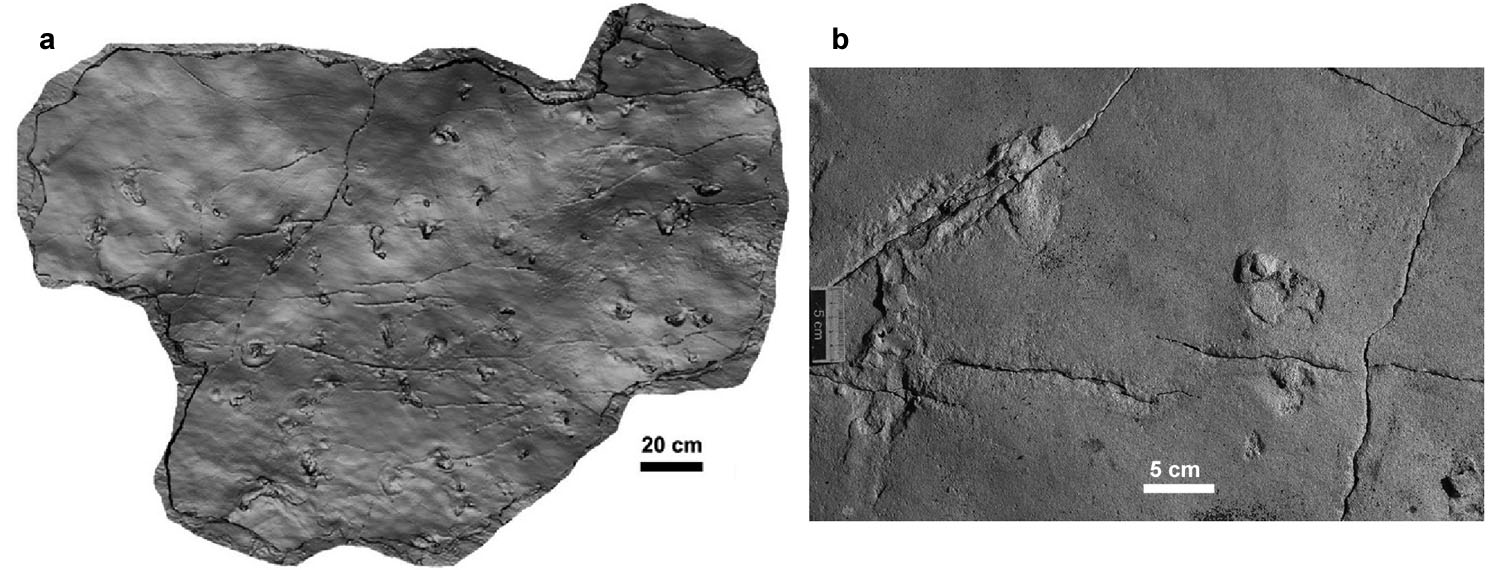
To see traces of where our forebears walked, such as the famous Australopithecus afarensis trackway at Laetoli in Tanzania, the footprints of Neanderthal children in 350 ka old Italian volcanic ash (The first volcanologists? Earth Pages March 2003) or even those of Mesolithic families in estuarine mud is about as heart stopping as it gets for a geologist. But imagine the astonishment of members of a multinational team working on Miocene shore-line sediments on Crete when they came upon a bedding surface covered with what are almost certainly the footprints of another bipedal animal from 5.7 Ma ago (Gierliński, G.D. et al. 2017. Possible hominin footprints from the late Miocene (c. 5.7 Ma) of Crete? Proceedings of the Geologists’ Association, online; https://doi.org/10.1016/j.pgeola.2017.07.006). Trackways preserve a few moments in time, however old they are and the chances of their being preserved are very small, yet they can supply information that is lost from even the best preserved fossil, such as gait, weight, speed and so forth.

Untitled-4
Track bearing surface; (b) two footprints in 5.7 Ma old Miocene sediments at Trachilos, Crete (credit: Gierliński, G.D. et al. 2017; Figures 2 and 8)

The tracks clearly indicate that whatever left them was bipedal and lacked claws, and closely resemble those attributed to A. afarensis at Laetoli in a 3.7 Ma old volcanic ash. What they do not resemble closely are those of non-hominin modern primates, such as chimpanzees. They are diminutive compared with adult modern human prints, being about 12.5 cm long (equivalent to a UK child’ shoe size 4 – US size 4.5, EU 20) and about a third to half the size of those at Laetoli. Were they around the age of those at Laetoli or younger there seems little doubt that they would be widely interpreted as being of hominin origin. But being from an island in the Mediterranean as well as far from sites in Africa that have yielded Miocene hominins (Ardipithecus kadabba from Ethiopia, Orrorin from Kenya and Sahelanthropus from Chad),  such an interpretation is bound to create controversy. Somewhat less controversial might be to regard them as having been created by a late-Miocene primate that convergently evolved a hominin-like upright gait and foot. Being preserved in what seem to be coastal marine sediments, there is probably little chance of body fossils being preserved in the exposed horizon. Since foot bones are so fragile, even if a primate fossil is discovered in the late Miocene of Crete the chances of resolving the issue are pretty remote. Yet fossil primate specialists will undoubtedly beat a well-trodden path to the Trachilos site near Kissamos on Crete

Wildfires and climate at the K-Pg boundary

It is now certain that the Cretaceous-Palaeogene boundary 66 Ma ago coincided with the impact of a ~10 km diameter asteroid that produced the infamous Chicxulub crater north of Mexico’s Yucatán peninsula. Whether or not this was the trigger for the mass extinction of marine and terrestrial fauna and flora – the flood basalts of the Deccan Traps are still very much in the frame – the worldwide ejecta layer from Chicxulub coincides exactly with the boundary that separates the Mesozoic and Cenozoic Eras. As well as shocked quartz grains, anomalously high iridium concentrations and glass spherules the boundary layer contains abundant elemental carbon, which has been widely ascribed to soot released by vegetation that went up in flames on a massive scale. Atmospheric oxygen levels in the late Cretaceous were a little lower than those at present, or so recent estimates from carbon isotopes in Mesozoic to Recent ambers suggest (Tappert, R. et al. 2013. Stable carbon isotopes of C3 plant resins and ambers record changes in atmospheric oxygen since the Triassic. Geochimica et Cosmochimica Acta, v. 121, p. 240-262,) – other estimates put the level substantially above that in modern air. Whatever, global wildfires occurred within the time taken for the Chicxulub ejecta to settle from the atmosphere; probably a few years. It has been estimated that about 700 billion tonnes of soot were laid down, suggesting that most of the Cretaceous terrestrial biomass and even a high proportion of that in soils literally went up in smoke.

Charles Bardeen and colleagues at the University of Colorado, Boulder, have modelled the climatic and chemical effects of this aspect of the catastrophe (Bardeen, C.G. et al. 2017. On transient climate change at the Cretaceous−Paleogene boundary due to atmospheric soot injections. Proceedings of the National Academy of Sciences; doi:10.1073/pnas.1708980114). Despite the associated release of massive amounts of CO2 and water vapour by both the burning and the impact into seawater, giving increased impetus to the greenhouse effect, the study suggests that fine-grained soot would have lingered as an all enveloping pall in the stratosphere. Sunlight would have been blocked for over a year so that no photosynthesis would have been possible on land or in the upper ocean, the temperatures of the continent and ocean surfaces would have dropped by as much as 28 and 11 °C respectively to cause freezing temperatures at mid-latitudes. Moreover, absorption of solar radiation by the stratospheric soot layer would have increased the temperature of the upper atmosphere by several hundred degrees to destroy the ozone layer. Consequently, once the soot cleared the surface would have had a high ultraviolet irradiation for around a year.

The main implication of the modelling is a collapse in both green terrestrial vegetation and oceanic phytoplankton; most of the food chain would have been absent for long enough to wipe out those animals that depended on it entirely. While an enhanced greenhouse effect and increased acidification of the upper ocean through CO2 emissions by the Deccan flood volcanism would have placed gradually increasing and perhaps episodic stresses on the biosphere, the outcome of the Chicxulub impact would have been immediate and terrible.

More on mass extinctions and impacts here and here