Perhaps the most evocative traces of our ancestors are their footprints preserved in once soft muds or silts, none more so than the 3.6 Ma old hominin trackway at Laetoli in Tanzania, discovered by Mary Leakey and colleagues in 1978. Such records of living beings’ activities are by no means vanishingly rare. In 2003 footprints of Neanderthal children emerged in volcanic ash that had formed on the slopes of an Italian volcano. The fact that the tracks zig-zagged and included handprints seemed to suggest that the children were playing on a tempting slope of soft sediment, much as they do today (see The first volcanologists? and Walking with the ancestors). The muddy sediments of the Severn and Mersey estuaries in England yield younger footprints of anatomically modern humans of all sizes every time tidal flows rip up the sedimentary layers. Now similar examples have been unearthed from 1.0 to 0.78 Ma old Pleistocene interglacial sediments at a coastal site in Norfolk, England, in which stone tools had been found in 2010 .
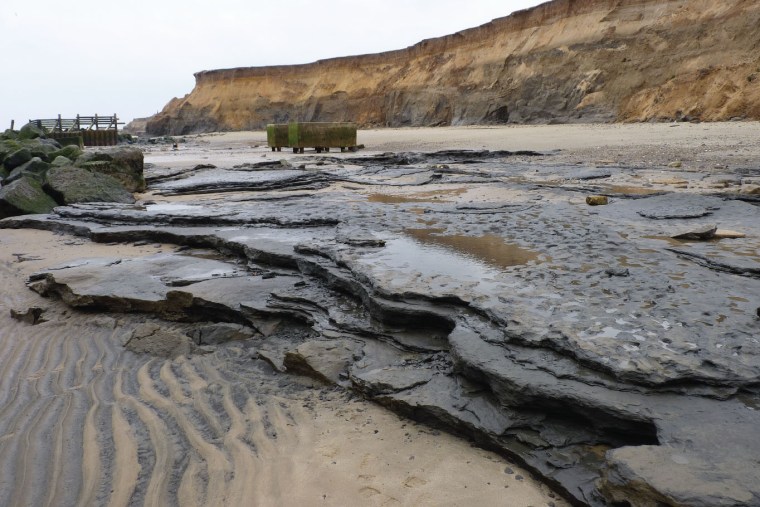
Coastal exposure of Pleistocene laminated sediments at Happisburgh; the top surface exposes the hominin trackway (credit: Ashton et al. 2014 PLOS1)
A team funded by the Pathways to Ancient Britain Project, involving scientists from a consortium of British museums and universities, rapidly conserved a 12 m2 surface of laminated sediments fortuitously exposed on the foreshore at Happisburgh (pronounced ‘Haze-burra’) by winter storms. It was covered in footprints (Ashton, N. and 11 others 2014. Hominin Footprints from Early Pleistocene Deposits at Happisburgh, UK. PLoS ONE v. 9: e88329. doi:10.1371/journal.pone.0088329). Analysis of the prints suggested a band of individuals who had tramped southwards across mudflats at the edge of an estuary. They were possibly members of an early human species, known as Homo antecessor, skeletal remains of whom are known from northern Spain. The Happisburgh individuals were of mixed size, probably including adults and juveniles: three footprint sets suggested 1.6 to 1.73 m stature; nine less than 1.4 m.
View from above of the well-trodden trackway at Happisburgh, with an enlarged example of one of the foot prints (credit: Ashton et al. 2014 PLoS1)
From pollen samples, East Anglia during the interglacial had a cool climate with pine, spruce, birch and alder tree cover with patches of heath and grassland. That it had attracted early humans to travel so far north from the Mediterranean climate where skeletal remains are found, suggests that food resources were at least adequate. It is hard to imagine the band having been seasonal visitors from warmer climes further south. They must have been hardy, and from the stone tools we know they were well equipped and capable of killing sizeable prey animals, bones of which marked by clear cut marks being good evidence for their hunting skills.
Note: Earth-Pages will be closing as of early July, but will continue in another form atEarth-logs
For many geoscientists and lay people the water cycle is considered to be part of the Earth’s surface system. That is, the cycle of evapotranspiration, precipitation and infiltration involving atmosphere, oceans, cryosphere, terrestrial hydrology and groundwater. Yet it links to the mantle through subduction of hydrated oceanic lithosphere and volcanism. The rate at which water vapour re-enters the surface part of the water cycle through volcanoes is reasonably well understood, but the same cannot be said about ‘recharge’ of the mantle through subduction.
The water cycle as visualised by the US Geological Survey (credit: Wikipedia)
Subducted oceanic crust is old, cold and wet: fundamentals of plate theory. The slab-pull that largely drives plate tectonics results from phase transitions in oceanic crust that are part and parcel of low-temperature – high-pressure metamorphism. They involve the growth of the anhydrous minerals garnet and high-pressure pyroxene that constitute eclogite, the dense form taken by basalt that causes the density of subducted lithosphere to exceed that of mantle peridotite and so to sink. This transformation drives water out of subducted lithosphere into the mantle wedge overlying a subduction zone, where it encourages partial melting to produce volatile-rich andesitic basalt magma – the primary magma of island- and continental-arc igneous activity. Thus, most water that does reenter the mantle probably resides in the ultramafic lithospheric mantle in the form of hydrated olivine, i.e. the mineral serpentine, and that is hard to judge.
Water probably gets into the mantle lithosphere when the lithosphere bends to begin its descent. That is believed to involve faults – cold lithosphere is brittle – down which water can diffuse to hydrate ultramafic rocks. So the amount of water probably depends on the number of such bend-related faults. A way of assessing the degree of such faulting and thus the proportion of serpentinite is analysis of seismic records from subduction zones. This has been done from earthquake records from the West Pacific subduction zone descending beneath northern Japan (Garth, T. & Rietbrock, A. 2014. Order of magnitude increase in subducted H2O due to hydrated normal faults within the Wadati-Bennioff zone. Geology, on-line publication doi:10.1130/G34730.1). The results suggest that between 17 to 31% of the subducted mantle there has been serpentinised.
In a million years each kilometre along the length of this subduction zone would therefore transfer between 170 to 318 billion tonnes of water into the mantle; an estimate more than ten times previous estimates. The authors observe that at such a rate a subduction zone equivalent to the existing, 3400 km long Kuril and Izu-Bonin arcs that affect Japan would have transferred sufficient water to fill the present world oceans 3.5 times over the history of the Earth. Had the entire rate of modern subduction along a length of 55 thousand kilometres been maintained over 4.5 billion years, the world’s oceans would have been recycled through the mantle once every 80 million years. To put that in perspective, since the Cretaceous Chalk of southern England began to be deposited, the entire mass of ocean water has been renewed. Moreover, subduction has probably slowed considerably through time, so the transfer of water would have been at a greater pace in the more distant past.
Remote sensing, including mapping of topographic elevation, and the recent exploits of three surface vehicles – the Spirit, Opportunity and Curiosity Rovers – have provided lots of data for a host of geological interpreters. Producing a time frame for Martian geological and geomorphological events has, understandably, been limited mainly to the use of stratigraphic principles. Various rock units and surface features can be placed in relative time order through simple stratigraphic principles, such as what sits on top of what and which features cut through pre-existing rock units or are masked by them. The most important guide up to now has been interpretation of the relations between impact craters and both rock units and other geomorphological features. The Inner Planets are assumed to have recorded the same variation through time of the frequency and energies of bombardment, and that has been calibrated to some extent by radiometric dating of impact-related rocks returned from the Moon by the crewed Apollo missions. Some detail of relative timings also emerge from some craters cutting earlier ones. The only other source of Martian ages has been from rare meteorites (there are only 114 of them) whose stable isotope compositions are different from those of terrestrial rocks and more common meteorites. By a process of elimination it is surmised that they were flung from Mars as a result of large impacts in the past to land eventually on Earth. The oldest of them date back to 4.5 Ga, much the same as the estimated age of the earliest crystallisation of magmas on Earth.
Colorised relief map of the western hemisphere of Mars, showing Valles Marineris at centre and the four largest volcanoes on the planet (credit: Wikipedia)
But all Martian stratigraphy is still pretty vague by comparison with that here, with only 4 time divisions based on reference to the lunar crater chronology and 3 based on evidence from detailed orbital spectroscopy and Rover data about the alteration of minerals on the Martian surface. Apart from meteorite dates there is very little knowledge of the earliest events, other than Mars must have had a solid, probably crystalline crust made of mainly anhydrous igneous minerals. This was the ‘target’ on which much of the impact record was impressed: by analogy with the Moon it probably spanned the period of the Late Heavy Bombardment from about 4.1 to 3.7 Ga, equivalent to the Eoarchaean on Earth. That period takes its name – Noachian – from Noachis Terra (‘land of Noah’), an intensely cratered, topographically high region of Mars’s southern hemisphere, whose name was given to this large area of high albedo by classical astronomers. Perhaps coincidentally, the Noachian provides the clearest evidence for the former presence of huge amounts of water on the surface of Mars and its erosional power that formed the gigantic Valles Marineris canyon system. The rocky surface that the craters punctured is imaginatively referred to as the pre-Noachian. A major episode of volcanic activity that formed Olympus Mons and other lava domes is named the Hesperian (another legacy of early astronomical nomenclature). It is vaguely ascribed to the period between 3.7 and 3.0 Ga, and followed by three billion years during which erosion and deposition under hyper-arid conditions formed smooth surfaces with very few craters and rare evidence for the influence of surface water and ice. It is named, inappropriately as it turns out, the Amazonian.
Remote sensing has provided evidence of episodes of mineral alteration. Clay minerals have been mapped on the pre-Noachian surface, suggesting that aqueous weathering occurred during the earliest times. Sulfates occur in exposed rocks of early Hesperian age, suggesting abundant atmospheric SO2 during this period of massive volcanicity. The last 3.5 billion years saw only the development of the surface iron oxides whose dominance led to Mars being nickname the ‘Red Planet’.
A ‘selfie’ of Curiosity Rover drilling in Gale Crater (credit: Euclid vanderKroew)
A recent paper (Farley, K.A. and 33 others plus the entire Mars Science Laboratory 2014. In Situ Radiometric and Exposure Age Dating of the Martian Surface. Science, v. 343, online publication DOI: 10.1126/science.1247166) suggests that radiometric ages can be measured ‘in the field’, as it were, by instruments carried by the Curiosity rover. How is that done? Curiosity carries a miniature mass spectrometer and other analytical devices. Drilling a rock surface produces a powder which is then heated to almost 900°C for half an hour to drive off all the gases present in the sample. The mass spectrometer can measure isotopes of noble gases, notably 40Ar, 36Ar, 21Ne and 3He. Together with potassium measured by an instrument akin to and XRF, the 40Ar yields a K-Ar age for the rock. A sample drilled from a fine-grained sedimentary in Gale Crater gave an age of 4.2 Ga, most likely that of the detrital feldspars derived from the ancient rocks that form the crater’s wall, rather than an age of sedimentation. The values for 36Ar, 21Ne and 3He provide a means for establishing how long the rock has been exposed at the surface: all three isotopes can be generated by cosmic-ray bombardment. The sample from Gale Crater gave an age of about 78 Ma that probably dates the eventual exposure of the rock by protracted wind erosion.
By themselves, these ages do not tell geologists a great deal about the history of Mars, but if Curiosity makes it through the higher levels of the sediments that once filled Gale Crater – and there is enough power to repeat the mass spectrometry at other levels – it could provide a benchmark for Noachian events. The exposure age, interesting in its own right, also suggests that sediments in the crater have not been exposed to cosmic-ray bombardment for long enough to have destroyed any organic materials that the science community longs for.



 Earth-logs