The prospect of climate chaos following major volcano eruptions

It hardly needs saying that volcanoes present a major hazard to people living in close proximity. The inhabitants of the Roman cities of Herculaneum and Pompeii in the shadow of Vesuvius were snuffed out by an incandescent pyroclastic during the 79 CE eruption of the volcano. Since December 2023 long-lasting eruptions from the Sundhnúksgígar crater row on the Reykjanes Penisula of Iceland have driven the inhabitants of nearby Grindavík from their homes, but no injuries or fatalities have been reported. Far worse was the 1815 eruption of Tambora on Sumbawa, Indonesia, when at least 71,000 people perished. But that event had much wider consequences, which lasted into 1817 at least. As well as an ash cloud the huge plume from Tambora injected 28 million tons of sulfur dioxide into the stratosphere. In the form of sulfuric acid aerosols, this reflected so much solar energy back into space that the Northern Hemisphere cooled by 1° C, making 1816 ‘the year without a summer’. Crop failures in Europe and North America doubled grain prices, leading to widespread social unrest and economic depression. That year also saw unusual weather in India culminate in a cholera outbreak, which spread to unleash the 1817 global pandemic. Tambora is implicated in a global death toll in the tens of millions. Thanks to the record of sulfur in Greenland ice cores it has proved possible to link past volcanic action to historic famines and epidemics, such as the Plague of Justinian in 541 CE. If they emit large amounts of sulfur gases volcanic eruptions can result in sudden global climatic downturns.

The ash plume towering above Pinatubo volcano in the Philippines on 12 June 1991, which rose to 40 km (Credit: Karin Jackson U.S. Air Force)

With this in mind Markus Stoffel, Christophe Corona and Scott St. George of the University of Geneva, Switzerland, CNRS, Grenoble France and global insurance brokers WTW, London, respectively, have published a Comment in Nature warning of this kind of global hazard (Stoffel, M., Corona, C. & St. George, S. 2024.  The next massive volcano eruption will cause climate chaos — we are unprepared. Nature v. 635, p. 286-289; DOI: 10.1038/d41586-024-03680-z). The crux of their argument is that there has been nothing approaching the scale of Tambora for the last two centuries. The 1991 eruption of Pinatubo fed the stratosphere with just over a quarter of Tambora’s complement of SO2, and decreased global temperatures by around 0.6°C during 1991-2. Should one so-called Decade Volcanoes – those located in densely populated areas, such as Vesuvius – erupt within the next five years actuaries at Lloyd’s of London estimate economic impacts of US$ 3 trillion in the first year and US$1.5 trillion over the following years. But that is based on just the local risk of ash falls, lava and pyroclastic flows, mud slides and lateral collapse, not global climatic effects. So, a Tambora-sized or larger event is not countenanced by the world’s most famous insurance underwriter: probably because its economic impact is incalculable. Yet the chances of such a repeat certainly are conceivable. A 60 ka record of sulfate in the Greenland ice cores allows the probability of eruptions on the scale of Tambora to be estimated. The data suggest that there is a one-in-six chance that one will occur somewhere during the 21st century, but not necessarily at a site judged by volcanologists to be precarious . Nobody expected the eruption from the Pacific Ocean floor of the Hunga Tonga-Hunga Ha’apai volcano on January 15, 2022: the largest in the last 30 years.

The authors insist that climate-changing eruptions now need to be viewed in the context of anthropogenic global warming. Superficially, it might seem that a few volcanic winters and years without a summer could be a welcome, albeit short-term, solution. However, Stoffel, Corona and St. George suggest that the interaction of a volcano-induced global cooling with climatic processes would probably be very complex. Global warming heats the lower atmosphere and cools the stratosphere. Such steady changes will affect the height to which explosive volcanic plumes may reach. Atmospheric circulation patterns are changing dramatically as the weather of 2024 seems to show. The same may be said for ocean currents that are changing as sea-surface temperatures increase. Superimposing volcano-induced cooling of the sea surface adds an element of chaos to what is already worrying. What if a volcanic winter coincided with an el Niño event? The Intergovernmental Panel on Climate Change that projects climate changes is ‘flying blind’ as regards volcanic cooling. Another issue is that our knowledge of the effects in 1815 of Tambora concerned a very different world from ours: a global population then that was eight times smaller than now; very different patterns of agriculture and habitation; a world with industrial production on a tiny proportion of the continental surface. Stoffel, Corona and St. George urge the IPCC to shed light on this major blind spot. Climate modellers need to explore the truly worst-case scenarios since a massive volcanic eruption is bound to happen one day. Unlike global warming from greenhouse-gas emission, there is absolutely nothing that can be done to avert another Tambora.

Water in unexpected places. 1: Atmosphere

As a liquid, solid or in gaseous form water is everywhere in the human environment: even in the driest deserts it rains at some time and they may become tangibly humid. Water vapour moves most quickly in the atmosphere because of continual circulation. But 99% of all the Earth’s gaseous water resides in the lowest part, the troposphere. In that layer temperature decreases upwards to around -70°C, reflected by the lapse rate, so that water vapour condenses out as liquid or ice at low altitudes in the tangible form of clouds. So as altitude increases the air becomes increasingly cold and dry until it reaches what is termed the tropopause, the boundary between the troposphere and the stratosphere. This lies at altitudes between 6 km at the poles and 18 km in the tropics. Higher still, counter intuitively, the stratospheric air temperature rises. This is due to the production of ozone (O3) as oxygen (O2) interacts with UV radiation. Ozone absorbs UV thereby heating the thin stratospheric air. The tropopause is therefore an efficient ‘cold trap’ for water vapour, thereby preventing Earth from losing its surface water. Any that does pass through rises to the outer stratosphere where solar radiation dissociates it into oxygen and hydrogen, the latter escaping to space. So for most of the time the stratosphere is effectively free of water.

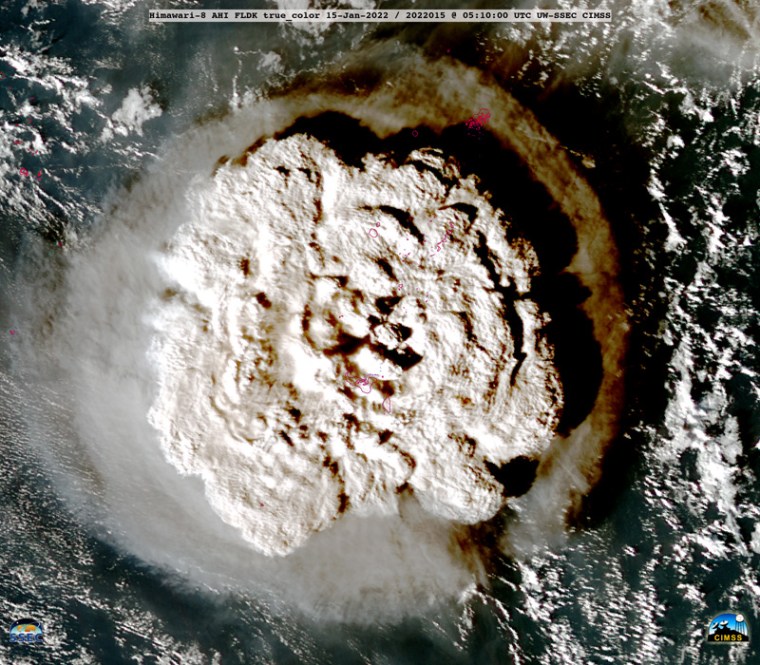
57 km high eruption plume and surrounding shock wave of Hunga Tonga-Hunga Ha’apai volcano one hour after explosion began on 15 January 2022: from the Himawari-8 satellite. The image is about 350 km across. Islands in red, the main island of Tonga being slightly to the south of the centre.

On 14 to 15 January 2022 the formerly shallow submarine Hunga Tonga-Hunga Ha’apai volcano in the Tonga archipelago of the South Pacific underwent an enormous explosive eruption (see an animation of the event captured by the Japanese weather satellite Himawari-8). The explosion was the largest in the atmosphere ever recorded by modern instruments, dwarfing even nuclear bomb tests, and the most powerful witnessed since that of Krakatoa in 1883. But, as regards global media coverage, it was a one-trick pony, trending for only a few days. It did launch tsunami waves that spanned the whole of the Pacific Ocean, but resulted in only 6 fatalities and 19 people injured. However, Hunga Tonga-Hunga Ha’apai managed to punch through the tropopause and in doing so, it changed the chemistry and dynamics of the stratosphere during the following year. A group of researchers from Harvard University and the University of Maryland used data from NASA’s Aura satellite to investigate changes in stratigraphic chemistry after the eruption (Wilmouth, D.M. et al. 2023. Impact of the Hunga Tonga volcanic eruption on stratospheric composition. Proceedings of the National Academy of Sciences, v. 120, article e23019941; DOI: 10.1073/pnas.2301994120). The Microwave Limb Sounder (MLS) carried by Aura measures thermal radiation emitted in the microwave region from the edge of the atmosphere, as revealed by Earth’s limb – seen at the horizon from a satellite. Microwave spectra from 0.12 to 2.5 mm in wavelength enable the concentrations of a variety of gases present in the atmosphere to be estimated along with temperature and pressure over a range of altitudes.

The team used MLS data for the months of February, April, September and December following the eruption to investigate its effects on the stratosphere n from 30°N to the South Pole. These data were compared with the averages over the previous 17 years. What emerged was a highly anomalous increase in the amount of water vapour between 0 and 30°S (the latitude band that includes the volcano) beginning in February 2022 and persisting until December 2023, the last dates of measurements. By April the peak showed up and persisted north of the Equator and at mid latitudes of the Southern Hemisphere and by December over Antarctica. It may well be present still. The estimated mass of water vapour that the eruption jetted into the stratosphere was of the order of 145 million tons along with about 0.4 million tons of SO2, the excess water helping accelerate the formation of highly reflective sulfate aerosols. Associated chemical changes were decreases in ozone (~ -14%) and HCl (~ -22%) and increases in ClO (>100%) and HNO3 (43%). Hunga Tonga-Hunga Ha’apai therefore changed the stratosphere’s chemistry and a variety of chemical reactions. As regards the resulting physical changes, extra water vapour together with additional sulfate aerosols should have had a cooling effect, leading to changes in its circulation with associated decrease in ozone in the Southern Hemisphere and increased ozone in the tropics. Up to now, the research has not attempted to match the chemical changes with climatic variations. The smaller 15 June 1991 eruption of Mount Pinatubo on the Philippine island of Luzon predated the possibility of detailed analysis of its chemical effects on the stratosphere. Nevertheless the material that is injected above the tropopause resulted in a global ‘volcanic winter’, and a ‘summer that wasn’t’ in the following year. The amount of sunlight reaching the surface fell by up to 10%, giving a 0.4 decrease in global mean temperature. Yet there seem to have been no media stories about such climate disruption in the aftermath of Hunga Tonga-Hunga Ha’apai. That is possibly because the most likely effect is a pulse of global warming in the midst of general alarm about greenhouse emissions, the climatically disruptive effect of the 2023 El Niño and record Northern Hemisphere temperature highs in the summer of 2023. Volcanic effects may be hidden in the welter of worrying data about anthropogenic global climate change.   David Wilmouth and colleagues hope to follow through with data from 2023 and beyond to track the movement of the anomalies, which are expected to persist for several more years. Their research is the first of its kind, so quite what its significance will be is hard to judge.