A ‘worm’ revolution and ecological transition before the Cambrian explosion

Bioturbated ‘pipe rock’ of the basal Cambrian sandstones of NW Scotland. Credit: British Geological Survey photograph P531881

About 530 Ma ago most of the basic body plans of today’s living organisms can be detected as fossils, i.e. preserved hard parts. Yet studies of trace fossils (ichnofossils) – marks left in sediments by active soft bodied creatures suggest that many modern phyla arose before the start of the Cambrian (~539 Ma), as early as 545 Ma. So the term ‘Cambrian explosion’ seems to be a bit of a misnomer on two counts: it lasted around 15 Ma and began before the Cambrian. Preceding it was the Ediacaran Period that began around 100 Ma earlier in the Neoproterozoic Era. Traces of its eponymous fauna of large soft-bodied organisms are found on all continents, but apparently none of them made it into the Phanerozoic fossil record. Another characteristic of the Ediacaran is that its sedimentary rocks – and those of earlier times – show no signs of burrowing: they are not bioturbated. That may be why the Ediacaran pancake-, bun-, bag- and pen-like lifeforms are so remarkably well preserved. But a lack of burrowing did not extend to the beginning of Cambrian times. The most likely reason why it was absent during the early Ediacaran Period is that sea-floor sediments then were devoid of oxygen so eukaryote animals could not live in them. But the presence of these large organisms showed that seawater must have been oxygenated. Now clear signs of burrowing have emerged from study of Ediacaran rocks exposed in the Yangtze Gorge of Hubei,southern China ( Zhe Chen & Yarong Liu 2025. Advent of three-dimensional sediment exploration reveals Ediacaran-Cambrian ecosystem transition. Science Advances, v. 11, article eadx9449; DOI: 10.1126/sciadv.adx9449).
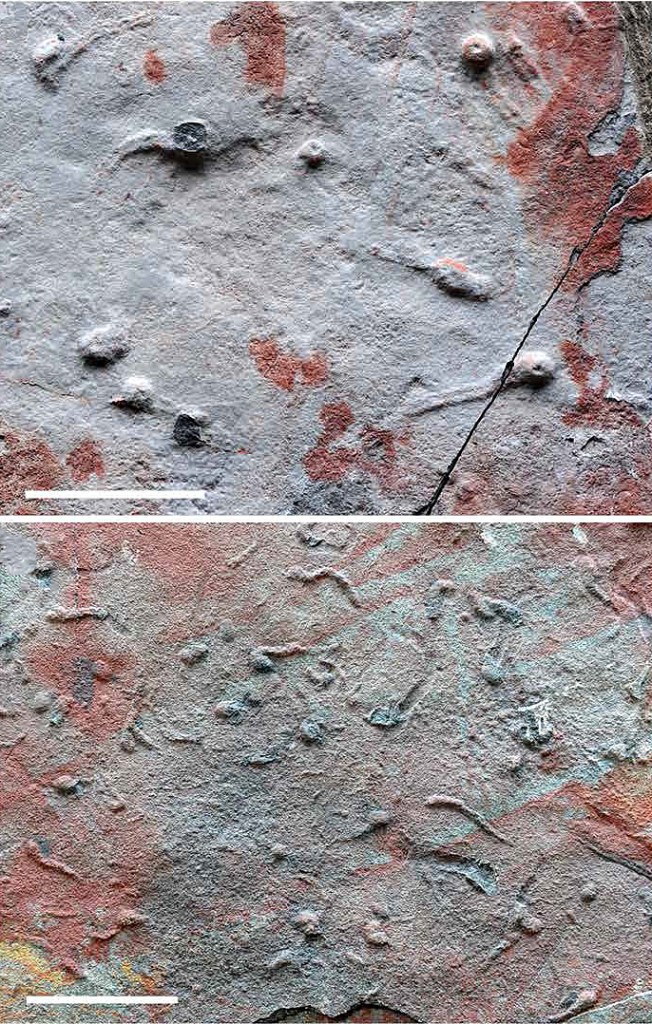
Tadpole-like trace fossils from the Ediacaran Dengying Formation in the Yangtze Gorge: 5 cm scale bars. The ‘heads’ show tiny depressions suggesting that there maker probed into the sediments as well as foraging horizontally. Credit: Zhe Chen & Yarong Liu; Figs 3B and 3D

Zhe Chen and Yarong Liu of the Nanjing Institute of Geology and Palaeontology and Chinese Academy of Sciences in China examined carbonates of the upper Ediacaran Dengying Formation. This overlies the Doushantuo Formation (550 to 635 Ma), known for tiny fossils of possibly the oldest deuterostome Saccorhytus coronaries; a potential candidate for the ancestor of modern bilaterian phyla. In the Yangtze Gorge locality sediments at this level show only traces of browsing of bacterial mats on the sediment surface; i.e. 2-D feeders. The basal Dengying sediments host clear signs that organisms could then penetrate into the sediments. These 3-D feeders , would have had access to buried organic remains, hitherto unexploited by living organisms. Such animal-sediment interactions would have disturbed and diminished the living microbial mats that held the sediment surface in place, and thus began to dismantle the substrate for the typical Edicaran fauna. Similar 3-D feeders occur throughout the 11 Ma represented by the Dengying Formation to the start of the Cambrian. This beginning of bioturbation heralded a period during which the Ediacaran fauna steadily waned. It also released nutrients into deep water, and opened up new ecological niches for more advanced animals on the seabed.  Dissolved oxygen could only slowly enter the sediments since atmospheric and oceanic O2 levels were low. But by the earliest Cambrian it had risen to about 5 to 10% by volume to support many other kinds of burrowing animals that could penetrate more deeply, as witnessed by the abundant sandstones that occur at the base of the Cambrian in Britain.

Detecting oxygenic photosynthesis in the Archaean Earth System

For life on Earth, one of the most fundamental shifts in ecosystems was the Great Oxygenation Event 2.5 to 2.3 billion years (Ga) ago. The first evidence for its occurrence was from the sedimentary record, particularly ancient soils (palaeosols) that mark exposure of the continental surface above sea level and rock weathering. Palaeosols older than 2.4 Ga have low iron contents that suggest iron was soluble in surface waters, i.e. in its reduced bivalent form Fe2+. Sediments formed by flowing water also contain rounded grains of minerals that in today’s oxygen-rich environments are soon broken down and dissolved through oxidising reactions, for instance pyrite (FeS2) and uraninite (UO2). After 2.4 Ga palaeosols are reddish to yellowish brown in colour and contain insoluble oxides and hydroxides of Fe3+ principally hematite (Fe2O3) and goethite (FeO.OH). After this time sediments deposited by wind action and rivers are similar in colour: so-called ‘redbeds’. Following the GOE the atmosphere initially contained only traces of free oxygen, but sufficient to make the surface environment oxidising. In fact such an atmosphere defies Le Chatelier’s Principle: free oxygen should react rapidly with the rest of the environment through oxidation. That it doesn’t shows that it is continually generated as a result of oxygenic photosynthesis. The CO2 + H2O = carbohydrate + oxygen equilibrium does not reach a balance because of continual burial of dead organic material.

Free oxygen is a prerequisite for all multicelled eukaryotes, and it is probably no coincidence that fossils of the earliest known ones occur in sediments in Gabon dated at 2.1 Ga: 300 Ma after the Great Oxygenation Event. However, the GOE relates to surface environments of that time. From 2.8 Ga – in the Mesoarchaean Era – to the late Palaeoproterozoic around 1.9 Ga, vast quantities of Fe3+ were locked in iron oxide-rich banded iron formations (BIFs): roughly 105 billion tons in the richest deposits alone (see: Banded iron formations (BIFs) reviewed; December 2017). Indeed, similar ironstones occur in Archaean sedimentary sequences as far back as 3.7 Ga, albeit in uneconomic amounts. Paradoxically, enormous amounts of oxygen must have been generated by marine photosynthesis to oxidise Fe2+ dissolved in the early oceans by hydrothermal alteration of basalt lava upwelling from the Archaean mantle. But none of that free oxygen made it into the atmosphere. Almost as soon as it was released it oxidised dissolved Fe2+ to be dumped as iron oxide on the ocean floor. Before the GOE that aspect of geochemistry did obey Le Chatelier!

A limestone made of stromatolites

The only likely means of generating oxygen on such a gargantuan scale from the earliest Archaean onwards is through teeming prokaryote organisms capable of oxygenic photosynthesis. Because modern cyanobacteria do that, the burden of the BIFs has fallen on them. One reason for that hypothesis stems from cyanobacteria in a variety of modern environments building dome-shaped bacterial mats. Their forms closely resemble those of Archaean stromatolites found as far back as 3.7 Ga. But these are merely peculiar carbonate bodies that could have been produced by bacterial mats which deploy a wide variety of metabolic chemistry. Laureline Patry of the Université de Bretagne Occidentale, Plouzané, France, and colleagues from France, the US, Canada and the UK have developed a novel way of addressing the opaque mechanism of Archaean oxygen production (Patry, L.A. and 12 others. Dating the evolution of oxygenic photosynthesis using La-Ce geochronology. Nature, v. 642, p. 99-104; DOI: 10.1038/s41586-025-09009-8).

They turned to the basic geochemistry of rare earth elements (REE) in Archaean stromatolitic limestones from the Superior Craton of northern Canada. Of the 17 REEs only cerium (Ce) is capable of being oxidised in the presence of oxygen. As a result Ce can be depleted relative to its neighbouring REEs in the Periodic Table, as it is in many Phanerozoic limestones. Five samples of the limestones show consistent depletion of Ce relative to all other REE. It is also possible to date when such fractionation occurred using 138La– 138Ce geochronology.  The samples were dated at 2.87 to 2.78 Ga (Mesoarchaean), making them the oldest limestones that show Ce anomalies and thus oxygenated seawater in which the microbial mats thrived. But that is only 300 Ma earlier than the start of the GOE. Stromatolites are abundant in the Archaean record as far back as 3.4 Ga, so it should be possible to chart the link between microbial carbonate mats and oxygenated seawater to a billion years before the GOE, although that does not tell us about the kind of microbes that were making stromatolites.

See also: Tracing oxygenic photosynthesis via La-Ce geochronology. Bioengineer.org, 29 May 2025; Allen, J.F. 2016. A proposal for formation of Archaean stromatolites before the advent of oxygenic photosynthesis. Frontiers in Microbiology, v. 7; DOI: 10.3389/fmicb.2016.01784.