How do subducted slabs accumulate at different mantle depths?

Seismic tomography provides no evidence that slabs of oceanic lithosphere descend intact through the whole mantle to the core-mantle boundary. It might once have happened when they were capped by abundant high-density rocks, such as Precambrian banded-iron formations. A great many actively descending slabs have been shown to cease sinking, slide sideways and accumulate at depths around 660 and 1000 km. Until recently these discontinuities were been generally ascribed to transitions in the structure of the dominant mafic mineral olivine (Mg2SiO4) in mantle peridotite induced by increasing pressure and temperature. The resulting increases in mantle density supposedly form barriers to further slab descent. Pressure-induced mineral transitions in the slabs themselves that increase their density, such as pyroxene to garnet, may somehow be inhibited thereby leading to stagnation in slab descent. That may be true for the 660 km discontinuity, but for stagnation at 1000 km deep no such density-changing mineral transitions have shown up in high-P high-T mineralogical experiments. Some other process must therefore be responsible for slab descent to that depth. Recent work by geoscientists at several universities in China gives insights into what may be going on (Li, J., Li, K., Li, J. et al 2026. Dual slab stagnation depths controlled by grain-size-induced sporadic low-viscosity zones at around 1000 km depth. Nature Communications DOI: 10.1038/s41467-026-69987-9).
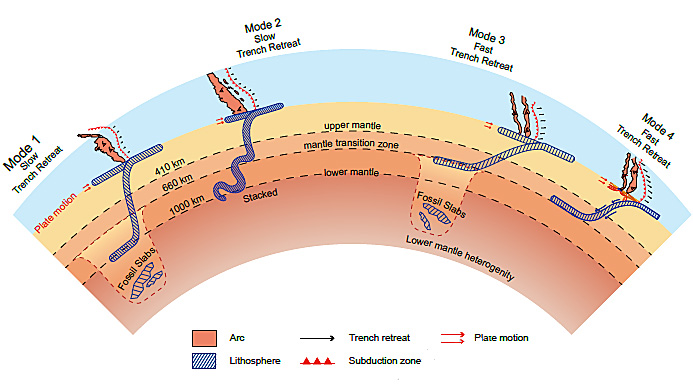
Four different modes of subduction at island arcs. Credit: Li et al. Fig 6

Jing Li and colleagues have focussed on the possibility that changes in the bulk viscosity of the mantle may play an important role. Their approach is twofold: experimental mineral physics and geodynamic modelling. Results suggest that recrystallization in the mantle when deeply penetrating slabs pass through it may patchily reduce the mantle’s grain size and thus its viscosity; the more so with larger volumes of subducted slab material. In turn, the resulting physical heterogeneity probably disrupts the steady downward passage of the slabs; fine-grained, less viscous zones ‘lubricating’ slab penetration, unchanged zones hindering it. The authors link such hypothetical micro-structural processes to modes of subduction that are currently active. They consider four modes of active subduction beneath island arcs with either a slow or a fast rate of trench retreat (see Figure). A slowly retreating trench system combined with low-viscosity patches at depth (Mode 1) results in penetration below 660 km and slab stagnation at 1000 km. Slow trench retreat with a homogenous lower mantle (Mode 2) gives rise to penetration and buckling of the descending slab between 660 and 1000 km. Fast trench retreat with a deeper low-viscosity zone (Mode 3), or with a homogeneous lower mantle (Mode 4) both result in slab stagnation at 660 km.

The models developed by Jing Li et al convincingly simulate various results of seismic tomography beneath island arcs. Interestingly, they suggest that the eventual assimilation of older slab materials into the deeper mantle (‘fossil’ slabs) may play a major role in mineral comminution and reduced mantle strength. That may leave behind low viscosity zones that later subduction may exploit. In fact, there are signs of possible fossil slabs in seismic tomograms more than 1000 km below the present Pacific Ocean floor in the form of zones of high P-wave velocity.

This work shows that plate tectonics is far from ‘done-and-dusted’, the mantle being far from uniform in its properties. Li et al’s results potentially open up new insights into whole-mantle convection, in which older tectonic events influence plate motions that are currently operating and the triggering of plumes rising from the deepest mantle. It also hints that such complex physical mixing of subducted material into the mantle may have resulted in the geochemical heterogeneities that increasingly emerge from analysis of magmas with ultimate origins in the mantle.

See also:Grain Size Creates Dual Slab Stagnation Zones at 1000 km. Scienmag 3 March 2026

Here is the plate tectonic forecast

As computing power and speed have grown ever more sophisticated models of dynamic phenomena have emerged, particularly those that focus on meteorology and climatology. Weather and climate models apply to the thin spherical shell that constitutes Earth’s atmosphere. They consider incoming solar radiation and longer wavelength thermal radiation emitted by the surface sources and sinks of available power, linked to the convective circulation of energy and matter, most importantly water as gas, aerosols, liquid and ice in atmosphere and oceans. Such general circulation models depend on immensely complex equations that relate to the motions of viscous media on a rotating sphere, modulated by other aspects of the outermost Earth: the absorptive and reflective properties of the materials from which it is composed – air, rocks, soils, vegetation, water in liquid, solid and gaseous forms; different means whereby energy is shifted – speeds of currents and wind, adiabatic heating and cooling, latent heat, specific heat capacity of materials and more still. The models also have to take into account the complex forms taken by circulation on account of Coriolis’ Effect, density variations in air and oceans, and the topography of land and ocean floor. The phrase ‘and much more besides’ isn’t really adequate for such an enormous turmoil, for the whole caboodle has chaotic tendencies in time as well as 3-D space. The fact that such modelling does enable weather forecasting that we can believe together with meaningful forward and backward ‘snapshots’ of overall climate depends on increasing amounts of empirical data about what is happening, where and when. Models of this kind are also increasingly able to address issues of why such and such outcomes occur, an important example being the teleconnections between major weather events around the globe and phenomena such as the El Nino-Southern Oscillation – the periodic fluctuation of ocean movements, winds and sea-surface temperatures over the tropical eastern Pacific Ocean.

The key principle of plate tectonics is that t...
The Earth’s 15 largest tectonic plates. (credit: Wikipedia)

The Earth’s lithosphere and deeper mantle in essence present much the same challenge to modellers. Silicate materials circulate convectively in a thick spherical shell so that radiogenic heat and some from core formation can escape to keep the planet in thermal balance.  There are differences, the obvious ones being sheer scale and a vastly more sluggish pace, but most important are the interactions between materials with very different viscosities; the ability of the deep mantle to move by plastic deformation while the lithosphere moves as rigid, brittle plates. For geophysicists interested in modelling there are other differences; information that bears on the system is orders of magnitude less, its precision is much poorer and all of it is based on measurement of proxies. For instance, information on temperature comes from variations in seismic wave speed given by analysis of arrival times at surface observatories of different kinds of wave emitted by individual earthquakes. That is, from seismic tomography, itself a product of immensely complex computation. Temptation by computing power and the basic equations of fluid dynamics, however, has proved hard to resist and the first results of a general circulation model for the solid Earth have emerged (Mallard, C. et al. 2016. Subduction controls the distribution and fragmentation of Earth’s tectonic plates. Nature, v. 535, p. 140-143).

As the title suggests, the authors’ main objective was understanding what controls the variety of lithospheric tectonic plates, particularly how strain becomes localised at plate boundaries. They used a circulation model for an idealised planet and examined several levels of a plastic limit at which the rigidity of the lithosphere drops to localise strain. At low levels the lithosphere develops many plate boundaries, and as the plastic limit increases so the lithosphere ends up with increasingly fewer plates and eventually a rigid ‘lid’. The modelling also identified divergent and convergent margins, i.e. mid-ocean ridges and subduction zones. The splitting in two of a single plate must form two triple junctions, whose type is defined by the kinds of plate boundary that meet: ridges; subduction zones; transform faults. Both the Earth and the models show significantly more triple junctions associated with subduction than with extension, despite the fact that ridges extend further than do subduction zones. And these trench-associated triple junctions are mainly those dividing smaller plates. This suggests that it is subduction that focuses fragmentation of the lithosphere, and the degree of fragmentation is controlled by the lithosphere’s strength. There is probably a feedback between mantle convection and lithosphere strength, suggesting that an earlier, hotter Earth had more plates but operated with fewer, larger plates as it cooled to the present. But that idea is not new at all, although the modelling gives support to what was once mere conjecture.