
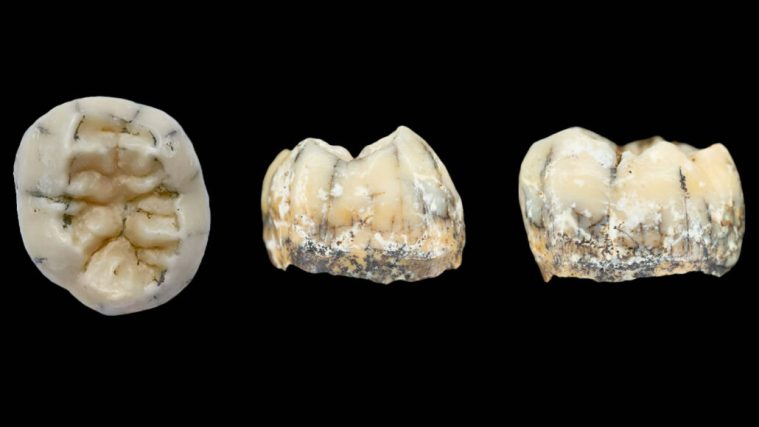
Finding human fossils in SE Asia is rare because its tropical climate generally results in decomposition of bones. Up to now the oldest known anatomically modern human (AMH) found beyond the Middle East is from Australia and has been dated to 65 ka. Other, less convincing candidates for the earliest appearance of AMH in Asia are scattered teeth found in Chinese caves that yielded dates of up to 139 ka: their assignment to AMH and the reliability of their dating are disputed. Now a large team of scientists from the USA, Germany, Australia, South Africa, France, Denmark and Laos have unearthed convincing but fragmented AMH bones among a jumble of diverse animal fossils in sediment flooring Tam Pà Ling cave in northern Laos (Friedline, S.E. and 30 others 2023. Early presence of Homo sapiens in Southeast Asia by 86–68 kyr at Tam Pà Ling, Northern Laos. Nature Communications, v. 14, article 3193; DOI: 10.1038/s41467-023-38715-y). Several dating techniques reveal ages of the AMH samples that range from 46 to 77 ka, and potentially as far back as 86 ka. It is conceivable that the oldest are from the population that subsequently reached Australia. Far to the west of Laos in Greece, Israel and Arabia an earlier AMH presence goes back as far as 90 to 210 ka. Moreover, palaeoclimatic studies suggest many opportunities for eastward migration since 290 ka ago that AMH emigrants may have exploited. Once beyond regions around Arabia and the Gulf, which were periodically hyperarid, the journey to the rest of Asia was probably continuously habitable throughout the last two glacial-interglacial cycles.

Another aspect of the AMH record in southern and SE Asia is that the individuals represented seem to have been anatomically very varied (Demeter, F. et al. 2023. Early Modern Humans and Morphological Variation in Southeast Asia: Fossil Evidence from Tam Pa Ling, Laos. PLOS ONE, v. 10, article e0121193. DOI:10.1371/journal.pone.0121193). This may suggest that migration was by significantly different groups at different times. Oddly, the earliest known examples have more ‘modern’ characteristics than younger ones that appear somewhat ‘archaic’. The age of the fossils conflicts with the 60 ka age reconstructed from genetic evidence for the main diffusion across Eurasia and Australasia. One possibility is that there were several pre-60 ka migrations, descendents of these early populations having been replaced or assimilated by a later, larger numbers of AMH migrants. At 74 ka the Sumatran Toba supervolcano erupted about 2,800 km3 of ash to blanket a vast area and cause global cooling that could have more than decimated migrating AMH groups. Alternatively the 60 ka ‘genetics’ date is not correct, as suggested by the minimum date of 65 ka for the earliest Australians. Such a conflict of evidence will surely spur further excavation: as one researcher observed about Laos, ‘There are thousands of caves to explore’.
See also: Coleman, J. 2023. Laos cave fossils prompt rethink of human migration map. Nature, v.618; DOI: 10.1038/d41586-023-01903-3; Ashworth, J. 2023. Fossils reveal early modern humans in southeast Asia 77,000 years ago. Natural History Museum’s Discover, 15 June 2023.


 Earth-logs