
Judging by the coverage in the media, there is huge excitement about a possible sign of life on a very distant planet. It emerged from a Letter to The Astrophysical Journal posted by a British-US team of astronomers led by Nikku Madhusudhan that was publicised by the Cambridge University Press Office (Madhusudhan, N.et al. 2025. New Constraints on DMS and DMDS in the Atmosphere of K2-18 b from JWST MIRI. The Astrophysical Journal, v. 983, article adc1c8; DOI: 10.3847/2041-8213/adc1c8). K2-18 b is a planet a bit smaller than Neptune that orbits a red dwarf star (K2-18) about 124 light years away. The planet was discovered by NASA’s now-defunct Kepler space telescope tasked with the search for planets orbiting other stars. An infrared spectrometer on the Hubble Space Telescope revealed in 2019 that the atmosphere of K2-18 b contained water vapour, making the planet a target for further study as it may possess oceans. The more sophisticated James Webb Space Telescope IR spectrometer was trained on it a year later to reveal methane and CO2: yet more reason to investigate more deeply, for water and carbon compounds imply both habitability and the potential for life forms being there.
The latest results suggest that that the atmosphere of K2-18 b may contain simple carbon-sulfur gases: dimethyl sulfide ((CH3)2S) and dimethyl disulfide (CH3SSCH3). Bingo! for exobiologists, because on Earth both DMS and DMDS are only produced by algae and bacteria. Indeed they are responsible for the odour of the seaside. They became prominent in 1987 when biogeochemist James Lovelock fitted them into his Gaia Hypothesis. He recognised that they encourage cloud formation and thus increase Earth’s reflectivity (albedo) and also yield sulfuric acid aerosols in the stratosphere when they oxidise: that too increases albedo. DMS generates a cooling feedback loop to counter the warming feedback of greenhouse emissions. That is an idea of planetary self-regulation not much mentioned nowadays. Such gases were proposed by Carl Sagan as unique molecular indicators that could be used to search for extraterrestrial life.
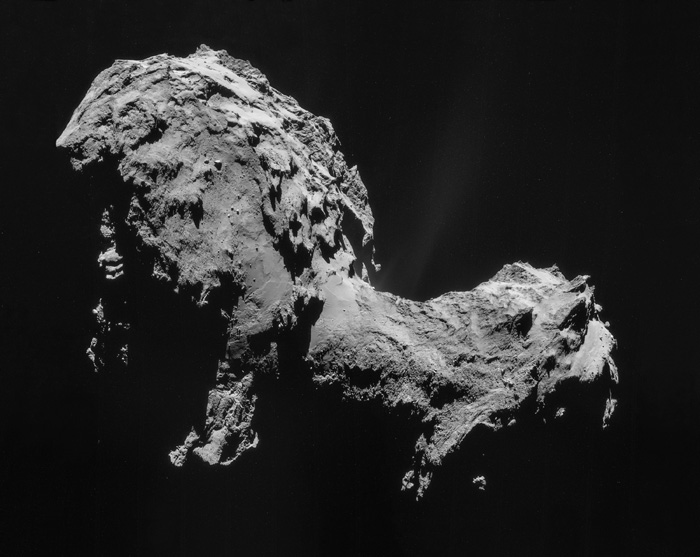
The discovery of possible DMS and DMDS in K2-18 b’s atmosphere is, of course, currently under intense scientific scrutiny. For a start, the statistics inherent in Madhusudhan et al.’s methodology (3σ or 99.7% probability) fall short of the ‘gold standard’ for discoveries in physics (5σ or 99.99999% probability). Moreover, there’s also a chance that exotic, inorganic chemical processes could also create the gases, such as lightning in an atmosphere containing C, H and S. But this is not the first time that DMS has been discovered in an extraterrestrial body. Comets, having formed in the infancy of the Solar System much further from the Sun than any planets, are unlikely to be ‘teeming with life’. The European Space Agency’s Rosetta spacecraft chased comet 67P/Churyumov-Gerasimenko for 2 years, directly sampling dust and gas that it shed while moving closer to the Sun. A single day’s data from Rosetta’s mass spectrometer showed up DMS, and also amino acids. Both could have formed in comets or interstellar dust clouds by chemistry driven by radiation, possibly to contaminate planetary atmospheres. Almost certainly, further remote sensing of K2-18 b will end up with five-sigma precision and some will say, ‘Yes, there is life beyond Earth!’ and celebrate wildly. But that does not constitute proof, even by the ‘weight of evidence’ criterion of some judiciaries. To me such a conclusion would be unseemly romanticism. Yet such is the vastness of the material universe and the sheer abundance of the elements C H O N and P that make up most living matter that life elsewhere, indeed everywhere, (but not life as we know it) is a near certainty. The issue of intelligent lifeforms ‘out there’ is, however, somewhat less likely to be resolved . . .

 Earth-logs