The world’s oldest crust in the Nuvvuagittuq Greenstone Belt, Quebec

Since 1999, the rocks generally acknowledged to be the oldest on Earth were part of the Acasta gneisses in the Slave Craton in Canada’s Northwest Territories; specifically the Idiwhaa tonalitic gneisses. Zircons extracted from that unit yielded an age of 4.02 billion years (Ga) using U-Pb radimetric dating, revealing the time of their crystallisation from granitic magma. But nine years later some metabasaltic rocks from the tiny (20 km2) Nuvvuagittuq Greenstone Belt on the eastern shore of Hudson Bay were dated using the Sm-Nd method at almost 4.3 Ga (see: At last, 4.0 Ga barrier broken; November 2008). Taken at face value the metabasaltic rocks seemed to be well within the Hadean Eon (4.6 to 4.0 Ga) and could thus represent primary crust of that antiquity. However, U-Pb dating of zircons from thin sodium-rich granitic rocks (trondhjemites) that intrude them yielded ages no older than about 3.8 Ga. Similar ages emerged from zircons found in metasediments interleaved in the dominant mafic unit. Discrepancies between the two completely different dating methods resulted in the Hadean antiquity of the mafic rocks having been disputed since 2008. It was possible that the Sm-Nd results from the metabasalts may have resulted from the original mafic magmas having inherited a Hadean Sm-Nd isotopic ‘signature’ from their mantle source. That is, they may have been contaminated and could have formed in the early Archaean.

Glacially smoothed outcrops near Inukjuak, Quebec that reveals rocks of the Nuvvuagittuq Greenstone Belt. Credit: Jonathan O’Neil, University of Ottawa

Jonathan O’Neil, now at Ottawa University in Canada, led the first isotopic investigation of the Nuvvuagittuq Greenstone Belt and has engaged in research there ever since. Further field and laboratory studies revealed that the previously dated mafic rocks had been intruded by large, chemically differentiated gabbro sills. A team of geochemists from the University of Ottawa and Carleton University, including O’Neil, has now published isotopic evidence from the intrusions that suggests a Hadean age for their parent magma (C. Sole et al. 2025. Evidence for Hadean mafic intrusions in the Nuvvuagittuq Greenstone Belt, CanadaScience, v. 388, p. 1431-1435. DOI: 10.1126/science.ads8461). The authors used the decay schemes of two radioactive samarium isotopes 147Sm and 146Sm; a significant advance in radiometric dating. The first decays to 143Nd with a half-life of about 1011 years, the second to 142Nd with a much shorter half life of about 108 years. Due to its more rapid decay, in geological terms,146Sm is now much rarer than 147Sm. Consequently, using the short-lived 146Sm-142Nd decay system is technically more difficult than that of the 147Sm-143Nd system. But the team managed to get good results from both the ‘fast’ and the ‘slow’ decay schemes. They tally nicely, yielding ages of 4157 and 4196 Ma.  The gabbros provide a minimum age for the metabasalts that they cut through. The original 4.3 Ga Sm-Nd date for the metabasalts is thus plausible. Sole and colleagues consider the dominant metabasaltic rocks to have formed a primary crust in late Hadean times that was invaded by later mantle-derived mafic magma about 100 Ma later. The granitic rocks that constitute about one third of the Nuvvuagittuq terrain seem to have been generated by partial melting more than 300 Ma later still, during the Palaeoarchaean.

Perhaps similar techniques will now be deployed in granite-greenstone terrains in other cratons. Many of the older ones, generally designated as Palaeoarchaean in age, also contain abundant metamorphosed mafic and ultramafic igneous rocks. Perhaps their origin was akin to those of Nuvvuagittuq; i.e. more Hadean crust may await unmasking. Meanwhile, there seems to be more to discover from Nuvvuagittuq. For instance, some of the rocks suggested to be metasediments interleaved in the metabasalts show intricate banding that resembles products of bacterial mat accumulation in younger terrains. Signs of Hadean life?

Since the first reliable radiometric dating of Archaean rocks in 1971, there has been an element of competition to date the oldest rocks on Earth: to push history back towards the initial formation of the Earth. It is one of the most disputatious branches of Earth history. Rivalry may play a significant part in driving the science, as well as the development of novel dating techniques and the continuing discovery of clearly old relationships using ‘old-fashioned’ relative dating, such as signs of intrusion, unconformities etcetera. But in some cases there is a darker side: the potential for profit. Recently, samples from Nuvvuagittuq appeared for sale on the Internet, priced at $10,000. They may have been collected under the guise of supplying museums by a group that shipped-in mechanical excavators in 2016. Unsurprisingly this angered the local Innuit community of Inukjuak. They were also worried about bona fide collection for scientific research that had left parts of the small, once pristine area somewhat battered, including cultural features such as an inukshuk navigational monument. Their fury at commercial exploitation of their homeland resulted in the community council closing the area to collecting in 2024. I emphasise that this violation of basic geological ethics was by commercial rock collectors and dealers, not academic geologists. The local people are now considering careful issue of research permits so that important research can continue. But further rock collecting may remain banned.

See also: New Research Verifies Northern Canada Hosts Earth’s Oldest Rocks. Scienmag, 26 June 2025; Gramling, C. 2025. Earth’s oldest rocks may be at least 4.16 billion years old. ScienceNews.

PS With many thanks to ‘Piso Mojado’ for alerting me to this paper

Sudden climate change: a warning from 8 millennia ago

Mesolithic hunter-gatherers in Britain must have had a very hard time around 8.2 thousand years age. The whole area around the North Atlantic experienced sudden climatic cooling of around 3.3°C together with drought that lasted about 70 years. To make things worse shortly afterwards, coasts around the North were devastated by a tsunami generated by a submarine landslide off western Norway. That event exceeded the maximum coast ‘run up’ of both the 26 December 2004 Indian Ocean tsunami and that in NW Japan on 11 March 2011. Doggerland, then in the central North Sea was devastated by a catastrophic event of a few days duration. It littered the seabed with the bones of its megafauna and even Mesolithic tools recovered by trawlers from its surviving relic the shallow Dogger Bank. It seems the tsunami arrived just as climate was warming back to ‘normal’ Holocene conditions: for many foragers, surely, a last straw.

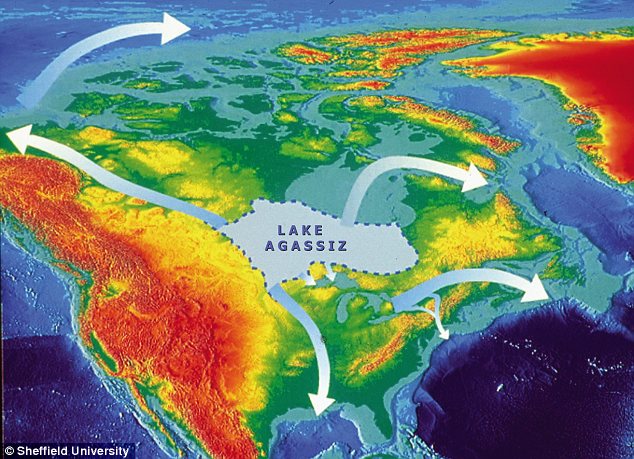
The cooling episode has been attributed to perturbation of the Atlantic Meridional Overturning Circulation (AMOC) as a result of meltwater discharge during the deglaciation of the Laurentide Ice Sheet (see: Just when you think it’s going to turn out alright… November 2009).The event may have unfolded in a similar fashion to the trigger for the Younger Dryas and the succession of warming-cooling episodes known as Dansgaard-Oeschger events that interrupted the otherwise relentless global cooling towards the last glacial maximum (see: Review of thermohaline circulation; February 2002). The physics that set off such climatic ‘hiccups’ is that freshening of surface seawater reduces its density, so that it cannot sink to be replaced by denser saline water ‘dragged’ northwards from warmer latitudes. That currently takes the form of the Gulf Stream with its warming influence, particularly in the eastern North Atlantic and even beyond Norway’s North Cape, responsible for much warmer winters than at similar latitudes on the western side. The culprit  had long been suggested to be the drainage of a huge lake dammed by the ice sheet that covered most of eastern Canada during late stages of deglaciation. Seemingly the best candidate was Lake Agassiz trapped by the early Holocene ice front in Manitoba – the largest proglacial lake known anywhere.

Colour coded topographic elevation of North America showing the maximum extent of Lake Agassiz and four possible routes for its drainage: north-west to the Arctic Ocean via the Mackenzie River; south to the Gulf of Mexico via the Mississippi valley; east to the North Atlantic via the Great Lakes and St Laurence River; north to the North Atlantic via Hudson Bay. (Credit: ©Sheffield University)

The present landforms of central Canada show evidence for several outflow directions at different times, Including to the northwest to reach the Arctic Ocean at the onset of the Younger Dryas. Until recently there was little detailed evidence for the flow volume and timing of its drainage around 8 to 9 ka. Providing the details in the context of the short-lived event around 8.2 ka requires accurate data over a mere 200 years able to reveal a change in sea level to a precision of better than a few tens of centimetre. Any site on the shores of the North Atlantic would do, provided it satisfies these criteria. Geographers from universities in York, Leeds, Sheffield and Oxford, UK selected the small estuary of the River Ythan in NE Scotland. There, a continuous sand unit just above fine-grained intertidal tidal muds marks the knife-sharp time datum of the Storegga tsunami (Rush, G. et al. 2023. The magnitude and source of meltwater forcing of the 8.2 ka climate event constrained by relative sea-level data from eastern Scotland. Quaternary Science Advances, v. 12, article 100119; DOI: 10.1016/j.qsa.2023.100119).

Cores of the intertidal sediments from beneath the present Ythan salt marsh contain plant remains that yielded precise radiocarbon dates at several stratigraphic levels from which to derive an age-depth model for the age range of interest. The buried sediments are also rich in marine microfossils (foraminifera and diatoms) that thrive in estuaries at a variety of depths.  These enabled fluctuations in relative sea level during the build-up of the intertidal sediments to be constrained at unprecedented resolution and precision for a three thousand year period from 9.5 to 6.5 ka. The authors show that there were two episodes of rapid sea-level rise over that time: between 8.53 and 8.37 ka (~2.4 m at 13 mm yr-1) and 8.37 to 8.24 ka (~ 0.6 m at 4 mm yr-1) – these would have been global increases in sea level.

Despite its vast size, it turns out that Lake Agassiz would have been unable to result in sea-level rises of that magnitude so quickly merely through outflow. Rush et al. suggest that the huge  and rapid addition of fresh water to the North Atlantic involved flow of lake water towards Hudson Bay, beneath the ice sheet, causing it to collapse and melt, followed by completion of Lake Agassiz’s emptying in the second stage. It took a long drawn-out ‘freshening’ of the North Atlantic surface water ultimately to shut down the Atlantic Meridional Overturning Circulation, thereby depriving high latitudes of its east-side warming effect by the Gulf Stream.

Sea level has been rising since the early 20th century mainly through the melting of Greenland’s ice cap together with a substantial amount of thermal expansion while global climate has been warming. Between 1901 and 2018 the rise has amounted to 15 to 25 cm at a rate of 1 to 2 mm yr-1. The AMOC is possibly weaker now than at any time during the last millennium (Zhu, C. et al. 2023. Likely accelerated weakening of Atlantic overturning circulation emerges in optimal salinity fingerprint. Nature Communications, v. 14, article 1245; DOI: 10.1038/s41467-023-36288-4). Yet increases in freshening of the northernmost parts of the North Atlantic are now being added to by annual increases in the melting of polar sea ice, which is salt-free. The AMOC may be approaching a tipping point, because warming is accelerating over Greenland at around 1.5°C each year: faster than most of the rest of the world. In 2021 it rained for the first time ever recorded at the ice cap’s summit (3.2 km above sea level). A ‘perturbation’ of the AMOC would add chaos to the dominantly linear view of global warming taken by climatologists. That could launch frigidity and drought at mid northern latitudes as it did eight millennia ago: the opposite of what is currently feared.

See also: Unlocking Ancient Climate Secrets – Melting Ice Likely Triggered Climate Change Over 8,000 Years Ago. Scitechdaily 16 September 2023.