Hobbit time

A few months after the diminutive hominin fossil Homo floresiensis, which because of its relatively large feet was quickly dubbed the ‘Hobbit’, turned out to be considerably older than previously thought it hit has the headlines again because its ancestors may have colonized the Indonesian island of Flores far earlier still. A pair of articles in the 9 June 2016 issue of Nature consider evidence from another site on the island where fluvial sediments offer more easily interpreted stratigraphy than the complex Liang Bua cave assemblage where the original skeletal remains were unearthed. The site in the So’a Basin became an important target for excavation following the discovery there in the 1950’s of stone artefacts, east of Wallace’s Line – a fundamental faunal and floral divide once thought to be due to the difficulty of crossing a deep, current-plagued channel in the Indonesian archipelago. The unexpected presence of artefacts drew palaeoanthropologists from far afield, but it was almost 50 years later before their exploration yielded hominin remains.

English: homo from flores
Homo floresiensis (credit: Wikipedia)

One of the papers reports sparse new finds of hominin material from the So’a Basin, a fragment of mandible and 6 isolated teeth thought to be from at least three individuals (van den Bergh, G.D. et al., 2016. Homo floresiensis-like fossils from the early Middle Pleistocene of Flores. Nature, v.  534, p. 245-248). The other covers newly discovered artefacts, the stratigraphic and palaeoecological setting, and radiometric dates of the finds (Brumm, A. and 22 others, 2016. Age and context of the oldest known hominin fossils from Flores. Nature, v.  534, p. 249-253). The jaw fragment shows signs of having once held a wisdom tooth, showing that it belonged to an adult. Yet although it resembles the dentition of the younger Liang Bua specimens, it seems more primitive and is even smaller. The other dental finds are most likely to be deciduous teeth of juveniles. Fission-track, uranium-series and 40Ar/39Ar dating indicates that the fossils entered the sediments about 700 ka ago. But tools and remains of prey animals in deeper sedimentary layers here and at other Flores sites indicate the presence of hominins back as far as about 1 Ma, before which there are no such signs.

So, at least a million years ago Flores was colonised by hominins. Either the original immigrants were uniquely small compared with other hominins of that vintage in Asia and Africa, or within 300 ka they had decreased in size through the evolutionary influence of limited resources on Flores and the process of island dwarfism. The second may also have been influenced by an initially small population of migrants or a later population ‘bottleneck’ that added a loss of genetic variability – a founder effect.   These two alternatives may point respectively to either the even earlier migration out of Africa and across most of Asia of perhaps H. habilis, or the dwarfing of a limited population of H. erectus who made their way there from their known occupation of Java. The authors painstaking analysis of the meagre remains suggest a closer dental resemblance to Asian Homo erectus than to earlier African hominins, so the second alternative seems more likely. However, even that scenario poses palaeoanthropology with a major problem; yet another evolutionary process that helps cryptify the links among our earlier relatives. (See also: Gomez-Robles, A., 2016. The dawn of Homo floresiensis. Nature, v.  534, p. 188-189.)

Art from half a million years ago

original fossils of Pithecanthropus erectus (n...
Original fossils of Pithecanthropus erectus (now Homo erectus) found By Eugene Dubois in Java in 1891 (credit: Wikipedia)

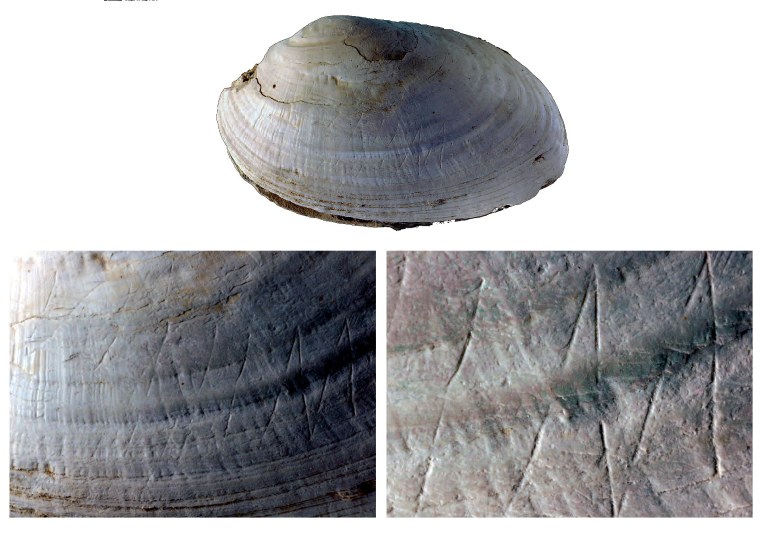
Eugene Dubois, an anatomist at the University of Amsterdam in the late 19th century, became enthralled by an idea that humans had evolved in what is now Indonesia, contrary to Charles Darwin’s suggestion of an African origin. So much so that Dubois took the extraordinary step of joining the Dutch army and scrounging a posting to the Dutch East Indies to facilitate his search for a ‘missing link’, accompanied by his wife and newborn daughter. After a four-year quest, in 1891 he discovered the upper cranium and brow of a being that was obviously related to us, but also quite distinct as regards its beetling brow ridges. Pithecanthropus erectus (now Homo erectus) raised a storm of controversy, sadly only resolved in Dubois’s favour after his death in 1940. Yet, as well as mounting the first deliberate search for human ancestors, Dubois collected everything possible in the sediments at Trinil, Java, so in a sense he was also an early palaeoecologist. The collection gathered dust in Leiden for the best part of a century, until archaeologist Josephine Joordens of the University of Leiden took on the task of reviewing its contents in 2007 (Joordens, J.C.A. and 20 others 2014. Homo erectus at Trinil on Java used shells for tool production and engraving. Nature (on-line): doi:10.1038/nature13962).

Progressively enlarged views of freshwater clam from Eugene Dubois's collecti9on from Trimil, showing clear evidence of deliberate engraving. (credit: Joordens et al., 2014 in Nature; photos by Wim Lustenhouwer, VU University Amsterdam
Progressively enlarged views of freshwater clam from Eugene Dubois’s collection from Trinil, showing clear evidence of deliberate engraving. (credit: Joordens et al., 2014 in Nature; photos by Wim Lustenhouwer, VU University Amsterdam)

Homo erectus clearly had a taste for freshwater clams and lots of their shells figure in the Trinil collection: all are of similar large size rather than showing a wide variation according to age, suggesting a shell midden rather than a natural assemblage. A piece of serendipity revealed what may prove to be the anthropological find of the year. High-quality photos of the shells taken by a visiting mollusc specialist showed up evidence that one of them had been meticulously engraved. Its surface had a near-perfectly geometric, zig-zag pattern deeply gouged by someone with a steady hand, who probably used an associated shark’s tooth as a scribing tool. Since the molluscs in life bear a dark, chitinous veneer the etching would have been more striking when freshly made. Another of these sturdy shells also show signs of having had its edge sharpened, suggesting that they were used for tools such as scrapers or graters.

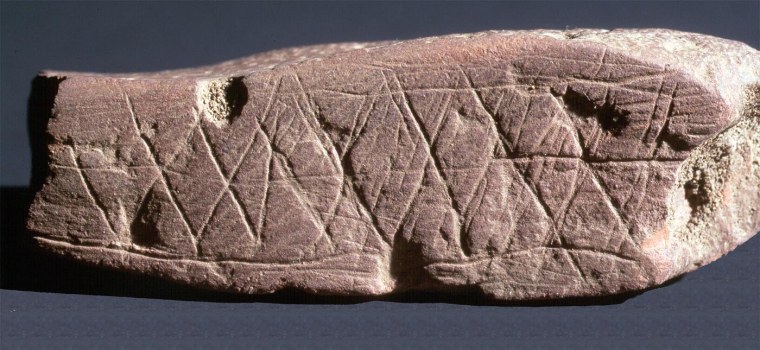
The stratigraphy at Trinil suggested that the engraved shell and tools were coeval with Homo erectus, but that needed proof. Using sediment grains trapped in the shells and a combination of 40Ar/39Ar and thermoluminescence dating, the team have shown that they and the human fossils from Trinil date to between 430 and 540 thousand years ago: at least 350 ka older than the very similar engravings made by an anatomically modern human on ochre that was found at Blombos Cave in South Africa. The next-oldest putative artwork is the controversial ‘Venus’ found at Berekhat Ram on the Israel-Syria border, dated between 250 and 280 ka.

Engraved ochre from Blombos Cave, South Africa. (credit Chris Henshilwood)
Engraved ochre from Blombos Cave, South Africa. (credit: Chris Henshilwood)

Probably the majority of palaeoanthropologists have dismissed humans other than ­H. sapiens as being cognitively incapable of either abstract or figurative art. The general view is that the mental capacity to create art or design began with the creation of the Blombos engraving, was restricted to anatomically modern humans and only exploded in Europe after they had migrated there by about 40 ka. A few argue that portable art, such as the Trinil and Blombos engravings, is bound by its very nature to be rare and easily overlooked. Whether having some use – counting? – merely being the making of an idle ‘doodle’ or expressing some unknowable ritual significance, the Trinil etching is a result of creativity and controlled skill that could only be the product of the H. erectus mind. Moreover, the very close comparison with the 0.35 Ma younger Blombos engraving suggests the product of a consciousness little different from that of our direct ancestors of 75 ka ago.

Human evolution news

Since discovery of its fossilised remains in Liang Bua cave on the Indonesian island of Flores was discovered in 2004 the diminutive Homo floresienesis, dubbed the ‘hobbit’ by the media, has remained a popular news item each time controversies surrounding it have flared. To mark the tenth anniversary  of its publication of a paper describing the remains Nature has summarised the recollections of many of those involved in trying to understand the significance of H. floresiensis (Callaway, E. 2014. Tales of the hobbit. Nature, v. 514, p. 422-426). Two main schools of thought continue in dispute, one holding that it is anatomically so different from anatomically modern humans and earlier members of the genus Homo that it constitutes a new species, despite its youngest member dating back only 18 ka, the other that it is H. sapiens, its tiny size having resulted from some kind of genetic disorder, such as microcephaly or Down’s syndrome. There have been so many attempts to expunge the idea of such an odd fossil cohabiting an island with fully modern humans yet being a different and perhaps extremely archaic species that such an outlook itself seems somewhat pathological.

English: Homo floresiensis, replica Deutsch: H...
Replica of the Homo floresiensis skull from Liang Bua cave, Flores, Indonesia (credit: Wikipedia)

The evidence presented to force H. floresiensis into a deformed human mould has never been convincing, and the best way of combating that view is to document from a ‘non-combatant ‘standpoint the many ways in which its anatomy differs from ours and how it might have arisen; a job to which Chris Stringer of the Museum of Natural History in London is amply qualified (Stringer, S. 2014. Small remains still pose big problems. Nature, v. 514, p. 427-429). He, like the original discoverers, feels this is a case of evolution of small stature due to a limited population being isolated for a long time on a relatively small island, which is just what happened to elephants that colonised Flores to become the pigmy Stegodon that H. floresiensis seemingly hunted. These tiny Flores dwellers (adults were about 1 m tall) used fire and made tools, similar ones dating as far back as ~1 Ma. Stringer mentions the possibility of first human colonisation about that time by Asian H. erectus but also the view that if it happened once there may have been several waves of immigration to Flores. The unusual ‘hobbit’ anatomy is not restricted to tiny size and a small skull and brain cavity (400 cm3), but includes odd hips, wrist bones, shoulder joint and collar bone. In fact the remains bear as much or more resemblance to australopithecines like ‘Lucy’ (3.2 Ma) than to other members of our genus, even H. erectus that has been proposed as its possible ancestor. Could they be far-travelled descendants of the 1.8 Ma old H. georgicus from Dmanisi in Georgia? More fossils clearly need to be found, and Stringer raises the possibility of the search being widened to other islands east of Java, such as Sulawesi, the Philippines and Timor. He hints that in such a tectonically active region tsunamis may have led to animals and humans saving themselves and then being current dispersed on rafts of broken vegetation, rather like some survivors of the 2004 Indian Ocean tsunami who ended up 150 miles from their homes by such a means.

Another story that is set to ‘run and run’ is that of ‘alien’ DNA in the human genome and productive relations between early out-of-Africa migrants with Neanderthals, Denisovans and perhaps yet a mysterious, earlier human species. The oldest (45 ka) anatomically modern human genome sequence so far charted is from a leg bone found by a mammoth-ivory prospector in Siberian permafrost (Fu, Q. and 27 others 2014. Genome sequence of a 45,000-year-old modern human from western Siberia. Nature, v. 514, p. 445-449). Like a great many living non-Africans this individual carried about 2 % Neanderthal DNA, but unlike living people the 45 ka genome has it in significantly longer segments. That allowed the authors to re-estimate the timing of the genetic flow from Neanderthals into the individual’s ancestors. Previous estimates from living DNA geve the possibility of that being between 37-86 ka, but this closer data suggests that it happened between 7 to 13 ka before the date of the fossil femur, i.e. narrowing it down to between 52 and 58 ka closer to the widely suggested time of African exodus around 60 ka (but see an Earth Pages item from September 2014)

More on human evolution here and here

An iconic early human skull

The earliest known human fossils outside of Africa were found at a site near Dmanisi in Georgia, between 1991 and 2005, following the discovery there in 1984 of primitive stone tools together with early Pleistocene animal bones. The Dmanisi finds occur with those of sabre-toothed cats and giant cheetahs, and so are probably not interments or in some kind of dwelling but were probably dragged into an underground carnivore den.

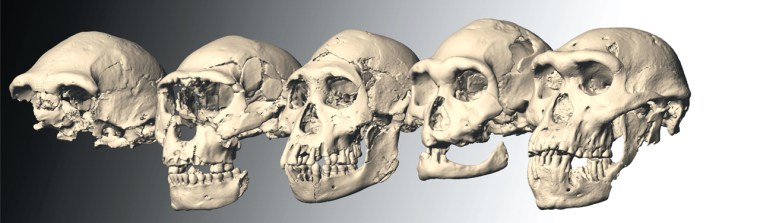
The five Dmanisi skulls of Homo erectus georgicus (credits; M.S. Ponce de Leon & P.E. Zollkofer, University of Zurich)

Initially the remains were assigned to a new species – Homo georgicus – but are now believed to be a subspecies of H. erectus. The finds are anatomically rich, with fossils of at least 5 individuals, both male and female, including 5 well-preserved skulls.  Analysing them has been a long process. Details of the best preserved, indeed the most complete early Homo skull ever found, have taken 8 years since its discovery in 2005 to reach publication (Lordkipanidze, D.  et al. 2013. A complete skull from Dmanisi, Georgia, and the evolutionary biology of early Homo. Science, v. 342, p. 326-331, DOI: 10.1126/science.1238484).

To the surprise of palaeoanthropologists, this specimen of Homo erectus georgicus has some ape-like features, including a protruding upper jaw in a relatively large face that most resembles the oldest African H. habilis, from Ethiopia, dated at 2.3 Ma. With a braincase of 546 cm3, the skull is on the small side of H. habilis and in the range of late australopithecines. Yet, like the much younger Homo floresiensis – dubbed ‘the Hobbit’ – the association with tools, of the most basic Oldowan type,  places it a cut above non-human hominins. The rest of the skeletal fossils show individuals with modern human proportions, albeit somewhat diminutive.

Surprises multiplied when comparative studies of all 5 skulls were complete. They are so different that, if found in widely separated specimens, would be placed in different species by most anatomists. Ruling out the chance association of several human species far from their Africa origins – few would suggest that up to 5 species left Africa at the same time and stuck together – a suggested explanation is that they represent a population of a human lineage in the process of evolving to a new species. The strength of this hypothesis contradicts the other recent view that several human species may have cohabited environments at different times. It also seems to throw into question the adoption of the name H. erectus for later human populations in both Africa and Eurasia: unless, as the authors tentatively suggest, there was genetic continuity and connectivity over large distances between both evolving populations