A sign of life on another planet? Should we be excited?

Judging by the coverage in the media, there is huge excitement about a possible sign of life on a very distant planet. It emerged from a Letter to The Astrophysical Journal posted by a British-US team of astronomers led by Nikku Madhusudhan that was publicised by the Cambridge University Press Office (Madhusudhan, N.et al. 2025. New Constraints on DMS and DMDS in the Atmosphere of K2-18 b from JWST MIRI. The Astrophysical Journal, v. 983, article adc1c8; DOI: 10.3847/2041-8213/adc1c8). K2-18 b is a planet a bit smaller than Neptune that orbits a red dwarf star (K2-18) about 124 light years away. The planet was discovered by NASA’s now-defunct Kepler space telescope tasked with the search for planets orbiting other stars. An infrared spectrometer on the Hubble Space Telescope revealed in 2019 that the atmosphere of K2-18 b contained water vapour, making the planet a target for further study as it may possess oceans. The more sophisticated James Webb Space Telescope IR spectrometer was trained on it a year later to reveal methane and CO2: yet more reason to investigate more deeply, for water and carbon compounds imply both habitability and the potential for life forms being there.

The latest results suggest that that the atmosphere of K2-18 b may contain simple carbon-sulfur gases: dimethyl sulfide ((CH3)2S) and dimethyl disulfide (CH3SSCH3). Bingo! for exobiologists, because on Earth both DMS and DMDS are only produced by algae and bacteria. Indeed they are responsible for the odour of the seaside. They became prominent in 1987 when biogeochemist James Lovelock fitted them into his Gaia Hypothesis. He recognised that they encourage cloud formation and thus increase Earth’s reflectivity (albedo) and also yield sulfuric acid aerosols in the stratosphere when they oxidise: that too increases albedo. DMS generates a cooling feedback loop to counter the warming feedback of greenhouse emissions. That is an idea of planetary self-regulation not much mentioned nowadays. Such gases were proposed by Carl Sagan as unique molecular indicators that could be used to search for extraterrestrial life.
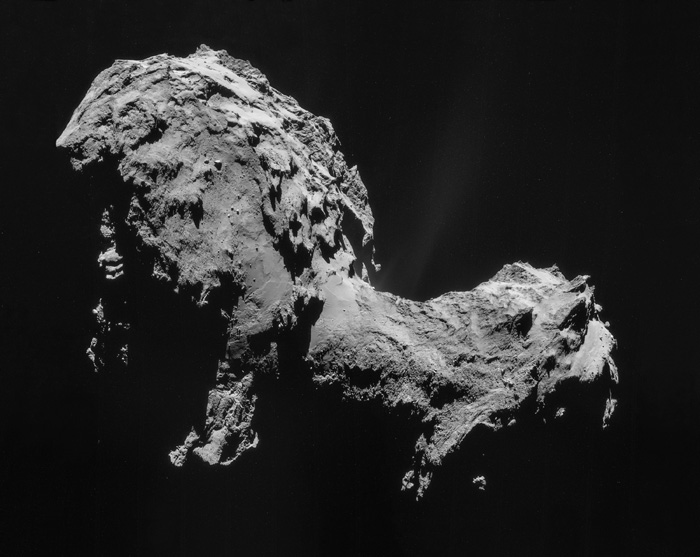
The coma of Comet Churyumov-Gerasimenko yielded both dimethyl sulfide and amino acids to the mass spectrometer carried by ESA’s Rosetta. Credit: ESA.

The discovery of possible DMS and DMDS in K2-18 b’s atmosphere is, of course, currently under intense scientific scrutiny. For a start, the statistics inherent in Madhusudhan et al.’s methodology (3σ or 99.7% probability) fall short of the ‘gold standard’ for discoveries in physics (5σ or 99.99999% probability). Moreover, there’s also a chance that exotic, inorganic chemical processes could also create the gases, such as lightning in an atmosphere containing C, H and S. But this is not the first time that DMS has been discovered in an extraterrestrial body. Comets, having formed in the infancy of the Solar System much further from the Sun than any planets, are unlikely to be ‘teeming with life’. The European Space Agency’s Rosetta spacecraft chased comet 67P/Churyumov-Gerasimenko for 2 years, directly sampling dust and gas that it shed while moving closer to the Sun. A single day’s data from Rosetta’s mass spectrometer showed up DMS, and also amino acids. Both could have formed in comets or interstellar dust clouds by chemistry driven by radiation, possibly to contaminate planetary atmospheres. Almost certainly, further remote sensing of K2-18 b will end up with five-sigma precision and some will say, ‘Yes, there is life beyond Earth!’ and celebrate wildly. But that does not constitute proof, even by the ‘weight of evidence’ criterion of some judiciaries. To me such a conclusion would be unseemly romanticism. Yet such is the vastness of the material universe and the sheer abundance of the elements C H O N and P that make up most living matter that life elsewhere, indeed everywhere, (but not life as we know it) is a near certainty. The issue of intelligent lifeforms ‘out there’ is, however, somewhat less likely to be resolved . . .

The peptide bond that holds life together may have an interstellar origin

In the 1950s Harold Urey of the University of Chicago and his student Stanley Miller used basic lab glassware containing 200 ml of water and a mix of the gases methane (CH4), ammonia (NH3) and hydrogen sulfide (H2S) to model conditions on the early Earth. Heating this crude analogue for ocean and atmosphere and continuous electrical discharge through it did, in a Frankensteinian manner, generate amino acids. Repeats of the Miller-Urey experiment have yielded 10 of the 20 amino acids from which the vast array of life’s proteins have been built. Experiments along similar lines have also produced the possible precursors of cell walls – amphiphiles. In fact, all kinds of ‘building blocks’ for life’s chemistry turn up in analyses of carbonaceous chondrite meteorites and in light spectra from interstellar gas clouds. The ‘embarrassment of riches’ of life’s precursors from what was until the 20th century regarded as the ‘void’ of outer space lacks one thing that could make it a candidate for life’s origin, or at least for precursors of proteins and the genetic code DNA and RNA. Both kinds of keystone chemicals depend on a single kind of connector in organic chemistry.

Reaction between two molecules of the amino acid glycene that links them by a peptide bond to form a dipeptide. (Credit: Wikimedia Commons)

Molecules of amino acids have acidic properties (COOH – carboxyl) at one end and their other end is basic (NH2 – amine). Two can react by their acid and basic ‘ends’ neutralising. A hydroxyl (OH) from carboxyl and a proton (H+) from amine produce water. This gives the chance for an end-to-end linkage between the nitrogen and carbon atoms of two amino acids – the peptide bond. The end-product is a dipeptide molecule, which also has carboxyl at one end and amine at the other. This enables further linkages through peptide bonds to build chains or polymers based on amino acids – proteins. Only 20 amino acids contribute to terrestrial life forms, but linked in chains they can form potentially an unimaginable diversity of proteins. Formation of even a small protein that links together 100 amino acids taken from that small number illustrates the awesome potential of the peptide bond. The number of possible permutations and combinations to build such a protein is 20100 – more than the estimated number of atoms in the observable universe! Protein-based life has almost infinite options: no wonder that ecosystems on Earth are so diverse, despite using a mere 20 building blocks. Simple amino acids can be chemically synthesised from C, H, O and N. About 500 occur naturally, including 92 found in a single carbonaceous chondrite meteorite. They vastly increase the numbers of conceivable proteins and other chain-molecules analogous to RNA and DNA: a point seemingly lost on exobiologists and science fiction writers!

Serge Kranokutski of the Max Planck Institute for Astronomy at the Friedrich Schiller University in Jena, German and colleagues from Germany, the Netherlands and France have assessed the likelihood of peptides forming in interstellar space in two publications (Kranokutski S.A. and 4 others 2022. A pathway to peptides in space through the condensation of atomic carbon. Nature Astronomy, v, 6, p. 381–386; DOI: 10.1038/s41550-021-01577-9. Kranokutski, S.A. et al. 2024. Formation of extraterrestrial peptides and their derivatives. Science Advances, v. 10, article eadj7179; DOI: 10.1126/sciadv.adj7179). In the first paper the authors show experimentally that condensation of carbon atoms on cold cosmic dust particles can combine with carbon monoxide (CO) and ammonia (NH3) form amino acids. In turn, they can polymerise to produce peptides of different lengths. The second demonstrates that water molecules, produced by peptide formation, do not prevent such reactions from happening. In other words, proteins can form inorganically anywhere in the cosmos. Delivery of these products, through comets or meteorites, to planets forming in the habitable ‘Goldilocks’ zone around stars may have been ‘an important element in the origins of life’ – anywhere in the universe. Chances are that, compared with the biochemistry of Earth, such life would be alien in an absolute sense. There are effectively infinite options for the proteins and genetic molecules that may be the basis of life elsewhere, quite possibly on Mars or the moons of Jupiter and Saturn: should it or its chemical fossils be detectable.