Drip tectonics beneath Türkiye

Tectonics and geomorphology of Turkey showing the main fault systems. The Konya basin is enclosed by the grey rectangle at centre. (Credit: Taymaz et al. Geological Society of London, Special Publication 291, p1-16, Fig 1)

The 1.5-2.0 km high Central Anatolian plateau in Türkiye has been rising since ~11 Ma ago: an uplift of about 1 km in the last 8 Ma. However, part of the southern Plateau shows signs of rapidly subsidence that has created the Konya Basin, marked by young lake sediments. Interferometric radar (InSAR) data from the European Space Agency’s Sentinel-1 satellite, which detects active movement of the Earth’s surface, reveal a crude, doughnut-shaped area of the surface that is subsiding at up to 50 mm per year. This ring of subsidence surrounds a core of active uplift that is about 50 km across (see the first figure). Expressed crudely, active subsidence suggests an excess of mass beneath the affected area, whereas uplift implies a mass deficit; in both cases within the lithosphere. So, when the InSAR data were published in 2020, it became clear that the lithosphere beneath Anatolia is doing something very strange.

Vertical velocities affecting the surface in the Konya Basin derived from InSAR data, velocities colour-coded cyan to blue show subsidence, yellow to red suggesting that the surface is rising. (Credit: Andersen et al., Fig 1c)

Canadian and Turkish geophysicists set out to find a tectonic reason for such aberrant behaviour (Andersen, A.J.  et al. 2024. Multistage lithospheric drips control active basin formation within an uplifting orogenic plateau. Nature Communications, v. 15, Article 7899; DOI: 10.1038/s41467-024-52126-7). They wondered if a process known as ‘drip tectonics’, first mooted as an explanation of anomalous features in some mountain belts in 2004 (see: Mantle dripping off mountain roots, October 2004; and A drop off the old block? May 2008) might be applicable to the Anatolian Plateau. The essence of this process is similar to the slab-pull force at the heart of subduction. Burial and cooling of basaltic material in oceanic lithosphere being driven beneath another tectonic plate converts its igneous mineralogy to the metamorphic rock eclogite, whose density exceeds that of mantle rocks. Gravity then acts to pull the changed material downwards. However, Anatolia shows little sign of subduction. But the mantle beneath shows seismic speed anomalies that hint at anomalously dense material.

Seismic tomography shows that in a large volume 100 to 200 km beneath the central part of the Plateau S-waves travel faster than in the surrounding mantle. The higher speed suggests a body that is denser and more rigid than its surroundings. This could be a sinking, detached block of ‘eclogitised’ lithosphere whose disconnection from the remaining continental lithosphere has been causing the uplift of the Plateau that began in the Late Miocene. A smaller high-speed anomaly lies directly under the Konya Basin, but at a shallower depth (50 to 80 km) just beneath the lithosphere-asthenosphere boundary. The authors suggest that this is another piece of the lower lithosphere that is beginning to sink and become a ‘drip’. Still mechanically attached to the lithosphere the sinking dense block is dragging the surface down.

Andersen et al. instead of relying on computer modelling created a laboratory analogue. This consisted of a tank full of a fluid polymer whose viscosity is a thousand times that of maple syrup that represents the Earth’s deep mantle beneath. They mimicked an overlying  plate by a layer of the same material with additional clay to render it more viscous – the model’s lithospheric mantle – with a ‘crust’ made of a sand of ceramic and silica spherules. A dense seed inserted into the model lithospheric mantle began to sink, dragging that material downwards in a ‘drip’. After that ‘drip’ had reached the bottom of the tank hours later, it became clear that another, smaller drip materialised along the track of the first and also began to sink. Monitoring of the surface of the ‘crust’ revealed that the initial drip did result in a basin. But the further down the drip fell the basin gradually became shallower: there was surface uplift. Once the initial drip had ‘bottomed-out’ the basin began to deepen again as the secondary drip formed and slowly moved downwards. The model seems to match the authors’ interpretation of the geophysics beneath the Anatolian Plateau. One drip created the potential for a lesser one, a bit like in inversion of the well-known slo-mo videos of a drop of milk falling into a glass of milk, when following the drop’s entry a smaller drop rebounds from the milky surface.
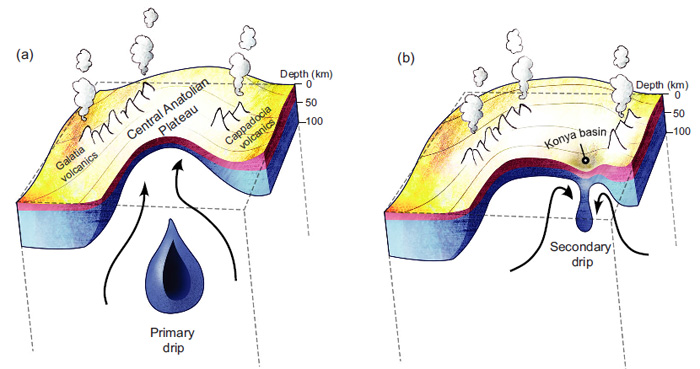
Cartoons of drip tectonics beneath the Anatolian Plateau. (a) Lower lithosphere detached from beneath Anatolia in the Late Miocene (10 to 8 Ma) descends into the mantle as it is ‘eclogitised’; (b) a smaller block beneath the Konya Basin beginning to ‘drip’, but still attached to the lithosphere. (Credit: Andersen et al., Fig 4)

In Anatolia the last 10 Ma has not been just ups and downs of the surface corresponding to drip tectonics. That was accompanied by volcanism, which can be explained by upwelling of mantle material displaced by lithospheric drips. When mantle rises and the pressure drops partial melting can occur, provided the mantle material rises faster than it can lose heat: adiabatic melting.

Brittle-ductile deformation in subduction zones

Almenning, Norway. The red-brown mineral is ga...
Eclogite: the red-brown mineral is garnet, omphacite is green and there is some white quartz.(credit: Kevin Walsh via Wikipedia)

The ultra-dense form of basalt, eclogite made from mainly garnet and a strange high-pressure, low-temperature pyroxene (omphacite) that forms from plagioclase and some of the basalt’s ferromagnesian minerals, is possibly the most important rock there is. Without the basalt to eclogite transition that takes place when ocean-floor is subducted the density of the lithosphere would be insufficient to pull more ocean floor to destruction and maintain the planetary circulation otherwise known as plate tectonics. Since the transition involves the formation of anhydrous eclogite from old, cold and wet basalt water is driven upwards into the mantle wedge that lies over subduction zones. The encourages partial melting which creates andesite magmas and island arcs, the ultimate source of the Earth’s continental crust.

Despite being cold and rigid, subducted oceanic lithosphere somehow manages to be moved en masse, showing its track by earthquakes down to almost 700 km below the Earth’s surface.  A major ophiolite in the Western Alps on the Franco-Italian border escaped complete loss to the mantle by rebounding upwards after being subducted and metamorphosed under high-P, Low-T condition when the Alps began to form. So the basaltic crustal unit is eclogite and that preserves a petrographic  record of what actually happened as it descended (Angiboust, S. et al. 2012. Eclogite breccia in a subducted ophiolite: A record of intermediate depth earthquakes? Geology, v.  40, p. 707-710). The French geologists found breccias consisting of gabbroic eclogite blocks set in a matrix of serpentinite and talc. The blocks themselves are breccias too, with clasts of eclogite mylonite set in fine-grained lawsonite-bearing eclogite. The relationships in the breccias point to possibly earthquake-related processes, grinding and fracturing basalt as it was metamorphosed: an essentially brittle process, yet the shearing that forms mylonites does seem reminiscent of ductile deformation too.

The deformation seems to have been at the middle level of oceanic crust where oceanic basalt lavas formed above cumulate gabbro, their plutonic equivalents. Yet much deformation was also at the gabbro-serpentinite or crust-mantle boundary, where water loss from serpentine may have helped lubricate some of the processes. Clearly the Monviso ophiolite will soon become a place to visit for geophysicists as well as metamorphic petrologists.

Plate tectonics monitored by diamonds

eclogite
Norwegian Eclogite. Image by kevinzim via Flickr

For more than 30 years a debate has raged about the antiquity of plate tectonics: some claim it has always operated since the Earth first acquired a rigid carapace not long after a molten state following formation of the Moon; others look to the earliest occurrences of island-arc volcanism, oceanic crust thrust onto continents as ophiolite complexes, and to high-pressure, low-temperature metamorphic rocks. The earliest evidence of this kind has been cited from as far apart in time as the oldest Archaean rocks of Greenland (3.9 Ga) and the Neoproterozoic (1 Ga to 542 Ma). A key feature produced by plate interactions that can be preserved are high-P, low-T rocks formed where old, cool oceanic lithosphere is pulled by its own increasing density into the mantle at subduction zones to form eclogites and blueschists. In the accessible crust, both rock types are unstable as well as rare and can be retrogressed to different metamorphic mineral assemblages by high-temperature events at lower pressures than those at which they formed. Relics dating back to the earliest subduction may be in the mantle, but that seems inaccessible. Yet, from time to time explosive magmatism from very deep sources brings mantle-depth materials to the surface in kimberlite pipes that are most commonly found in stabilised blocks of ancient continental crust or cratons. Again there is the problem of mineral stability when solids enter different physical conditions, but there is one mineral that preserves characteristics of its deep origins – diamond. Steven Shirer and Stephen Richardson of the Carnegie Institution of Washington and the University of Cape Town have shed light on early subduction by exploiting the relative ease of dating diamonds and their capacity for preserving other minerals captured within them (Shirey, S.B. & Richardson, S.H. 2011. Start of the Wilson cycle at 3 Ga shown by diamonds from the subcontinental mantle. Science, v. 333, p. 434-436). Their study used data from over four thousand silicate inclusions in previously dated large diamonds, made almost worthless as gemstones by their contaminants. It is these inclusions that are amenable to dating, principally by the Sm-Nd method. Adrift in the mantle high temperature would result in daughter isotopes diffusing from the minerals. Once locked within diamond that isotopic loss would be stopped by the strength of the diamond structure, so building up with time to yield an age of entrapment when sampled.  The collection spans five cratons in Australia, Africa, Asia and North America, and has an age spectrum from 1.0 to 3.5 Ga. Note that diamonds are not formed by subduction but grow as a result of reduction of carbonates or oxidation of methane in the mantle at depths between 125 to 175 km. In growing they may envelop fragments of their surroundings that formed by other processes.

A notable feature of the inclusions is that before 3.2 Ga only mantle peridotites (olivine and pyroxene) are trapped, whereas in diamonds younger than 3.0 Ga the inclusions are dominated by eclogite minerals (garnet and Na-, Al-rich omphacite pyroxenes). This dichotomy is paralleled by the rhenium and osmium isotope composition of sulfide mineral inclusions. To the authors these consistent features point to an absence of steep-angled subduction, characteristic of modern plate tectonics, from the Earth system before 3 Ga. But does that rule out plate tectonics in earlier times and cast doubt on structural and other evidence for it? Not entirely, because consumption of spreading oceanic lithosphere by the mantle can take place if basaltic rock is not converted to eclogite by high-P, low-T metamorphism when the consumed lithosphere is warmer than it generally is nowadays – this happens beneath a large stretch of the Central Andes where subduction is at a shallow angle. What Shirey and Richardson have conveyed is a sense that the dominant force of modern plate tectonics – slab-pull that is driven by increased density of eclogitised basalt – did not operate in the first 1.5 Ga of Earth history. Eclogite can also form, under the right physical conditions, when chunks of basaltic material (perhaps underplated magmatically to the base of continents) founder and fall into the mantle. The absence of eclogite inclusions seems also to rule out such delamination from the early Earth system. So whatever tectonic activity and mantle convection did take place upon and within the pre-3 Ga Earth it was probably simpler than modern geodynamics. The other matter is that the shift to dominant eclogite inclusions appears quite abrupt from the data, perhaps suggesting major upheavals around 3 Ga. The Archaean cratons do provide some evidence for a major transformation in the rate of growth of continental crust around 3 Ga; about 30-40 percent of modern continental material was generated in the following 500 Ma to reach a total of 60% of the current amount, the remaining 40% taking 2.5 Ga to form through modern plate tectonics

Bouncing back from the deep

eclogite
Eclogite from Norway. Image by kevinzim via Flickr

Because the average density of the rocks making up the continental crust is about 2.7 t m-3 while that of the mantle is greater than 3.0 t m-3 it might seem as though continents cannot be subducted. Indeed, that was one of the first principles of plate tectonics, which would account for continental crust dating back to 4000 Ma, whereas there is no oceanic crust older than about 150 Ma. In the southern foothills of the Alps in Piemonte, Italy is a site which refutes the hypothesis in a stunning fashion. The minor ski resort of Monte Mucrone is backed by cliffs in what to all appearances is a common-or-garden granite: it even seems to contain phenocrysts of plagioclase feldspar. Microscopic examination of the megacrysts reveals them to be made up of a complex intergrowth between jadeite, a high-pressure sodic pyroxene, and quartz. This is exactly what should form if albite, the sodium-rich kind of plagioclase feldspar, if it descended to depths over 70 km below the surface, i.e. to mantle depths.

Monte Mucrone proves that continental materials can be subducted, but also reveals that these granites popped back up again when the forces of subduction were relieved at the end of the Alpine orogeny. Other examples have since turned up, but few so spectacular as continental rocks from Switzerland (Herwartz, D. et al. 2011. Tracing two orogenic cycles in one eclogite sample by Lu-Hf garnet chronometry. Nature Geoscience, v. 4, p. 178-183). The Adula nappe of the Swiss Lepontine Alps consists of granitoid gneisses and metasediments of continental affinities, associated with mafic and ultramafic metamorphic rocks. The mafic rocks include eclogites typical of high-pressure, low-temperature metamorphism characteristic of subduction. Their minerals record formation temperatures around 680°C at a depth of more than more than 80 km. Eclogites are beautiful green and red rocks containing high-pressure omphacite pyroxene and pyrope garnet. Garnets generally contain abundant rare-earth elements especially those with the highest atomic numbers. One of these is lutetium (Lu) that has a radioactive isotope 176Lu with a half-life of 3.78×10¹⁰ years to yield a daughter isotope of hafnium 176Hf; garnets can be dated using this method. Garnets are frequently zoned, and the Adula eclogites clearly show several generations of zonation. Zoning can form as metamorphic conditions change, so in itself is not unusual, but dating different generations is. The German team from the Universities of Bonn, Cologne and Münster found that the garnets defined two distinct isochrons, one of Variscan age of just over 330 Ma, the other Alpine around 38 Ma. Clearly the pre-Variscan crust (probably once part of the African continent) had been subducted twice but had wrested itself clear of the mantle’s clutches on both occasions, each time remaining more or less intact. One idea that stems from this coincidence is that the Variscan mountain belt that formed at the earlier subduction zone subsequently split at its high P – low T core, so that the eclogites lay at a new continental margin and could suffer the same extreme compression when new subduction began there.

It also turns out that the region in which  Monte Mucrone lies, the Sesia zone of the Western Alps, also records a double whammy of continental subduction, but a repetition that occurred during the early events of the  Alpine orogeny (Rubatto, D. et al. 2011. Yo-yo subduction recorded by accessory minerals in the Italian Western Alps. Nature Geoscience, v. 4, p. 338-342). The team of Australian, Swiss and Italian geologists focused on the P-T record preserved in zoned garnets, allanites and zircons and evidence for two generation of white micas in eclogites and blueschists. Backed by U-Pb dating of zircon and allanite zones, the authots uncovered two episodes of deep subduction separated by period of rapid exhumation over the period between 79 to 65 Ma ago. The double subduction took place while the African plate converged obliquely with Eurasia; a strike-slip configuration that probably resulted in large-scale switches from compression to extension.

See also: Bruekner, H.K. 2011. Double-dunk tectonics. Nature Geoscience, v. 4, p. 136-138