When giant worms roamed the seas!

At the start of the Cambrian Period animal life began to diversify from that of the Ediacaran world. For the first time sediments on the seafloor were explored for sustenance, leading to a variety of burrows that disrupted fine depositional layers. The basal Cambrian sandstones found in Britain and elsewhere are pervasively bioturbated: good evidence for the start of a ‘Worm world’ that marks the Precambrian-Phanerozoic boundary. That is probably a misnomer for the shallow seabed of that time, as fossils of burrowers with a variety of hard parts turn up in the oldest Cambrian sequences. Also appearing for the first time are tooth-like microfossils that took on such a range of bizarre shapes that they have long been used for correlating sedimentary strata in the absence of larger creatures. Some of these conodonts have been attributed to early vertebrates akin to modern lampreys and hag fish, but others may have been the grasping mouth-spines of a group of predatory worms which also survive to the present: chaetognaths. Apart from these oral spines chaetognaths lack hard parts, so anatomical details of ancient ones are only found in sites of exquisite preservation or lagerstätten. In such rare, tranquil places soft tissues such as muscles may be preserved by phosphatisation during decay.
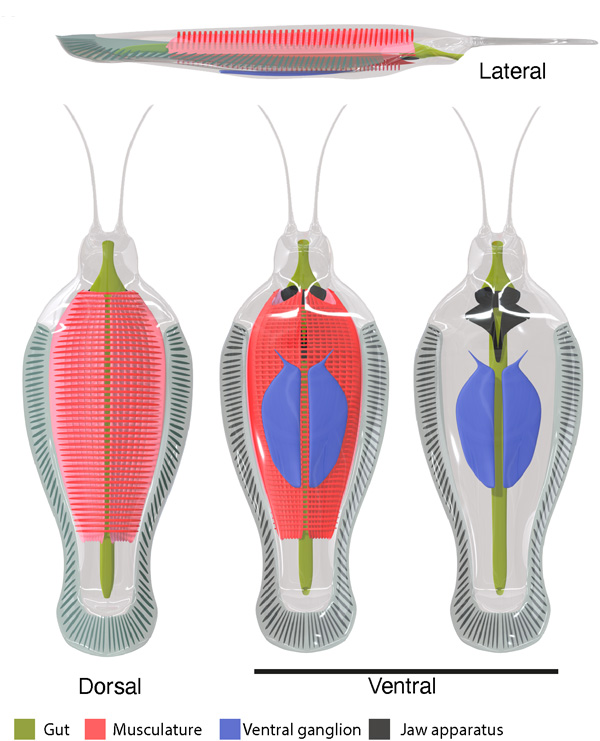
Reconstruction of Timorebestia koprii showing its musculature, nerve system and mouthparts, It probably propelled itself by fluttering its outer and rear flaps, much like a modern flatfish. Credit: Park et al., Fig 4

One of the earliest Phanerozoic lagerstätten (Sirius Passet) occurs in northern Greenland. It is curiously named after the Sirius Dog Sled Patrol, an elite pair of naval troops with a sledge and 12 dogs that enforces Danish sovereignty over the Greenlandic shore of the Arctic Ocean. The Sirius Passet fauna includes a monstrous chaetognath over 30 cm long (Park, T.-Y. S. and 12 others 2024. A giant stem-group chaetognath. Science Advances, v. 10 article eadi6678; DOI: 10.1126/sciadv.adi6678). It is called Timorebestia koprii (Timorebestia is Latin for ‘terror beast’) and was related to the living, but tiny, arrow worms that prey on zooplankton in modern oceans. This description and moniker may seem to be somewhat hyperbolic, but Timorobestia outranks in size any Early Cambrian predatory arthropods. It was probably high in the Early Cambrian trophic pyramid, but was soon relegated by the later Cambrian rise of trilobites and then of cephalopods and eventually jawed vertebrate fishes in the Silurian. One specimen contained shells of a swimming arthropod whose protective spines did not deter the ‘terrible’ chaetognath from swimming them down.

See also: ‘Giant’ predator worms more than half a billion years old discovered in North Greenland. Science Daily, 3 January 2024.

Land almost colonized during the Cambrian Explosion

One of the major shale-gas source strata in the eastern USA, the Middle Cambrian Conasauga Shale, formed in a shallow inland sea. Consequently the sedimentology of the lowest Palaeozoic Era of the region and the strange structures affecting it during deformation that formed the Appalachian Mountains have become a focus of intense tectonic and stratigraphic interest – economic potential generally helps fund academic research at a time when money for pure science is short. This has extended into the deepest part of the Cambrian lying unconformably just above the crystalline Precambrian basement. The Lower Cambrian of the Appalachians marks the earliest stage of rifting that flooded former dry land and comprises the multicoloured mudstones, siltstones and sandstones of the Rome Formation. Though only sparsely fossiliferous, the Rome formation contains archetypical trilobites of the genus Olenellus, typical of the Lower Cambrian and used to correlate sedimentary rocks of this age far and wide. They occur far across the North Atlantic in coeval rocks of the Northwest Highlands of Scotland, but not in those a mere couple of hundred kilometres to the south in Wales. This faunal disparity forms a major line of evidence that the olenelid fauna occupied one side of a once major ocean – Iapetus – another different bunch of early trilobites being characteristic of its opposite flank. The almost hemispherical extent of similar faunas was long regarded as an indication that they inhabited open ocean water. In fact, their wide distribution is as much due to juvenile arthropods being planktonic, while adults may have occupied all sorts of marine environments. It now turns out that Olenellus lived in very shallow water (Mángano, M.G. et al. 2014. Trilobites in early Cambrian tidal flats and the landward expansion of the Cambrian explosion. Geology, online pre-publication doi:10.1130/G34980.1).

Illustration of Olenellus thompsoni.png

Gabriela Mángano of the University of Saskatchewan and colleagues from Argentina and the US found that the Rome Formation is full of sedimentary structures typical of modern intertidal zones. Tidal-flat strata are full of suncracks but are also criss-crossed by tracks made by substantial arthropods, only fossil olenellid trilobites being big enough to have made them while feeding , maybe on microbial mats formed on the mudflats or on worms that burrowed the muds. Clearly these animals were literally only a few steps away from colonising the land very shortly after abundant, sturdy animal life appeared in the Cambrian Explosion. Currently the dominant hypothesis for permanent entry of animals onto land is that the colonizers first adapted to fresh- or brackish water habitats. Yet, apparently, there was little to stop a direct invasion from the sea.

Enhanced by Zemanta

Earliest animals from continental environments

Skolithos trace fossil. Scale bar is 10 mm.
Skolithus burrows. Image via Wikipedia

Following closely on discovery in 1 Ga old sediments of the earliest evidence for eukaryote life in continental environments (see Eukaryote conquest of the continents posted June 11, 2011) it seems that metazoan animals colonised non-marine environments earlier than had previously been thought. Up to now most palaeontologists believed that there was a lag of at least 80 Ma between the emergence of marine bilaterian metazoans and their expansion into freshwater, due to a number of physiological hurdles that had to be overcome, such as regulation of trace element chemistry within their cells and bodily fluids. It has been know for more than a century that the first signs of sturdy animals in the marine realm are burrows in tidal sediments that formed more or less at the Cambrian-Precambrian boundary; the earlier sac-like Ediacaran fauna seemed ill-suited to a burrowing or infaunal habitat. A considerable thickness of clastic sediments occur in the Cambrian of eastern California, USA. The earliest are clearly shallow-marine and contain abundant evidence of burrowing. Succeeding them are intensively studied fluviatile sands and silts that have been used a model for sedimentation in the absence of the stabilising influence of land plants. What has been overlooked until recently is evidence for colonisation of the river-laid deposits by burrowing animals (Kennedy, M.J. & Droser, M.L. 2011. Early Cambrian metazoans in fluvial environments, evidence of the non-marine Cambrian radiation. Geology, v. 39, p. 583-586).

The burrows include the vertical U-shaped forms given the name Arenicolites, which is the most common trace fossil, simple vertical tubes (Skolithus) and horizontal, meandering tubes with furrowed sides (Psammichnites). Anyone who has seen the Early Cambrian Pipe Rock of NW Scotland will also have seen these trace fossils, yet the Pipe Rock shows evidence of tidal deposition and is shallow marine. Their non-marine equivalents in California are coeval with the earliest known trilobites in the Cambrian marine sequence. It seems that whatever the burrowing animals were, they easily overcame any physiological or environmental barriers to adopting a life in freshwater, encouraged by the ready sustenance that terrestrially adapted acritarchs and cyanobacteria had provided for half a billion years previously.