

About 530 Ma ago most of the basic body plans of today’s living organisms can be detected as fossils, i.e. preserved hard parts. Yet studies of trace fossils (ichnofossils) – marks left in sediments by active soft bodied creatures suggest that many modern phyla arose before the start of the Cambrian (~539 Ma), as early as 545 Ma. So the term ‘Cambrian explosion’ seems to be a bit of a misnomer on two counts: it lasted around 15 Ma and began before the Cambrian. Preceding it was the Ediacaran Period that began around 100 Ma earlier in the Neoproterozoic Era. Traces of its eponymous fauna of large soft-bodied organisms are found on all continents, but apparently none of them made it into the Phanerozoic fossil record. Another characteristic of the Ediacaran is that its sedimentary rocks – and those of earlier times – show no signs of burrowing: they are not bioturbated. That may be why the Ediacaran pancake-, bun-, bag- and pen-like lifeforms are so remarkably well preserved. But a lack of burrowing did not extend to the beginning of Cambrian times. The most likely reason why it was absent during the early Ediacaran Period is that sea-floor sediments then were devoid of oxygen so eukaryote animals could not live in them. But the presence of these large organisms showed that seawater must have been oxygenated. Now clear signs of burrowing have emerged from study of Ediacaran rocks exposed in the Yangtze Gorge of Hubei,southern China ( Zhe Chen & Yarong Liu 2025. Advent of three-dimensional sediment exploration reveals Ediacaran-Cambrian ecosystem transition. Science Advances, v. 11, article eadx9449; DOI: 10.1126/sciadv.adx9449).
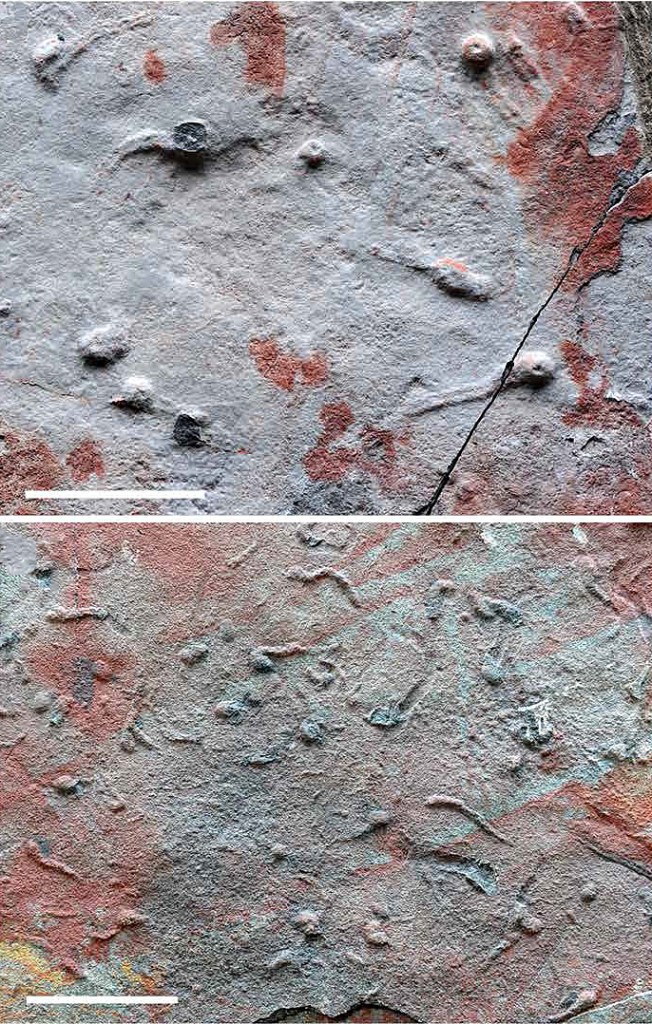
Zhe Chen and Yarong Liu of the Nanjing Institute of Geology and Palaeontology and Chinese Academy of Sciences in China examined carbonates of the upper Ediacaran Dengying Formation. This overlies the Doushantuo Formation (550 to 635 Ma), known for tiny fossils of possibly the oldest deuterostome Saccorhytus coronaries; a potential candidate for the ancestor of modern bilaterian phyla. In the Yangtze Gorge locality sediments at this level show only traces of browsing of bacterial mats on the sediment surface; i.e. 2-D feeders. The basal Dengying sediments host clear signs that organisms could then penetrate into the sediments. These 3-D feeders , would have had access to buried organic remains, hitherto unexploited by living organisms. Such animal-sediment interactions would have disturbed and diminished the living microbial mats that held the sediment surface in place, and thus began to dismantle the substrate for the typical Edicaran fauna. Similar 3-D feeders occur throughout the 11 Ma represented by the Dengying Formation to the start of the Cambrian. This beginning of bioturbation heralded a period during which the Ediacaran fauna steadily waned. It also released nutrients into deep water, and opened up new ecological niches for more advanced animals on the seabed. Dissolved oxygen could only slowly enter the sediments since atmospheric and oceanic O2 levels were low. But by the earliest Cambrian it had risen to about 5 to 10% by volume to support many other kinds of burrowing animals that could penetrate more deeply, as witnessed by the abundant sandstones that occur at the base of the Cambrian in Britain.

 Earth-logs