A sudden collapse of global climate around 12.8 ka and equally brusque warming 11.5 ka ago is called the Younger Dryas. It brought the last ice age to an end. Because significant warming preceded this dramatic event palaeoclimatologists have pondered its cause since it came to their attention in the early 20th century as a stark signal in the pollen content of lake cores – Dyas octopetala, a tundra wild flower, then shed more pollen than before or afterwards; hence the name. A century on, two theories dominate: North Atlantic surface water was freshened by a glacial outburst flood that shut down the Gulf Stream [June 2006]; a large impact event shed sufficient dust to lower global temperatures [July 2007]. An oceanographic event remains the explanation of choice for many, whereas the evidence for an extraterrestrial cause – also suggested to have triggered megafaunal extinctions in North America – has its supporters and detractors. The first general reaction to the idea of an impact cause was the implausibility of the evidence [November 2010], yet the discovery by radar of a major impact crater beneath the Greenland ice cap [November 2018] resurrected the ‘outlandish’ notion. A recent paper in Nature: Scientific Reports further sharpens the focus.
Temperature fluctuations over the Greenland ice cap during the past 17,000 years, showing the abrupt cooling during the Younger Dryas. (credit: Don Easterbrook)
Because the configuration of continents inevitably affects the ocean currents that dominate the distribution of heat across the face of the Earth, tectonics has a major influence over climate. So too does the topography of continents, which deflects global wind patterns, and that is also a reflection of tectonic events. For instance, a gap between North and South America allowed exchange of the waters of the Pacific and Atlantic Oceans throughout the Cenozoic Era until about 3 Ma ago, at the end of the Pliocene Epoch, although the seaway had long been shallowing as a result of tectonics and volcanism at the destructive margin of the eastern Pacific. That seemingly minor closure transformed the system of currents in the Atlantic Ocean, particularly the Gulf Stream, whose waxing and waning were instrumental in the glacial-interglacial cycles that have persisted for the last 2.5 Ma. This was partly through its northward transport of saltier water formed by tropical evaporation that cooling at high northern latitudes encouraged to sink to form a major component of the global oceanic heat conveyor system. Another example is the rise of the Himalaya following India’s collision with Eurasia that gave rise to the monsoonal system dominating the climate of southern Asia. The four huge climatic shifts to all-pervasive ice-house conditions during the Phanerozoic Eon are not explained so simply: one during the late-Ordovician; another in the late-Devonian; a 150 Ma-long glacial epoch spanning much of the Carboniferous and Permian Periods, and the current Ice Age that has lasted since around 34 Ma. Despite having been at the South Pole since the Cretaceous Antarctica didn’t develop glaciers until 34 Ma. So what may have triggered these four major shifts in global climate?
Five palaeoclimatologists from the University of California and MIT set out to find links, starting with the most basic parameter, how atmospheric greenhouse gases might have varied. In the long term CO2 builds up through its emission by volcanoes. It is drawn down by several geological processes: burial of carbon and carbonates formed by living processes; chemical weathering of silicate minerals by CO2 dissolved in water, which forms solid calcium carbonate in soil and carbonate ions in seawater that can be taken up and buried by shell-producing organisms. Rather than comparing gross climate change with periods of orogeny and mountain building, mainly due to continent-continent collisions, they focused on zones that preserve signs of subduction of oceanic lithosphere – suture zones (Macdonald,F.A. et al. 2019. Arc-continent collisions in the tropics set Earth’s climate state. Science, v. 363 (in press); DOI: 10.1126/science.aav5300 ). Comparing the length of all sutures active at different times in the Phanerozoic with the extent of continental ice sheets there is some correlation between active subduction and glaciations, but some major misfits. Selecting only sutures that were active in the tropics of the time – the zone of most intense chemical weathering – results in a far better tectonic-climate connection. Their explanation for this is not tropical weathering of all kinds of exposed rock but of calcium- and magnesium-rich igneous rocks; basaltic and ultramafic rocks. These dominate oceanic lithosphere, which is exposed to weathering mainly where slabs of lithosphere are forced, or obducted, onto continental crust at convergent plate margins to form ophiolite complexes. The Ca- and Mg-rich silicates in them weather quickly to take up CO2 and form carbonates, especially in the tropics. Through such weathering reactions across millions of square kilometres the main greenhouse gas is rapidly pulled out of the atmosphere to set off global cooling.
Top – variation in the total length of active, ophiolite-bearing sutures during the Phanerozoic; middle – length of such sutures in the tropics; bottom – extent of Phanerozoic glaciers. (Credit: Macdonald et al. 2019; Fig.2
Rather than the climatic influence of tectonics through global mountain building, the previous paradigm, Macdonald and colleagues show that the main factor is where subduction and ophiolite obduction were taking place. In turn, this very much depended on the configuration of continents on which ophiolites can be preserved. The most active period of tectonics during the Mesozoic, as recorded by the global length of sutures, was at 250 Ma – the beginning of the Triassic Period – but they were mainly outside the tropics, when there is no sign of contemporary glaciation. During the Ordovician, late-Devonian and Permo-Carboniferous ice-houses active sutures were most concentrated in the tropics. The same goes for the build-up to the current glacial epoch.
As shown by oxygen-isotope records from marine sediments, before about 1.25 Ma global climate cycled between cold and warm episodes roughly every 41 ka. Between 1.25 to 0.7 Ma these glacial-interglacial pulses lengthened to the ~100 ka periods that have characterised the last seven cycles that were also marked by larger volume of Northern Hemisphere ice-sheet cover during glacial maxima. Both periodicities have been empirically linked to regular changes in the Earth’s astronomical behaviour and their effects on the annual amount of energy received from the Sun, as predicted by Milutin Milankovich. As long ago as 1976 early investigation of changes of oxygen isotopes with depth in deep-sea sediments had revealed that their patterns closely matched Milankovich’s hypothesis. The 41 ka periodicity matches the rate at which the Earth’s axial tilt changes, while the ~100 ka signal matches that for variation in the eccentricity of Earth’s orbit. 19 and 24 ka cycles were also found in the analysis that reflect those involved in the gyroscope-like precession of the axis of rotation. Surprisingly, the 100 ka cycling follows by far the weakest astronomical effect on solar warming yet the climate fluctuations of the last 700 ka are by far the largest of the last 2.5 million years. In fact the 2 to 8 % changes in solar heat input implicated in the climate cycles are 10 times greater than those predicted even for times when all the astronomical influences act in concert. That and other deviations from Milankovich’s hypothesis suggest that some of Earth’s surface processes act to amplify the astronomical drivers. Moreover, they probably lie behind the mid-Pleistocene transition from 41 to 100 ka cyclicity. What are they? Changes in albedo related to ice- and cloud cover, and shifts in the release and absorption of carbon dioxide and other greenhouse gases are among many suggested factors. As with many geoscientific conundrums, only more and better quality data about changes recorded in sediments that may be proxies for climatic variations are likely to resolve this one.
Adam Hazenfratz of ETH in Zurich and colleagues from several other European countries and the US have compiled details about changing surface- and deep-ocean temperatures and salinity – from δ18O and Mg/Ca ratios in foraminifera shells from a core into Southern Ocean-floor sediments – that go back 1.5 Ma (Hazenfratz, A.P. and 9 others 2019. The residence time of Southern Ocean surface waters and the 100,000-year ice age cycle. Science, v. 363, p. 1080-1084; DOI: 10.1126/science.aat7067). Differences in temperature and salinity (and thus density) gradients show up at different times in this critical sediment record. In turn, they record gross shifts in ocean circulation at high southern latitudes that may have affected the CO2 released from and absorbed by sea water. Specifically, Hazenfratz et al. teased out fluctuations in the rate of mixing of dense, cold and salty water supplied to the Southern Ocean by deep currents with less dense surface water. Cold, dense water is able to dissolve more CO2 than does warmer surface water so that when it forms near the surface at high latitudes it draws down this greenhouse gas from the atmosphere and carries it into long-term storage in the deep ocean when it sinks. Deep-water formation therefore tends to force down mean global surface temperature, the more so the longer it resides at depth. When deep water wells to the surface and warms up it releases some of its CO2 content to produce an opposite, warming influence on global climate. So, when mixing of deep and surface waters is enhanced the net result is global warming, whereas if mixing is hindered global climate undergoes cooling.
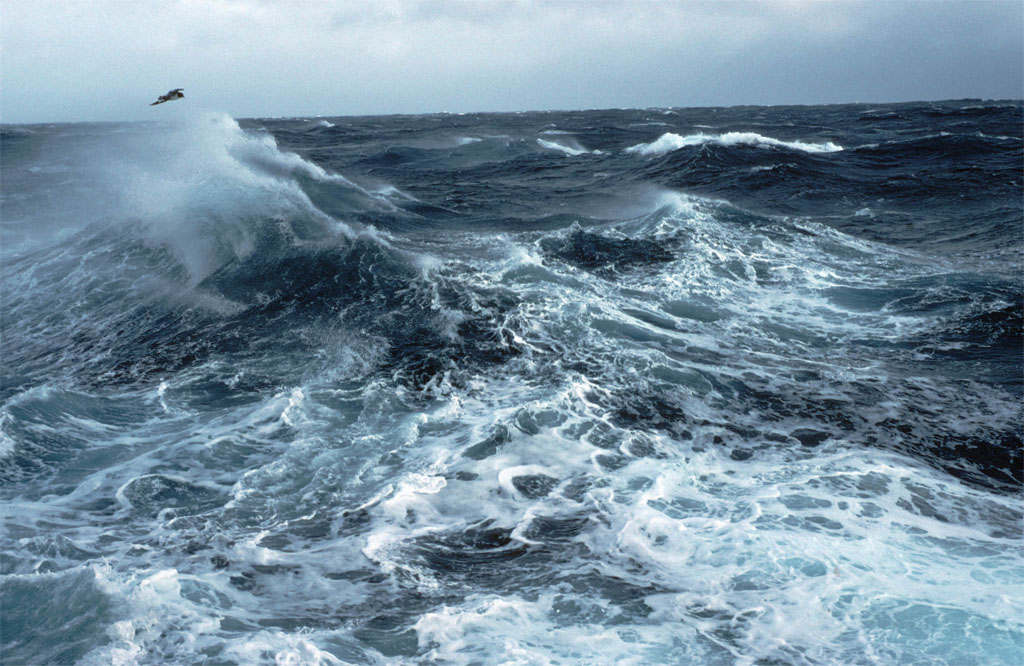
The Southern Ocean, where most dissolved and gaseous carbon dioxide are emitted and absorbed by seawater (Credit: British Antarctic Survey)
The critical factor in the rate of mixing deep with surface water is the density of that at the surface. When its salinity and density are low the surface water layer acts as a lid on what lies beneath, thereby increasing the residence time of deep water and the CO2 that it contains. This surface ‘freshening’ in the Southern Ocean seems to have begun at around 1.25 Ma and became well established 700 ka ago; that is, during the mid-Pleistocene climate transition. The phenomenon helped to lessen the greenhouse effect after 700 ka so that frigid conditions lasted longer and more glacial ice was able to accumulate, especially on the northern continents. This would have made it more difficult for the 41 ka astronomically paced changes in solar heating to have restored the rate of deep-water mixing to release sufficient CO2 to return the climate to interglacial conditions That would lengthen the glacial-interglacial cycles. The link between the new 100 ka cyclicity and very weak forcing by the varying eccentricity of Earth’s orbit may be fortuitous. So how might anthropogenic global warming affect this process? Increased melting of the Antarctic ice sheet may further freshen surface waters of the Southern Ocean, thereby slowing its mixing with deep, CO2-rich deep water and the release of stored greenhouse gases. As yet, no process leading to the decreased density of surface waters between 1.25 and 0.7 Ma has been suggested, but it seems that something similar may attend global warming.



 Earth-logs