Life at the battery terminal

Mussels of species Bathymodiolus childressi (B...
Hydrothermal-vent mussel Bathymodiolus. Image via Wikipedia

Having an interior that is dominated by reducing conditions and oxidising surface environments since free oxygen gradually permeated from its initial build up in the atmosphere to the ocean depths, the Earth has been likened to a massive self-charging battery. Electrons flow continually as a consequence of the nature of the linked oxidation-reduction: in terms of electrons, oxidation involves loss while reduction involves gain (the OILRIG mnemonic). Although there are natural electrical currents, most of the electron flow is in the form of reduced compounds rich in electrons that make their way through the flow of fluids from the deep Earth – effectively an anode – towards the surface  where the reduced compounds lose electrons to create the equivalent of a cathode. Reduction-oxidation (redox) is therefore a power source. Inorganic reactions, such as the precipitation on the sea floor of sulfides from hydrothermal fluids at ‘black smokers’ dissipate energy. Yet the power has considerable potential for organic life. Some bacteria oxidise hydrogen sulfide carried by hydrothermal fluids and others do the same to upwelling methane. In 1977 a teeming biome of worms, molluscs and higher animals was discovered in a totally dark environment around ocean-floor vents. It soon became clear that it could only subsist on chemical energy of this kind, rather than any form of photosynthesis. The key to some metazoans’ success had to be symbiosis with bacteria that could perform the chemical tricks possible in the cathode region of the Earth’s electron flow. There are several candidate compounds: H2S, CH4, NH4, metal ions and even hydrogen gas.

As hydrothermal fluids cycle ocean water into the basaltic crust and underlying peridotite mantle, they not only hydrate the olivines and pyroxenes that dominate the oceanic lithosphere but trigger other reactions one of whose products is hydrogen. As well as a reaction being eyed by those keen on a cheap source of clean fuel, it generates more energy potential for biological metabolism in the guise of hydrogen than those which form other common compound in the returning fluids. Although the nature of hydrogen’s organic use has been elusive, it has now come to light in a surprising guise (Petersen, J.M. and 14 others 2011. Hydrogen is an energy source for hydrothermal vent symbioses. Nature, v. 476, p. 176-180).

One highly successful animal in ocean-floor hot spring systems is a mussel called Bathymodiolus. Genetic experiments by the German-French-US team revealed that a gene known as hupL is present in the mussels’ gill tissue; a gene found in bacteria that use either carbon monoxide or hydrogen as an electron donor. The hupL gene encodes for enzymes known as hydrogenases that are needed to set off the reaction H2 = 2H+ + 2e that provides electrons needed in bacterial metabolism; a sort of living fuel cell. Hydrogen-using bacteria interact symbiotically with the mussels, which would otherwise be unable to live in the pitch black environment. Genomic sequencing of tube worms and shrimps that occur in the vent communities also contain the bacterial hupL gene. Hydrogenase enzymes are proteins with an iron-nickel core, and probably evolved far back in bacterial evolution around metal-rich hot springs. Interesting as the specific detail of hydrogen-based symbiosis is, the general concept of Earth’s redox systems’ having battery-like behaviour is very useful. On land groundwater sometimes comes into contact with sulfide ore bodies that are oxidised to yield hydrogen and sulfate ions ,while the groundwater is reduced: a battery comes into being with a cathode in the aerated groundwater and electrons flow from the unaltered orebody towards it. Such currents are useful in revealing hidden orebodies using the ‘self-potential’ or SP method. Indeed the downward change from oxidising to reducing groundwater, caused by the redox reactions involved in weathering and soil formation also result in weak negative and positive ‘electrodes’ with a sluggish flow of compounds that bacteria can exploit and thereby encourage metazoan life through symbiosis. In doing so, changes in redox conditions affect the inorganic load of the slowly moving groundwater so that reduced metal ions can be precipitated once they rise into the oxidising horizon. The general enrichment of the upper horizons of soils in iron oxides and hydroxides, and metal depletion in lower horizons probably stem from the ‘Earth battery’ produced by an interplay between inorganic and organic redox reactions. Be on the look-out for more on this topic as the quest for hydrogen fuels becomes more urgent. A former colleague, Gordon Stanger, investigating groundwater in the Semail ophiolite of the Oman for his PhD in the 1970s discovered to his surprise that in outcrops of the mantle sequence there were springs from which hydrogen bubbled freely: fortunately he was not a smoker…

Feathers will fly: Archaeopteryx relegated

Archaeopteryx
A not unimaginative reconstruction of Archaeopteryx. Image via Wikipedia

This year, 2011, is the 150th anniversary of the first Archaeopteryx specimen being unearthed from the famous Solnhofen  limestone lagerstätte. With its feathered, lizard-like tail; two-clawed, stubby wings; a bill-shaped muzzle with teeth but no keratin coating; feet capable of perching and unlike those of small dinosaurs; a ‘wishbone’ and lightweight bones, Archaeopteryx was just the half-and-half missing link in the fossil record so desperately needed to support Darwin’s Origin of Species, published two years beforehand.  It has remained controversial ever since, even having been claimed to be a forgery by such luminaries as cosmologist Fred Hoyle in 1985, despite its superbly preserved intricacies and the existence at the time of 6 slightly different specimens from the same source some discovered long after Hoyle’s supposed master craftsman must have died. Creationists soon after the first discovery claimed it was simply a bird created on a Friday together with fish (Genesis 1:20) and must have predated dinosaurs by a day, as they were created on the 6th Day along with all the ‘cattle and creeping thing and beast of the earth’ (Genesis 1:24-31). That scurrilous sect will certainly leap gleefully on the new discovery of a feathered dinosaur from the ever productive Late Jurassic Tiaojishan Formation in NE China (Xu, X. et al.2011. An Archaeopteryx-like theropod from China and the origin of the Avialae. Nature, v. 475, p. 465-470) because ironically, by itself, it could be said to be a missing link too.

Archaeopteryx lithographica, specimen displaye...
Cast of the first-described Archaeopteryx fossil. Image via Wikipedia

In fact, Xiaotingia zhengi possesses features very like those displayed by Archaeopteryx but convincingly close affinities to deinonychosaurian dinosaurs. The shared features show that neither is a bird (Avialae) and nor are they part of the clade that evolved to birds: they are part of the growing group of feathered dinosaurs that may well have glided or even flown. As Lawrence Witmer of Ohio University has observed (Witmer, L.M. 201. An icon knocked off its perch. Nature, v. 475, p. 458-459), ‘This finding is likely to be met with considerable controversy (if not outright horror)…’. However, Witmer still considers Archaeopteryx to have iconic status, indeed yet more, for its taxonomy and that of its related feathery dinosaurs provides compelling evidence that the origin and evolution of life was a ‘rather messy affair’. Undoubtedly, more feathered creatures hundreds of million years old will be unearthed; it is even possible that further finds will push the beast of Solnhofen back onto its avian perch. Let the celebrations begin!

Added 12 August 2011: Ironically, yesterday the German mint issued a €10 silver coin commemorating the 150th anniversary of the first discovery of Archaeopteryx, artwork of the skeleton with fully fledged arms on the reverse side of the coin compared with the stylised German eagle on the front. This event coincides with the greatest crisis facing the eurozone in its short history, though Germany still retains its ‘triple A’ financial status unlike France and the US. See: http://witmerlab.wordpress.com/2011/01/31/evolution-icon-archaeopteryx-turns-150-this-year-how-are-we-celebrating/

From small beginnings

Camarasaurus, Brachiosaurus, Giraffatitan, Euh...
Some really cool sauropods. Image via Wikipedia

The great vegetarian sauropod dinosaurs, such as Brachiosaurus, were the biggest animals to walk the Earth, weighing up to 100 tonnes, as long as 60 m from snout to the end of their tails and more than 10 m tall. So big, indeed, that even the largest contemporary predators would have been unable to get sufficient purchase with their jaws to do them much damage. This vast bulk, unlike even bigger modern whales, was unsupported by water and would have posed major problems had the sauropods not evolved very porous, low-density neck and tail bones and kept their heads small relative to the rest of their bodies. Such small heads needed to take in up to a tonne of vegetation each day to keep the monsters alive and  ambling. Their teeth are not those of a chewer, being peg- or spoon-like and pointed forwards; specialised for raking in leaves and twigs, swallowed unchewed in great gulps. Once that style of eating developed in their precursors, with no need for massive chewing muscles it became possible to evolve necks up to 15 m long with increasingly diminutive heads. Studies of large numbers of some species of sauropod precursors indicate that juveniles grew astonishingly quickly, essential if their initial vulnerability was to be outpaced; newly hatched they would have weighed little more than 10 kg. At the growth rates of modern reptiles, the largest sauropods would only have reached full size in about a century. The estimated growth rates suggest warm bloodedness, research suggesting that they maintained body temperatures up to 12°C higher than do alligators. Clearly, sauropod dinosaurs were highly specialised, and their evolution is now known to have been lengthy.

A major news feature in Nature (Heeren, F. 201. Rise of the titans. Nature, v. 475, p. 159-161) traces that evolution through several surprising stages. The earliest likely ancestors, which appear in the Late Triassic (~230 Ma), were about the size of a turkey and had teeth adapted for shredding fibrous plant material; other early dinosaurs show clear signs of a predatory lifestyle. There is a limit to the size of predators bound up with the energy balance between flesh consumption and the energy expended in casing down prey and killing them. The limits on the size of plant eaters are mechanical: how much they can stuff in and the strength of their bodies, especially legs. In a world dominated in numbers by predatory dinosaurs, the selection pressure for herbivores to outgrow them and become too big to bite would have been substantial.

Little Triassic Panphagia (‘eater of everything’) was also bipedal, but the fossil record of sauropod precursors clearly shows their growth to the order of 10 m by the Early Jurassic, but not yet a four-legged gait though they had evolved relatively short but sturdy legs, signs of mass-saving porous neck and tail bones, and jaws with a large gape suited to gulping rather than chewing. By the mid-Jurassic Period sauropods were big, strong and four-legged, and by the Cretaceous they reached unmatched dimensions with the titanosaurs. This evolutionary path was not the only one adopted for dinosaurian herbivory. The famous Iguanodon discovered in 1822 by Gideon Mantell in the Early Cretaceous of Sussex was a member of a bipedal group of herbivores, including the duck-billed dinosaurs, that spanned more or less the same time range as sauropods. Fredric Heeren’s article is accompanied by an on-line ‘tour’ of sauropod evolution (go.nature.com/c7zlct), while the American Museum of Natural History has a website for a major exhibition of sauropods (www.amnh.org/exhibitions/wld/ and http://www.youtube.com/AMNHorg ) that includes footage of  a full-scale animatronic Mamenchisaurus from China which breathes and moves, (Switek, B. 2011. Living it large: review of The World’s Largest Dinosaurs exhibition. Nature, v. 475, p. 172).

Earliest animals from continental environments

Skolithos trace fossil. Scale bar is 10 mm.
Skolithus burrows. Image via Wikipedia

Following closely on discovery in 1 Ga old sediments of the earliest evidence for eukaryote life in continental environments (see Eukaryote conquest of the continents posted June 11, 2011) it seems that metazoan animals colonised non-marine environments earlier than had previously been thought. Up to now most palaeontologists believed that there was a lag of at least 80 Ma between the emergence of marine bilaterian metazoans and their expansion into freshwater, due to a number of physiological hurdles that had to be overcome, such as regulation of trace element chemistry within their cells and bodily fluids. It has been know for more than a century that the first signs of sturdy animals in the marine realm are burrows in tidal sediments that formed more or less at the Cambrian-Precambrian boundary; the earlier sac-like Ediacaran fauna seemed ill-suited to a burrowing or infaunal habitat. A considerable thickness of clastic sediments occur in the Cambrian of eastern California, USA. The earliest are clearly shallow-marine and contain abundant evidence of burrowing. Succeeding them are intensively studied fluviatile sands and silts that have been used a model for sedimentation in the absence of the stabilising influence of land plants. What has been overlooked until recently is evidence for colonisation of the river-laid deposits by burrowing animals (Kennedy, M.J. & Droser, M.L. 2011. Early Cambrian metazoans in fluvial environments, evidence of the non-marine Cambrian radiation. Geology, v. 39, p. 583-586).

The burrows include the vertical U-shaped forms given the name Arenicolites, which is the most common trace fossil, simple vertical tubes (Skolithus) and horizontal, meandering tubes with furrowed sides (Psammichnites). Anyone who has seen the Early Cambrian Pipe Rock of NW Scotland will also have seen these trace fossils, yet the Pipe Rock shows evidence of tidal deposition and is shallow marine. Their non-marine equivalents in California are coeval with the earliest known trilobites in the Cambrian marine sequence. It seems that whatever the burrowing animals were, they easily overcame any physiological or environmental barriers to adopting a life in freshwater, encouraged by the ready sustenance that terrestrially adapted acritarchs and cyanobacteria had provided for half a billion years previously.

Eukaryote conquest of the continents

NW end of a classic example of a mesa form of ...
Suilven, a spectacular outlier of Torridonian terrestrial sandstones resting on a buried landscape of Archaean gneisses near Lochinver, Sutherland. Image via Wikipedia

Geologists often assume that the continents were first colonised by plants, insects then vertebrates beginning in the Ordovician Period with preservation of spores very like those of the liverworts, which incidentally can only be removed from gravel driveways by the use of acetic acid, glyphosate, pycloram and flamethrowers having no lasting effect. The most intractable of all organisms found on the land surface today are prokaryotic (nucleus-free cells) cyanobacteria whose biofilms cement desert varnish (see Desert varnish, May 2008 in Subjects: GIS and Remote Sensing). Cyanobacteria have long been suspected to have been the first life forms to adopt a terrestrial habit, and their cells have been discovered in the now-famous Neoproterozoic lagerstätten in the Doushantuo Formation of China (see The earliest lichens, May 2005 in Subjects: Geobiology, palaeontology, and evolution) The oldest un-metamorphosed sediments in Britain, the Torridonian redbeds that form the magnificent scenery of north-western Scotland, now push back the date of the earliest eukaryotic (cells with nuclei) terrestrial life, of which we are one form, half a billion years before the Doushanto cyanobacteria (Strother, P.K. et al. 2011. Earth’s earliest non-marine eukaryotes. Nature, v. 473, p. 505-509). The Torridonian is one of the thickest (~12 km) terrestrial sequences on the planet, and spans a time range of around 200 Ma (1.2 to 1 Ga). It is a repository of almost the entire range of humid continental sedimentary environments: colluvial fan; bajada; alluvial; deltaic and lacustrine build-ups. Grey lake-bed mudstones and phosphate nodules in the Torridonian yield small organic fossils lumped in the sack-term acritarchs. Similar bodies, whose affinities are diverse and generally obscure, have been reported from marine sediments as old as 3.2 Ga. The fascination of those from the Torridonian, other than their terrestrial association, is that some include aggregates of spherical cells with tantalising suggestions of central nuclei and, as a whole assemblage, exhibit a range of morphologies far beyond that of nucleus-free prokaryotes and the signature of cytoskeletal filaments that form a ‘scaffold’ for eukaryote cells. Worth noting is that one of the authors is Martin Brasier of Oxford University, whose meticulous bio-morphological skills in microscopy has made him one of the foremost critics of speculation on Precambrian  microfossils (see Doubt cast on earliest bacterial fossils April 2003 in Subjects: Geobiology, palaeontology, and evolution). The authors opine that the ecological diversity of freshwater and land systems, and the physico-chemical stress associated with repeated wetting and desiccation compared with the marine domain may have been instrumental in origination of the Eucarya, which should give the Torridonian a scientific reputation that extends beyond these shores.

Wide-eyed dinosaurs

Dinosaur Exhibition Beijing
Image by Ivan Walsh via Flickr

One of the surprises concerning the dinosaurs was that some species were able to live at near-polar latitudes. The surprise is not about their ability to survive a cold climate for the Cretaceous world was one characterised by greenhouse conditions and ice-free polar regions swathed in forests. On top of that, evidence is accumulating that some dinosaurs at least were able to regulate their body temperature; they may have been warm-blooded. The oddity is that they were able to survive the winter darkness of latitudes above those of the Arctic and Antarctic Circles. It now seems that some groups of dinosaurs evolved excellent night-time vision (Schmitz, L. & Motani, R. 2011. Nocturnality in dinosaurs inferred from scleral ring and orbit morphology. Science, v. 332, p. 705-708). Not only did some have large eyes, but preservation of the fibrous outer ring of the eye or sclera – the ‘whites’ in our case – in some large-eyed dinosaurs shows a reduction in width that is characteristic of good scotopic or night vision. Since much of the polar ‘night’ is more like twilight than perpetually full darkness, enhanced night vision would have allowed high-latitude dinosaurs to survive winter by crepuscular feeding habits. This more or less extinguishes the notional day-night duality of terrestrial vertebrate life during the Mesozoic; dinosaurs by day and early mammals by night that allowed mammalian ancestors to escape the clutches of dinosaur predators. Indeed many Mesozoic mammals show signs of diurnality.

Some megafaunas of the recent past

Harvey was an imaginary, 2 m tall rabbit which befriended Elwood P. Dowd in Mary Chase’s 1944 comedy of errors named after the said rabbit, filmed in 1950 and starring James Stewart as the affable though deranged Dowd. Though not so tall, a giant fossil rabbit (relative to modern rabbits) weighing it at 12 kg has emerged from the prolific Late Neogene cave deposits of Minorca (Quintana, J. Et al. 2011. Nuralagus rex, gen. et sp. nov., an endemic insular giant rabbit from the Neogene of Minorca (Balearic Islands, Spain). Journal of Vertebrate Paleontology, v. 31, p. 231-240). At about 3 times heavier than Barrington my lagomorphophagic (rabbit-eating to the uninitiated) cat, this would have been, to him, a beast best avoided, as the name N. rex might suggest. So unexpected was a gigantic rabbit that, interestingly, it was first mistaken for a fossil tortoise, albeit one lacking a carapace.

Island faunas have long been recognized as havens for peculiar trends in evolutionary successions, either towards dwarfism as in the case of the tiny elephants on which H. floresiensis preyed until quite recently on the Indonesian island of Flores or gigantism as in this remarkable case. As the authors infer, on account of the creature’s ‘…(short manus and pes with splayed phalanges, short and stiff vertebral column with reduced extension/flexion capabilities), and the relatively small size of sense-related areas of the skull (tympanic bullae, orbits, braincase, and choanae)…’ this was a rabbit which sadly could not hop. This un-rabbit-like locomotion may well have been a result of it not having needed to hop, being so large as to challenge seriously the largest Neogene predators on the island – lizards – and thereby saving energy. For much the same evolutionary logic, neither did N. rex have long ears, having less need to detect a stealthy nemesis.

The demise of Late Neogene megafaunas in general has often been ascribed to human intervention. Though N. rex became extinct at around 3 Ma and avoided human predation, later giants did not fare so well. A case in point is the celebrated wooly mammoth, the last of the steppe mammoths, that first appeared in the fossil record of Siberia around 750 ka ago (Nicholls H. 2011. Last days of the mammoth. New Scientist, v. 209 (26 March 2011), p. 54-57). DNA evidence from hairs preserved in permafrost suggests that ancestors of the steppe mammoth line diverged with that of Asian elephants from African elephant ancestors around 5 Ma. Interestingly, ancestral steppe mammoths – without shaggy coats but having the archetypical curved tusks – roamed Africa until 3 Ma when they disappear to reappear in Europe and Asia, yet without adaptation to cold until the onset of northern glaciations around 2.5 Ma. At that point the true steppe mammoths evolved increased tooth enamel needed for a diet of mainly silica-rich grasses to resist wear. The family spread to North America when sea-level fell to expose the sea floor of the Bering Straits. The woolly mammoth is the star partly because specimens periodically turn up almost perfectly preserved in permafrost. This has allowed almost half of a full DNA sequence to be restored. Preserved haemoglobin from a woolly mammoth shares with that from modern musk oxen an ability to release oxygen at temperatures well below zero so that they could function even if their extremities became chilled.

The Woolly Mammoth at the Royal BC Museum, Vic...
Reconstructed woolly mammoth at the Royal BC Museum, Victoria, British Columbia (Image via Wikipedia)

Astonishingly, all elephants urinate so copiously that they soak their range lands in DNA, though it only lingers in ultra cold climes. This bizarre fact encouraged a large team of palaeobiologists to comb frozen soils in an alluvium section in Arctic Alaska for mammoth DNA (Haile, J and 17 others, 2009. Ancient DNA reveals late survival of mammoth and horse in interior Alaska.  Proceedings of the National Academy of Sciences of the USA, v. 106, p. 22352–22357). Mammoth DNA turned up in soils as young as 10.5 ka. Moreover mammoth overlapped with human occupation for several millennia, casting doubt on theories that mammoth extinction resulted either from human predation or the introduction of epidemic disease that might have felled mammoths quickly: they declined gradually. Yet the empirical fact that steppe mammoths in general and the woolly mammoth in particular survived through at least 8 major glacial-interglacial transitions only to become extinct at the start of the current Holocene interglacial period at the same time as humans recolonised the frigid desert of Arctic latitudes, where woolly mammoths could survive except at the last glacial maximum surely points to some influence that arose from human activity.

Antarctic analogue for alien life?

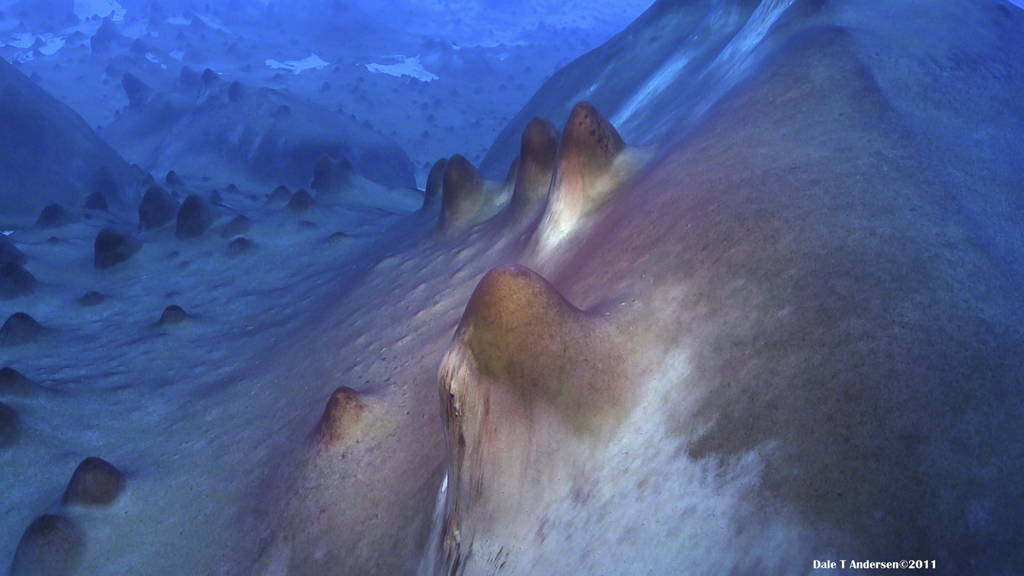
The full ‘Snowball Earth’ model for episodes in the Neoproterozoic that left glaciogenic sediments at near-equatorial palaeolatitudes implies that the oceans were frozen over globally. An objection to that is the likelihood that all photosynthetic activity would have been shut down leading to near catastrophe for all life forms of the time except those based on chemoautotrophic metabolism, as around hydrothermal vents. Antarctica has around 140 lakes that have been frozen over for at least hundreds of thousands if not millions of years, the best known being Lake Vostok, deep within the continent, that Russian scientists are on the verge of tapping after drilling through more than 3 km of glacial ice. Who knows what they might find? Far less extreme, but also having perennial ice cover, is Lake Untersee close to the coast in East Antarctica. Its summer ice cover is 3 m thick and it is presumed to have remained icebound through previous interglacials, although it is fed by meltwater from a nearby glacier in summer. It is not filled with fresh water, however, having a pH up to 12.1, around that of household bleach. It also has very high oxygen content, in fact supersaturated at 50% more than the solubility expected at 0°C. Lake Untersee would be expected to have little life, being an extremely hostile environment. Nonetheless, it does boast a biome and sufficient light gets through the ice cover to support microbial mats of photosynthesising blue-green bacteria (Andersen, D.T. et al. 2011. Discovery of large conical stromatolites in Lake Untersee, Antarctica. Geobiology, v. 9, p. 280–293). As well as perhaps helping elevate the oxygen levels in the lake water, these organisms have secreted stromatolite-like cones, pinnacles and mounds, but not ones made of carbonate. Although the water contains plenty of calcium ions, there is insufficient carbon as CO3 or HCO3 ions for calcite to be precipitated. The carbon-poor nature of the water seems to confirm its long-term isolation from the atmosphere. Instead, the stromatolites are made of laminated clay, maybe derived by exceedingly slow breakdown of feldspars that would also yield calcium and hydroxyl ions to explain the waters peculiar chemistry. The different shapes of stromatolites are linked to different cyanobacterial communities, which may help explain morphological variations among fossil stromatolites.

Stromatolites in Lake Untersee, East Antarctica. Image Dale Andersen,
            Carl Sagan Center for the Study of Life in the Universe

The lead author is from the SETI Institute in California, and presumably visited Lake Untersee in the cause of exobiology, as reported in other commentaries on the paper. However, the peculiarities of the lake and its life seem to be just that, with little relevance to frigid sedimentation in the distant past apart from a possible explanation for varying shapes of fossil stromatolites. Nor is the lake sterilised by virtue of perennial ice cover. Being fed by glacial melting it has received rock flour that has broken down to clays, and that implies meltwater carries other materials from the ice cap. Even Antarctica is not isolated from wind-blown dust, so cyanobacteria may have been introduced by sturdy, wind-borne spores being incorporated in the ice cap, eventually to end up in Lake Untersee. It seems that the lead author actually dived in the lake, which puts the fears of contamination by careful drilling into Lake Vostok into perspective. How such an environment links to notions of life elsewhere in the universe is hard to see. The truly fascinating thing about home-grown cyanobacteria is that early variants may well have cuddled up with other simple cells for mutual wellbeing to become the chloroplasts of eucaryan photosynthesising autotrophs, on which most metazoan life on Earth now depends.

Visit: http://www.astrobiology.com/news/viewnews.html?id=1515

Bigging-up the Ediacaran

Cropped and digitally remastered version of an...
A distinctive Ediacaran fossil. Image via Wikipedia

The biota dominated by large, indistinct and generally flabby creatures named together with the eponymous Period (635-542 Ma) from their type occurrence in late Neoproterozoic sediments of the Ediacara Hills of South Australia is made up of imprints of a strange bunch of organisms – bags; discs; donut-shapes and the enigmatic quilted organisms that likely subsisted by osmotically drawing nutrients from ocean water through their skins – together with others that have forms suggestive of extant groups – cnidarians; bilaterian embryos; mollusc-like and segmented forms.  The Avalon fauna of Newfoundland, discovered after those of Charnwood Forest, UK and the Ediacara Hills, added other life forms, including the fractal-like rangeomorphs from earlier (~579 Ma) times in the Ediacaran. Recently, the oldest known (630-551 Ma) members of the Ediacaran biota were presented (Yuan, X. et al. 2011. An early Ediacaran assemblage of macroscopic and morphologically differentiated eukaryotes. Nature, v. 470 , p. 390-393). Unlike the better known organisms that were preserved against all odds in quite coarse sand- and siltstones, the host rocks in South China are a more familiar lagerstätten of black shales in which fossils take the form of carbonaceous films. These preserve considerable detail and are unlike the later Ediacaran organisms. Many resemble marine algae (seaweeds), some very like kelp, in their living positions and probably represent quite sunlit seabed habitats(the authors also suggest that some rare forms may be bilaterian worms and cnidarians). Dating of this Lantian assemblage stems from several ash beds and correlation of C-isotope anomalies with other Ediacaran sections.

From their age, the Lantian fossils are of organisms that evolved shortly after the Marinoan (635 Ma) ‘Snowball Earth’ episode, whereas the faunas of Newfoundland and Australia followed the less prominent Gaskiers glacial epoch (582 Ma). So they represent another evolutionary surge presaged by global ice cover and massive stress for all terrestrial life. If the Lantian organisms were algae, then photosynthesising eukaryotes may have been the first large multicelled organisms. All eukaryotes – autotrophs and heterotrophs – are obliged to live in oxygenated conditions, so at least shallow water after the Marinoan glacial event must have been such, although preservation of the Lantian fossils does indicate anoxic conditions during burial. The association of evolutionary bursts with two ‘Snowball Earth’ periods ought to point palaeobiologists to the sedimentary sequences that followed the earliest such event, the Sturtian (~720 Ma), which shows similar violent swings in C-isotopes that indicate surges and declines in burial of organic matter. So far only sponge-like fossils have been found from the Cryogenian Period of the Neoproterozoic that encompasses the Sturtian and Marinoan glacial episodes (Maloof, C. & 8 others 2010. Possible animal-body fossils in pre-Marinoan limestones from South Australia. Nature Geoscience, v. 3, p. 653-659).

Feeding habits of ammonites

Photograph of a fossil cast of a Baculites she...
The uncoiled ammonite Baculites used in the study. Image via Wikipedia

Emerging in the Upper Palaeozoic and rapidly diversifying through the Mesozoic, thereby surviving over a period of 340 Ma, ammonites proved to be a stratigrapher’s dream organism as well as being the most widely collected fossils. As well as their rapid evolution of form, they were able to spread widely though the oceans in larval form, through the jet propulsion they shared with other cephalopods and because they floated when dead and drifted with currents. Much of ammonite taxonomy has centred for almost two centuries on their external for: ribs, keels, knobbles, intricacy of the sutures separating each body chamber and the previous one and whether or not their growing shell coils hid earlier parts or developed into an open spiral. These characteristics enables such a wealth of easily recognised genera and species that as zone fossils ammonites have been used to finely divide Mesozoic sediments; Jurassic ammonites locally divide the Jurassic (199 – 145 Ma) into time slices each of which represent a few hundred thousand years.

What is least familiar to non-specialists is the feeding apparatus of ammonites and what they actually ate. Thanks to the use of high energy X-ray images it turns out that, unlike squid, octopuses and the similar looking modern Nautilus, some Cretaceous ammonites would not have been able to rip apart large prey (Kruta, I et al. 2011. The role of ammonites in the Mesozoic marine food web revealed by jaw preservation. Science, v. 331, p. 70-72). Instead of a large beak-like process the ammonites studied sported a rasp-like radula, similar to that used on lettuce by the slug. The radula is armed with tiny but quite fearsome looking barbs, suitable for grating but not gnawing. The analysed ammonites may probably have eaten plankton. Indeed, one specimen turned out to have fragments of its last meal lodged in its radula; an isopod and a small gastropod. That diet tallies with the likely habitat of some ammonites; they were probably able to change their buoyancy by manipulating the gas and water content of their abandoned earlier body chambers to move up and down in the upper ocean. However, such was the stratigraphic duration, global spread and diversification of the ammonites, further studies of this kind would be needed to verify general plankton feeding. However, such a diet may well explain the conundrum of the total extinction of ammonites at the end of the Cretaceous while the superficially similar nautiloids survived and live today. The Cretaceous-Palaeocene (K-P formerly K-T) mass extinction devastated plankton, while larger marine organisms lived on to serve as nautiloids prey.