Subglacial impact structure: trigger for Younger Dryas?

Radar microwaves are able to penetrate easily through several kilometres of ice. Using the arrival times of radar pulses reflected by the bedrock at glacial floor allows ice depth to be computed. When deployed along a network of flight lines during aerial surveys the radar returns of large areas can be converted to a grid of cells thereby producing an image of depth: the inverse of a digital elevation model. This is the only means of precisely mapping the thickness variations of an icecap, such as those that blanket Antarctica and Greenland. The topography of the subglacial surface gives an idea of how ice moves, the paths taken by liquid water at its base, and whether or not global warming may result in ice surges in parts of the icecap. The data can also reveal topographic and geological features hidden by the ice (see The Grand Greenland Canyon September 2013).
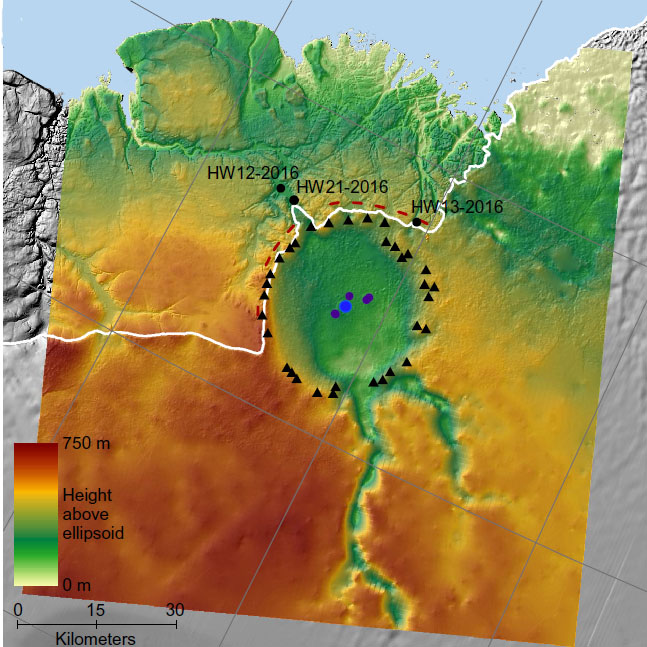
Untitled-2
Colour-coded subglacial topography from radar sounding over the Hiawatha Glacier of NW Greenland (Credit: Kjaer et al. 2018; Fig. 1D)

Such a survey over the Hiawatha Glacier of NW Greenland has showed up something most peculiar (Kjaer, K.H. and 21 others 2018. A large impact crater beneath Hiawatha Glacier in northwest Greenland. Science Advances, v. 4, eaar8173; DOI: 10.1126/sciadv.aar8173). Part of the ice margin is an arc, which suggests the local bed topography takes the form of a 31km wide, circular depression. The exposed geology shows no sign of a structural control for such a basin, and is complex metamorphic basement of Palaeoproterozoic age. Measurements of ice-flow speeds are also anomalous, with an array of higher speeds suggesting accelerated flow across the depression. The radar image data confirm the presence of a subglacial basin, but one with an elevated rim and a central series of small peaks. These are characteristic of an impact structure that has only been eroded slightly; i.e. a fairly recent one and one of the twenty-five largest impact craters on Earth.. Detailed analysis of raw radar data in the form of profiles through the ice reveals  that the upper part is finely layered and undisturbed. The layering continues into the ice surrounding the basin and is probably of Holocene age (<11.7 ka), based on dating of ice in cores through the surrounding icecap. The lower third is structurally complex and shows evidence for rocky debris. Sediment deposited by subglacial streams where they emerge along the arcuate rim contain grains of shocked quartz and glass, as well as expected minerals from the crystalline basement rocks. Some of the shocked material contains unusually high concentrations of transition-group metals, platinum-group elements and gold; further evidence for impact of extraterrestrial material – probably an iron asteroid that was originally more than 1 km in diameter. The famous Cape York iron meteorite, which weighs 31 t – worked by local Innuit to forge harpoon blades – fell in NW Greenland about 200 km away.

The central issue is not that Hiawatha Glacier conceals a large impact crater, but its age. It certainly predates the start of the Holocene and is no older than the start of Greenland glaciation about 2.6 Ma ago. That only Holocene ice layers are preserved above the disrupted ice that rests immediately on top of the crater raises once again the much-disputed possibility of an asteroid impact having triggered the Younger Dryas cooling event and associated extinctions of large mammals in North America at about 12.9 ka (see Impact cause for Younger Dryas draws flak May 2008). Only radiometric dating of the glassy material found in the glaciofluvial sediments will be able to resolve that particular controversy.

Oceanic hydrothermal vents and the origin of life

A range of indirect evidence has been used to suggest that life originated deep in the oceans around hydrothermal vents, such as signs of early organic matter in association with Archaean pillow lavas. One particularly persuasive observation is that a number of proteins and other cell chemicals are constructed around metal sulfide groups. Such sulfides are common around hydrothermal ‘smokers’ associated with oceanic rift systems. Moreover, Fischer-Tropsch reactions between carbon monoxide and hydrogen produce quite complex hydrocarbon molecules under laboratory conditions. Such hydrogenation of a carbon-bearing gas requires a catalyst, a commonly used one being chromium oxide (see Abiotic formation of hydrocarbons by oceanic hydrothermal circulation May 2004). It also turns out that fluids emitted by sea-floor hydrothermal systems are sometimes rich in free hydrogen, formed by the breakdown of olivine in ultramafic rocks to form hydroxylated minerals such as serpentine and talc. The fact that chromium is abundant in ultramafic rocks, in the form of its oxide chromite, elevates the possibility that Fischer-Tropsch reactions may have been a crucial part of the life-forming process on the early Earth. What is needed is evidence that such reactions do occur in natural settings.

407458aa.2
A white carbonate mound forming at the Lost City hydrothermal vent field on the Mid-Atlantic Ridge (Credit: Baross 2018)

One site on the mid-Atlantic ridge spreading centre, the Lost City vent field, operates because of serpentinisation of peridotites exposed on the ocean floor, to form carbonate-rich plumes and rocky towers; ‘white smokers’. So that is an obvious place to test the abiotic theory for the origin of life. Past analyses of the vents have yielded a whole range of organic molecules, including alkanes, formates, acetates and pyruvates, that are possible precursors for such a natural process. Revisiting Lost City with advanced analytical techniques has taken the quest a major step forward (Ménez, B. et al. 2018. Abiotic synthesis of amino acids in the recesses of the oceanic lithosphere. Nature, advance online publication; DOI: 10.1038/s41586-018-0684-z). The researchers from France and Kazakhstan focused on rock drilled from 170 m below the vent system, probably beyond the influence of surface contamination from living organisms. Using several methods they detected the nitrogen-containing amino acid tryptophan, and that alone. Had they detected other amino acids their exciting result would have been severely tempered by the possibility of surface organic contamination. The formation of tryptophan implies that its abiotic formation had to involve the reduction of elemental nitrogen (N2) to ammonia (NH3). Bénédicte Ménez and colleagues suggest that the iron-rich clay saponite, which is a common product of serpentine alteration at low temperatures, may have catalysed such reduction and amino-acid synthesis through Friedel–Crafts reactions. Fascinating as this discovery may be, it is just a step towards confirming life’s abiogenesis. It also permits speculation that similar evidence may be found elsewhere in the Solar System on rocky bodies, such as the moons Enceladus and Europa that orbit Saturn and Jupiter respectively. That is, if the rock base of hydrothermal systems thought to occur there can be reached.

Related article: Baross, J.A. 2018. The rocky road to biomolecules. Nature, v. 564, p. 42-43; DOI: 10.1038/d41586-018-07262-8.