Eclogite: the red-brown mineral is garnet, omphacite is green and there is some white quartz.(credit: Kevin Walsh via Wikipedia)
The ultra-dense form of basalt, eclogite made from mainly garnet and a strange high-pressure, low-temperature pyroxene (omphacite) that forms from plagioclase and some of the basalt’s ferromagnesian minerals, is possibly the most important rock there is. Without the basalt to eclogite transition that takes place when ocean-floor is subducted the density of the lithosphere would be insufficient to pull more ocean floor to destruction and maintain the planetary circulation otherwise known as plate tectonics. Since the transition involves the formation of anhydrous eclogite from old, cold and wet basalt water is driven upwards into the mantle wedge that lies over subduction zones. The encourages partial melting which creates andesite magmas and island arcs, the ultimate source of the Earth’s continental crust.
Despite being cold and rigid, subducted oceanic lithosphere somehow manages to be moved en masse, showing its track by earthquakes down to almost 700 km below the Earth’s surface. A major ophiolite in the Western Alps on the Franco-Italian border escaped complete loss to the mantle by rebounding upwards after being subducted and metamorphosed under high-P, Low-T condition when the Alps began to form. So the basaltic crustal unit is eclogite and that preserves a petrographic record of what actually happened as it descended (Angiboust, S. et al. 2012. Eclogite breccia in a subducted ophiolite: A record of intermediate depth earthquakes? Geology, v. 40, p. 707-710). The French geologists found breccias consisting of gabbroic eclogite blocks set in a matrix of serpentinite and talc. The blocks themselves are breccias too, with clasts of eclogite mylonite set in fine-grained lawsonite-bearing eclogite. The relationships in the breccias point to possibly earthquake-related processes, grinding and fracturing basalt as it was metamorphosed: an essentially brittle process, yet the shearing that forms mylonites does seem reminiscent of ductile deformation too.
The deformation seems to have been at the middle level of oceanic crust where oceanic basalt lavas formed above cumulate gabbro, their plutonic equivalents. Yet much deformation was also at the gabbro-serpentinite or crust-mantle boundary, where water loss from serpentine may have helped lubricate some of the processes. Clearly the Monviso ophiolite will soon become a place to visit for geophysicists as well as metamorphic petrologists.
Carbonaceous chondrite meteorite. (credit: Mila Zinkova via Wikipedia)Comet Hyakutake. (credit: E. Kolmhofer & H. Raab via Wikipedia)
Because they can be so big, consist mainly of water ice and there are probably a great many lurking in the outer reaches of the solar system impacting comets have long been thought to have delivered the water that makes the Earth so dynamic and, so far as we know, the only place in near-space that hosts complex life. Remote sensing studies of the isotopic composition of water in one comet (Hartley 2) caused great excitement in 2011 by showing that its ratio of deuterium to hydrogen was very similar to that of Earthly ocean water. Other D:H ratios have recently been published from a suite of meteorites gleaned from the surface of Antarctic ice (Alexander, C.M.O’D. et al. 2012. The provenances of asteroids, and their contributions to the volatile inventories of the terrestrial planets. Science, v. 337, p. 721-723). These meteorites are carbonaceous chondrites thought to be the source of much of the solid material in planets of the Inner Solar System. To cut short a long and closely argued argument, it seems that the CI-type chondrites’ water is isotopically quite different from that in analysed comets, knocking another popular hypothesis on the head; that comets and carbonaceous chondrites formed in the same part of the Solar System.
Since hydrocarbons in comets – known from interplanetary dust particles – contain hydrogen with a far richer complement of its heavy isotope deuterium than does cometary water ice, the crashing of entire comets onto planets such as the Earth would not produce the observed terrestrial D:H ratio even though their water ice alone does match it. The US, British and Canadian meteoriticists conclude what seems to be a unifying explanation whereby CI chondritic solids and volatiles alone would have been able to form the Inner Planets and their various complements of water by initial accretion. Comets as a second-stage source, in this account, are relegated to mere curiosities of the Solar System with little role to play other than occasional big impacts that may, or may not, have influenced evolution by the power that they delivered not through their chemistry.
Dreaming Spires (credit: Steve Daniels via Wikipedia)
Brian Deer, the British investigative journalist who exposed Andrew Wakefield’s methods that implicated the MMR vaccine as a cause of autism, has broadened his scope to research misconduct throughout science (Deer, B. 2011. Doctoring the evidence: what the scientific establishment doesn’t want you to know. The Sunday Times, 12 August 2012, p. 16). His article comes in the wake of several related articles in leading scientific journals (Enserink, M. 2012. Fraud-detection tool could shake up psychology. Science, 6 July 2012, p. 21-22. Macilwain, C. 2012. The time is right to confront misconduct. Nature, 2 August 2012, p. 7. Godlee, F. 2012.Helping institutions tackle research misconduct. The British Medical Journal, 10 August 2012). The focus has shifted in the last decade from a major campaign against plagiarism by students tempted by the information largesse of Wikipedia, Google and other electronic treasure troves to unwholesome behaviour among university academics. In an age when redundancy at universities has become an issue for the first time in nine centuries, many academics – frenzied by looming cuts – are engaged in a Gaderene rush for promotion and funding. The now obligatory stream of ‘learned’ papers seeks to justify their own puff and, equally as important, the puff of their departments, faculties and institutions trying to blag their corporate way through funding shortages. Misconduct is the child of education-as-commodity.
There are three mortal sins of academic fraudulence: plagiarism, including self-plagiarism (see Self-plagiarism, 6 January 2011); data falsification, including fiddling with those of other people (see Sabotage in Science, 4 November 2010), and fabrication of data, such as starting with a made-up graph and then using it to create plausible values in a table. Venial sins include publishing much the same data and interpretations again and again. The last highlights one of the reasons why miscreants get away with their chicanery and benefit from it; sloppy academic editing and even sloppier peer review.
Deer observes that ‘The science establishment’s consensus is that there is no need for outside scrutiny because … science is above that kind of misconduct that has tainted the Roman Catholic church, politics, the press and, of course, the banks.’ But, as in these notorious cases, the lid is coming off scientific misconduct, largely through the bravery of ‘whistle-blowers’ within the system. Yet the offenders who have been unmasked were unfortunate enough to work in institutions that have appropriate investigative mechanisms and the will at high office to use them. That determination to maintain the highest ethical standards is perhaps not as widespread as it once was.
Geoscientists have yet to figure much in the rogues’ gallery of malfeasants, except for the odd light-fingered palaeontologist. That may have something to do with the vagueness of much of their scope, epitomised by the trajectory of a lithological boundary on a geological map of poorly exposed ground. Indeed, virtually every aspect of the science is open to many interpretations, and errors of omission are perhaps more common than those of commission – any field worker knows that they will inevitably have missed something. But there are quantitative, laboratory-based aspects of the science, such as radiometric dating, that are more readily scrutinised for malpractice. In the early days of using radioactive isotopes and their daughter products to work out an age for an igneous or metamorphic event a common analytical tool was the isochron plot, as in the Rb-Sr method. A ‘good’ age was signified by all the data points falling on or very close to the line of best fit from which an age was calculated. Consequently, there may well have been cases where errant data were conveniently ‘lost’, but there was no way of telling.
That it did happen emerged from the honesty of those isotope geochemists who openly admitted that some mass-spectrometry runs had been omitted because the samples showed some signs of ‘contamination’ or ‘open-system behaviour’. For that they were merely taken to task by those who disagreed with their findings, but excused by those whose ideas the results supported: ethically honest. But how many Rb-Sr runs never made it to a published data table? Things are now a great deal more sophisticated than the days of punched tape and IBM cards in the geochemistry lab, geophysical software and that used for the growing cottage industry of process modelling. So much data and such a wealth of corrections that vast spreadsheets develop in the course of analysis, correction and calculation: few peer reviewers are going to go through data-processing steps with a fine-tooth comb, even if they have been lodged in public data repositories. Such settings provide ample scope for data invention, ‘fiddling’, ‘fudging’ and, in labs with a cavalier attitude to security, stealing but little way of pinning down any malpractice: that is, unless a culprit is either carelessly overconfident or a serial offender. A simple test that any peer reviewer might apply, most usefully at random, is to ask for a copy of laboratory notes associated with a manuscript. If one is not forthcoming, then suspicions will arise naturally.
A measure of just how much dodgy behaviour may go on is a survey conducted by Daniele Fanelli of the Institute for the Study of Science, Technology & Innovation, at the University of Edinburgh (Fanelli, D. 2009. How Many Scientists Fabricate and Falsify Research? A Systematic Review and Meta-Analysis of Survey Data. PLoS ONE, 4, e5738 http://www.plosone.org/article/info%3Adoi%2F10.1371%2Fjournal.pone.0005738). In it he found that up to a third of all researchers admit – anonymously – to engaging in shoddy practices, while around 2% admitted to having fabricated, falsified or modified data or results at least once. When asked off the record about colleagues, 85% of researchers reported suspicious behaviour known to them, 14% for data falsification.
Ivory Towers, Chancery Lane, London. (credit: Colin Smith via Wikipedia)
Time cannot be far off when the red laser-beam spot moves across geoscience labs and individual geoscientists. Are they audited by disinterested peers and in such a small tightly-knit discipline are there such individuals? Do managing academics scrupulously keep records themselves and demand that their research fellows do likewise? Are there victims or witnesses brave enough to blow the whistle on any spite, fraud or slovenly methods, or will our science remain in its habitual state of bliss?
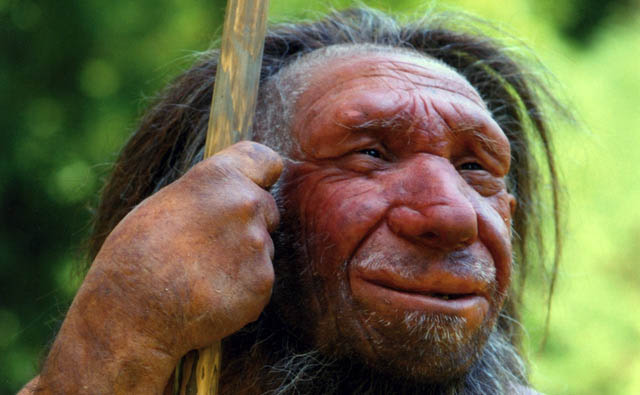
Reconstruction of a Neanderthal man (H. Neumann / Neanderthal Museum)
There is no doubt that the reconstruction of DNA from Neanderthal and Denisovan fossils is the most important forensic breakthrough as regards hominin evolution and relationships, but another approach has is starting to shed light on past lifestyles. Most workers have regarded Neanderthals as being predominantly meat-eaters from the evidence for their big-game hunting feats. In an attempt to get close to their actual diet some researchers have begun to exploit the lack of dental hygiene among fossil hominins: many teeth bear plaque or dental calculus (hardy, K. and 16 others 2012. Neanderthal medics? Evidence for food, cooking, and medicinal plants entrapped in dental calculus. Naturwissenschaften, v. 99, p. 617-626). Karen Hardy of the Universitat Autònoma de Barcelona and British, Spanish and Australian colleagues used gas chromatography and mass spectrometry and analysis of trapped microfossils in Neanderthal teeth to explore their everyday lives.
The results show signs of wood smoke: a good indicator of cooking and perhaps smoke preservation. Bitumen traces help confirm its use in hafting tools. But the most interesting feature is the consistent identification of cooked carbohydrate residues, enzyme activity on which would have produced the sugars strongly implicated in the formation of substantial plaque deposits. The data suggest that nuts, grass seeds, and possibly even green vegetables were a major part of the Neanderthal diet, A fascinating outcome is the discovery of molecules of the compounds that confer bitterness on a number of herbs with known medicinal properties, such as yarrow and chamomile. That does not prove that Neanderthals were accomplished herbalists, for many primates seek out such plants when feeling ill and even domestic cats will be seen eating grass if they have digestive problems or worms. Yet practical knowledge of herbal remedies cannot be ruled out. This novel, hi-tech approach to life-style analysis will surely blossom for most fossilized hominin dentition bears plenty of plaque. We await with interest the first signs of regular use of tooth-cleaning with woody fibres.
Neanderthals and Aurignacians survived massive volcanic disaster
About 39 thousand years ago the famous volcanic field of the Campi Flegrei west of Naples underwent a massive explosive eruption that created a huge ash plume whose deposition blanketed most of southeastern and eastern Europe with the Campanian Ignimbrite. The ashfall and the probable disruption of climate and ecosystems over a number of years would have greatly stressed both Neanderthal and modern human (Aurignacian) populations of the area. There are a few sites in the Ukraine and Russia where tools occur below, within and above the ash deposit, but little to suggest the extent to which both populations were affected. However, tangible ash deposits are not the only evidence for volcanic events in human history: fine ash would have permeated everything during the eruption. A host of European geologists and archaeologists have sought microscopic evidence of the Campanian Ignimbrite in sediments within caves that were occupied at this time (Lowe, J. and 41 others 2012. Volcanic ash layers illuminate the resilience of Neanderthals and early modern humans to natural hazards. Proceedings of the National Academy of Sciences doi/10.1073/pnas.1204579109): ignimbrite events are signified in cave deposits by ash dominated by minute glassy shards, whose shape is distinctive. The study was able to show that although the effects of the 39 ka eruption must have been devastating for local humans, both groups pulled through. The fact that Neanderthals survived the eruption and attendant prolonged climatic cooling suggests indirectly that their eventual demise was probably not a result of ecological disaster and more likely to have reflected their incapacity to compete successfully with the Aurignacian and later fully-modern human cultures.
Who was the earliest human? Initially this accolade went to Homo habilis, first found by Louis Leakey at Olduvai Gorge, Tanzania in 2 Ma old sediments. Similar fossils turned up at Koobi Fora on the shores of Lake Turkana (formerly Lake Rudolr) in Kenya also thanks to the Leakey dynasty. Yet as more remains of that antiquity were found differences among them began to emerge, which some ascribed to different species and others to effects of sexual dimorphism among H. habilis. The majority view emerged of two distinct species H. habilis and ergaster but the possibility of a third cohabiting member of the early East African human family was clung to in the shape of the single-fossil ‘H. rudolfensis’ . There the issue stood for more than two decades. Then, in the manner of London Transport, fossils of three individual humans were unearthed at Koobi Fora by the determined Leakey family (Leakey, M.G. et al. 2012. New fossils from Koobi Fora in northern Kenya confirm taxonomic diversity in early Homo. Nature, v. 488, p. 201-204). They seem to have confirmed three separate cohabiting species of human in Kenya in the period between 1.8 and 2.0 Ma: habils, rudolfensis and erectus/ergaster. Now, this is quite odd as the threefold morphological distinction ought to reflect three lifestyles sufficiently different to support the species over several hundred thousand years. Hopefully, there are teeth and dental plaque…




 Earth-logs
