Drip tectonics beneath Türkiye

Tectonics and geomorphology of Turkey showing the main fault systems. The Konya basin is enclosed by the grey rectangle at centre. (Credit: Taymaz et al. Geological Society of London, Special Publication 291, p1-16, Fig 1)

The 1.5-2.0 km high Central Anatolian plateau in Türkiye has been rising since ~11 Ma ago: an uplift of about 1 km in the last 8 Ma. However, part of the southern Plateau shows signs of rapidly subsidence that has created the Konya Basin, marked by young lake sediments. Interferometric radar (InSAR) data from the European Space Agency’s Sentinel-1 satellite, which detects active movement of the Earth’s surface, reveal a crude, doughnut-shaped area of the surface that is subsiding at up to 50 mm per year. This ring of subsidence surrounds a core of active uplift that is about 50 km across (see the first figure). Expressed crudely, active subsidence suggests an excess of mass beneath the affected area, whereas uplift implies a mass deficit; in both cases within the lithosphere. So, when the InSAR data were published in 2020, it became clear that the lithosphere beneath Anatolia is doing something very strange.

Vertical velocities affecting the surface in the Konya Basin derived from InSAR data, velocities colour-coded cyan to blue show subsidence, yellow to red suggesting that the surface is rising. (Credit: Andersen et al., Fig 1c)

Canadian and Turkish geophysicists set out to find a tectonic reason for such aberrant behaviour (Andersen, A.J.  et al. 2024. Multistage lithospheric drips control active basin formation within an uplifting orogenic plateau. Nature Communications, v. 15, Article 7899; DOI: 10.1038/s41467-024-52126-7). They wondered if a process known as ‘drip tectonics’, first mooted as an explanation of anomalous features in some mountain belts in 2004 (see: Mantle dripping off mountain roots, October 2004; and A drop off the old block? May 2008) might be applicable to the Anatolian Plateau. The essence of this process is similar to the slab-pull force at the heart of subduction. Burial and cooling of basaltic material in oceanic lithosphere being driven beneath another tectonic plate converts its igneous mineralogy to the metamorphic rock eclogite, whose density exceeds that of mantle rocks. Gravity then acts to pull the changed material downwards. However, Anatolia shows little sign of subduction. But the mantle beneath shows seismic speed anomalies that hint at anomalously dense material.

Seismic tomography shows that in a large volume 100 to 200 km beneath the central part of the Plateau S-waves travel faster than in the surrounding mantle. The higher speed suggests a body that is denser and more rigid than its surroundings. This could be a sinking, detached block of ‘eclogitised’ lithosphere whose disconnection from the remaining continental lithosphere has been causing the uplift of the Plateau that began in the Late Miocene. A smaller high-speed anomaly lies directly under the Konya Basin, but at a shallower depth (50 to 80 km) just beneath the lithosphere-asthenosphere boundary. The authors suggest that this is another piece of the lower lithosphere that is beginning to sink and become a ‘drip’. Still mechanically attached to the lithosphere the sinking dense block is dragging the surface down.

Andersen et al. instead of relying on computer modelling created a laboratory analogue. This consisted of a tank full of a fluid polymer whose viscosity is a thousand times that of maple syrup that represents the Earth’s deep mantle beneath. They mimicked an overlying  plate by a layer of the same material with additional clay to render it more viscous – the model’s lithospheric mantle – with a ‘crust’ made of a sand of ceramic and silica spherules. A dense seed inserted into the model lithospheric mantle began to sink, dragging that material downwards in a ‘drip’. After that ‘drip’ had reached the bottom of the tank hours later, it became clear that another, smaller drip materialised along the track of the first and also began to sink. Monitoring of the surface of the ‘crust’ revealed that the initial drip did result in a basin. But the further down the drip fell the basin gradually became shallower: there was surface uplift. Once the initial drip had ‘bottomed-out’ the basin began to deepen again as the secondary drip formed and slowly moved downwards. The model seems to match the authors’ interpretation of the geophysics beneath the Anatolian Plateau. One drip created the potential for a lesser one, a bit like in inversion of the well-known slo-mo videos of a drop of milk falling into a glass of milk, when following the drop’s entry a smaller drop rebounds from the milky surface.
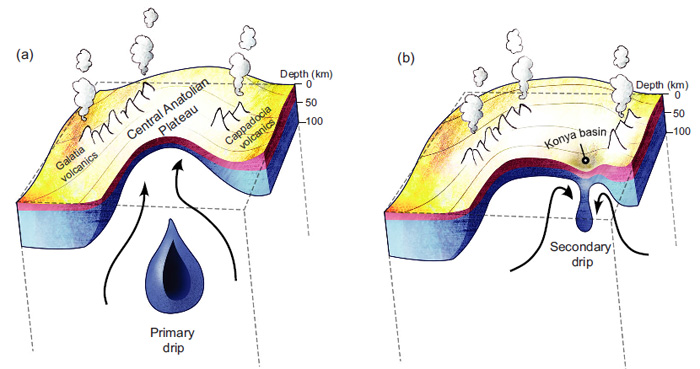
Cartoons of drip tectonics beneath the Anatolian Plateau. (a) Lower lithosphere detached from beneath Anatolia in the Late Miocene (10 to 8 Ma) descends into the mantle as it is ‘eclogitised’; (b) a smaller block beneath the Konya Basin beginning to ‘drip’, but still attached to the lithosphere. (Credit: Andersen et al., Fig 4)

In Anatolia the last 10 Ma has not been just ups and downs of the surface corresponding to drip tectonics. That was accompanied by volcanism, which can be explained by upwelling of mantle material displaced by lithospheric drips. When mantle rises and the pressure drops partial melting can occur, provided the mantle material rises faster than it can lose heat: adiabatic melting.

What controls the height of mountains?

‘Everybody knows’ that mountains grow: the question is, ‘How?’ There is a tale that farmers once believed that they grew from pebbles: ‘every year I try to rid my field of stones, but more are back the following year, so they must grow’… Geoscientists know better – or so they think[!] – and for 130 years have referred to ‘orogeny’, a classically-inspired term (from the Ancient Greek óros and geneia – high-ground creation’) adopted by the US geologist Grove Gilbert. It incorporates the concept of crustal thickening that results from lateral forces and horizontal compression. Another term, now rarely used, is ‘epeirogeny’ (coined too by G.K. Gilbert), wherein the continental surface rises or falls in response to underlying gravitational forces. That could include: changing mantle density over a hot, rising plume; detachment or delamination into the mantle of dense lower lithosphere; loading or unloading by ice during glacial cycles. Epeirogeny is bound up with isostasy, the maintenance of gravitational balance of mass in the outermost Earth.

A small part of the High Himalaya (credit: Access-Himalaya)

In 1990, Peter Molnar and Philip England pointed out that the incision of deep valleys into mountain ranges results in stupendous and rapid removal of mass from orogenic belts, which adds a major isostatic force to mountain building (Molnar, P. & England, P. 1990. Late Cenozoic uplift of mountain ranges and global climate change: chicken or egg? Nature, v. 346, p. 29–34; DOI: 10.1038/346029a0). In their model, the remaining peaks are driven higher by isostasy. They, and others, coupled climate change with compressional tectonics in a positive feedback that drives peaks to elevations that they would otherwise never achieve. Molnar and England’s review saw complex interplays contributing to mountain building, accompanying chemical weathering even changing global climate by sequestering atmospheric CO2 into the minerals that it produces. As well as the height of peaks in active zones of crustal shortening and thickening, such as the Himalaya, Molnar and England’s theory explained the aberrant high peaks at the edge of high plateaus that are passively subject to erosion. Examples of the latter are the isolated peaks beyond the eastern edge of the Ethiopian Plateau that locally have the greatest elevation than the flood basalts that form the plateau: unloading around these peaks has caused them to rise isostatically.

Thirty years on, this paradigm is being questioned, at least as regards active orogens (Dielforder, A. et al. 2020. Megathrust shear force controls mountain height at convergent plate margins. Nature, v. 582, p. 225–229; DOI: 10.1038/s41586-020-2340-7). Armin Dielforder and colleagues at the German Research Centre for Geosciences in Potsdam and The University of Münster consider that overall mountain height is sustained by interactions between three forces. 1. They are prevented from falling apart under their own weight or being pushed up further against gravity by lateral tectonic force. 2. Climate controlled erosion limits mountain height by removing material from the highest elevations. 3. Isostasy keeps the mountains ‘afloat’ above the asthenosphere. The authors have attempted to assess and balance all three major forces that determine the overall elevation of mountain belts.

At a convergent plate margin where one plate is shoved beneath another, the megathrust above the subduction zone behaves in a brittle fashion, with associated friction, towards the surface. At depth this transitions to a zone of ductile deformation dominated by viscosity. A major assumption in this work is that stress in the crust below a mountain belt is neutral; i.e. horizontal, tectonic compression is equal to the weight of the mountains themselves and thus to their height. So, the greater the tectonic compressive force the higher the mountain range that it can support. The test is to compare the actual elevation with that predicted from plate-tectonic considerations. For 10 active orogenic belts there is a remarkable correspondence between the model and actuality. the authors conclude that variation over time of mountain height reflects log-term variations in the force balance, in which they find little sign of a climatic/erosional control. But that doesn’t resolve the issue satisfactorily, at least for me.

The study focuses on the mean elevation, and this leaves out the largest mountains; for instance, their maximum mean elevation for the Himalaya is about 5.46 km (in fact for a narrow  NE-SW swath that may not be representative of the whole range). Yet the Himalaya contains 10 of the world’s highest mountains, all over 8 km high and 50 peaks that top 7 km, adjacent to the Tibetan Plateau. The mean elevation of the whole Himalayan range is 6.1 km. Consequently, it seems to me, the range’s maximum mean elevation must be somewhat higher than that reported by Dielforder et al.  The difference suggests that non-tectonic forces do contribute significantly to Himalayan terrain

See also:  Wang, K. 2020. Mountain height may be controlled by tectonic force, rather than erosion. Nature, v. 582, p. 189-190; DOI: 10.1038/d41586-020-01601-4

Low-lying Tibet before India-Asia collision

The Tibetan plateau lies between the Himalayan...
The semi-arid Tibetan Plateau from spaceImage via Wikipedia

The vast Tibetan Plateau at an average elevation of 4500 m is a major influence on the climate of Asia, being central to the annual monsoons, as well as one the world’s largest continental tectonic features. When it formed is crucial in palaeoclimatic modelling as well as to geomorphologists and structural geologists. Whether or not it was present before the Indian subcontinent collided with Asia at 50 Ma has been the subject of perennial debate; it could have formed during the more or less continual accretion of terranes to southern Eurasia since the Jurassic Period. A novel approach to timing uplift of Tibet is obviously needed to resolve the controversies, and that may have been achieved (Hetzel, R. et al. 2011. Peneplain formation in southern Tibet predates the India-Asia collision and plateau uplift.  Geology, v.39, p.983-986). North of Lhasa is an area of coincident small plateaus at around 5200-5400 m into which are cut valleys a few hundred metres. It has the hallmarks of a peneplain stripped to the base level of erosion, and developed on Cretaceous granites. The German-Chinese-South African team applied a range of geochronological techniques to date the emplacement of the granites and their cooling history. U/Pb dating shows the granites to have crystallised between 120 to 110 Ma; U-Th/He dating of zircons in them indicate their cooling from 180° to 60°C between 90 and 70 Ma; apatite  U-Th/He and fission-track dating show that the granites experienced surface temperatures by around 55 Ma during a period of erosion at a rate of 200-400 m Ma-1. The clear inference is that an area >10 000 km2 became a peneplain by the end of the Palaeocene, to be unconformably overlain by Eocene continental redbeds.

By the Eocene the northern Lhasa Block had become a low-elevation plain from which a vast amount of sediment had been removed to be deposited elsewhere – Palaeocene and Eocene sediments are not common throughout the whole Tibetan Plateau. This is strong evidence that uplift of the Plateau only began after the India-Asia collision during the Eocene. Despite that and the erosion that would have taken place, much of the peneplain remains; given resistant bedrock peneplains can be very long-lived.