How the earliest continental crust may have formed

Detrital zircon grains extracted from sandstones deposited ~3 billion year (Ga) ago in Western Australia yield the ages at which these grains crystallised. The oldest formed at about 4.4 Ga; only 150 Ma after the origin of the Earth (4.55 Ga). Various lines of evidence suggest that they originally crystallized from magmas with roughly andesitic compositions, which some geochemists suggest to have formed the first continental crust (see: Zircons and early continents no longer to be sneezed at; February 2006). So far, no actual rocks of that age and composition have come to light. The oldest of these zircon grains also contain anomalously high levels of 18O, a sign that water played a role in the formation of these silicic magmas. Modern andesitic magmas – ultimately the source of most continental crust – typically form above steeply-dipping subduction zones where fluids expelled from descending oceanic crust encourage partial melting of the overriding lithospheric mantle. Higher radiogenic heat production in the Hadean and the early Archaean would probably have ensured that the increased density of later oceanic lithosphere needed for steep subduction could not have been achieved. If subduction occurred at all, it would have been at a shallow angle and unable to exert the slab-pull force that perpetuated plate tectonics in later times (see: Formation of continents without subduction, March, 2017).

Landsat image mosaic of the Palaeoarchaean granite-greenstone terrain of the Pilbara Craton, Western Australia. Granite bodies show as pale blobs, the volcanic and sedimentary greenstone belts in shades of grey.

Geoscientists have been trying to resolve this paradox for quite a while. Now a group from Australia, Germany and Austria have made what seems to be an important advance (Hartnady, M. I. H and 8 others 2025. Incipient continent formation by shallow melting of an altered mafic protocrust. Nature Communications, v. 16, article 4557; DOI: 10.1038/s41467-025-59075-9). It emerged from their geochemical studies of rocks in the Pilbara Craton of Western Australia that are about a billion years younger than the aforementioned ancient zircon grains. These are high-grade Palaeoarchaean metamorphic rocks known as migmatites that lie beneath lower-grade ‘granite-greenstone’ terrains that dominate the Craton, which Proterozoic deformation has forced to the surface. Their bulk composition is that of basalt which has been converted to amphibolite by high temperature, low pressure metamorphism (680 to 730°C at a depth of about 30 km). These metabasic rocks are laced with irregular streaks and patches of pale coloured rock made up mainly of sodium-rich feldspar and quartz, some of which cut across the foliation of the amphibolites. The authors interpret these as products of partial melting during metamorphism, and they show signs of having crystallised from a water-rich magma; i.e. their parental basaltic crust had been hydrothermally altered, probably by seawater soon after it formed. The composition of the melt rocks is that of trondhjemite, one of the most common types of granite found in Archaean continental crust. Interestingly, small amounts of trondhjemite are found in modern oceanic crust and ophiolites.
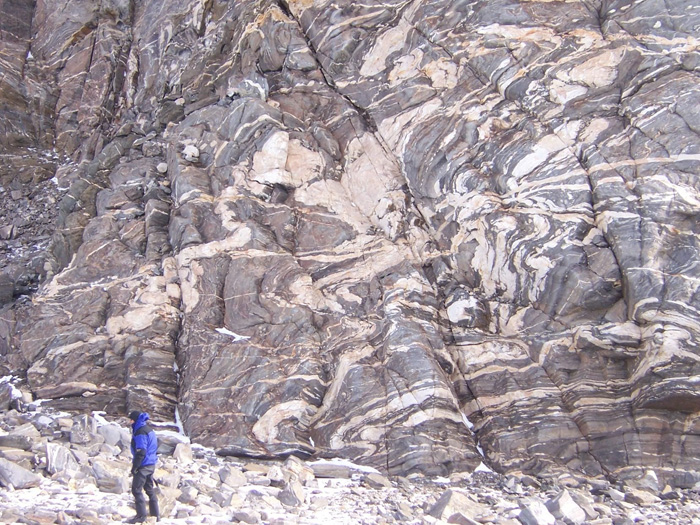
A typical migmatite from Antarctica showing dark amphibolites laced with quartzofeldspathic products of partial melting. Credit: Lunar and Planetary Laboratory, University of Arizona

The authors radiometrically dated zircon and titanite (CaTiSiO₅) – otherwise known as sphene – in the trondhjemites, to give an age of 3565 Ma. The metamorphism and partial melting took place around 30 Ma before the overlying granite-greenstone assemblages formed. They regard the amphibolites as the Palaeoarchaean equivalent of basaltic oceanic crust. Under the higher heat production of the time such primary crust would probably have approached the thickness of that at modern oceanic plateaux, such as Iceland and Ontong-Java, that formed above large mantle plumes. Michael Hartnady and colleagues surmise that this intracrustal partial melting formed a nucleus on which the Pilbara granite-greenstone terrain formed as the oldest substantial component of the Australian continent. The same nucleation may have occurred during the formation of similar early Archaean terrains that form the cores of most cratons that occur in all modern continents.

Did giant impacts trigger formation of the bulk of continental crust?

Earth is the only one of the rocky Inner Planets that has substantial continental crust, the rest being largely basaltic worlds. That explains a lot. For a start, it means that almost 30 percent of its surface area stands well above the average level of the basaltic ocean basins – more than 5 km – because of the difference in density between continental and oceanic lithosphere. Without continents and the inability of subduction to draw them back  into the mantle  Earth would remain a water-world as it is thought to have been during the Hadean and early Archaean Eons. The complex processes involved in geochemical differentiation and the repeated reworking of the continents through continual tectonic and sedimentary processes has further enriched parts of them in all manner of useful elements and chemical compounds. And, of course, the land has had a huge biosphere since the Devonian period that subsequently helped to draw down CO­2 well as evolving us.

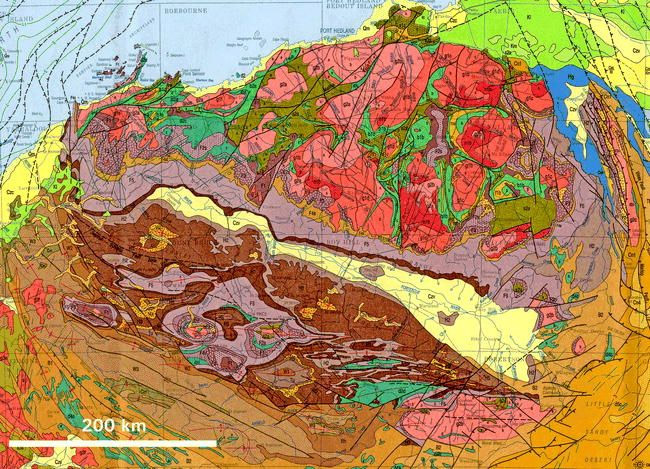
It has been estimated that during the Archaean (4.0 to 2.5 Ga) around 75% of continental crust formed. Much of this Archaean crust is made up of sodium-rich granitoids: grey tonalite-trondhjemite-granodiorite (TTG) gneisses in the main. Their patterns of trace elements strongly suggest that their parent magmas formed by partial melting at shallow depths (25 to 50 km). Their source was probably basalts altered by hydrothermal fluids to amphibolites, unlike the post-Archaean dominance of melting associated with subducted slabs of lithosphere. Yet most of the discourse on early continents has centred on when plate tectonics began and when they became strong enough to avoid disruption into subductible ‘chunks’. Yet 10 years ago geochemists at the University of St Andrews in Scotland used hafnium and oxygen isotopes in Archaean zircons to suggest that the first continents grew very quickly in the Hadean and early Archaean at around 3.0 km3 yr-1, slowing to an average of 0.8 km3 yr-1 after 3.5 Ga. In 2017 Geochemists working on one of the oldest cratons in the Pilbara region of Western Australia developed a new, multistage model for early crust formation that did not have a subduction component. They proposed that high degrees of mantle melting first produced a mafic-ultramafic crust of komatiites, which became the source for a 3.5 Ga mafic magma with a geochemistry similar to those of modern island-arc basalts. If a crust of that composition attained a thickness greater than 25 km and was itself partially melted at its base, theoretically it could have generated TTG magma and Archaean continental crust. Three members of that team from Curtin University, Western Australia, and others have now contributed to formulating a new possibility for early continent formation (Johnson, T.E. et al. 2022.  Giant impacts and the origin and evolution of continents. Nature, v. 608, p. 330–335; DOI: 10.1038/s41586-022-04956-y).

The distinctive Archaean granite-greenstone terrain of the Pilbara craton of Western Australia. TTG granites are shown in reds in the form of domes, which are enveloped by metamorphosed sediments and mafic-ultramafic volcanics in khaki and emerald green. Other colours signify post Archaean rocks. (Credit: Warren B. Hamilton; Earth’s first two billion years. GSA, 2007)

Tim Johnson and colleagues base their views on oxygen isotopes in Archaean zircon grains from the Pilbara. The zircons’ O-isotopes fall into three kinds of cluster: low 18O that indicate a hydrothermally altered source; intermediate 18O suggesting a mantle source; high 18O signifying contamination by metasedimentary and volcanic rocks. The first two alternate in the 3.6 to 3.4 Ga period; 4 clusters with mantle connotations occupy the 3.4 to 3.0 Ga range; a cluster with supracrustal contamination follows 3.0 Ga. This record can be reconciled agreeably with the geological and broad geochemical history of the Pilbara craton. But there is another connection: the Late Heavy Bombardment (LHB) recognised on most rocky bodies in the Solar System.

Bodies with much more sluggish internal processes than the Earth have preserved much of their earliest surfaces and the damage they have suffered since the Hadean. The Moon is the best example. Its earliest rocks in the lunar Highlands record a vast number of impact craters. Their relative ages, deduced from older ones being affected by later ones, backed up by radiometric ages of materials produced by impacts, such as melt spherules and basaltic magmas that flooded the lunar maria, revealed the time span of the LHB. The maria formed between 4.2 and 3.2 billion years ago and the damage done then is shown starkly by the dark maria that make up the ‘face’ of the Man in the Moon. The lunar bombardment was at a maximum between 4.1 and 3.8 Ga but continued until 3.5 Ga, dropping off sharply from its maximum effects. Earth preserves no tangible sign of the LHB, but because it is larger and more massive than the Moon, and both have always been in much the same orbit around the Sun, it must have been subject to impacts on a far grander scale. Projectiles carry kinetic energy that enables them to do geological work when they impact: 1/2 x mass x speed2. The minimum speed of an impact is the same as the target’s escape velocity – 2.4 km s-1 for the Moon and 11.2 km s-1 for the Earth. So the energy of an object hitting the Earth would be 20 times more than if it struck the lunar surface. Taking into account the Earth’s larger cross sectional area, the amount of geological work done here by the LHB would have been as much as 300 times greater than that on Earth’s battered satellite.

The Earth’s early geological history was rarely seen in that context before the 21st century, but that is the framework plausibly adopted by Johnson and colleagues. Archaean  sediments in South Africa contain several beds of impact spherules older than 3.2 Ga, as do those of the Pilbara. The LHB also left a geochemical imprint on Earth in the form of anomalous isotope proportions of tungsten in 3.8 Ga gneisses from West Greenland (See: Tungsten and Archaean heavy bombardment and Evidence builds for major impacts in Early Archaean; respectively, July and August 2002). Johnson et al. suggest a 3-stage process for the evolution of the Pilbara craton: First a giant impact akin to the lunar Maria that formed a nucleus of mafic-ultramafic crust from shallow melting of the mantle; its chemical fractionation to produce low-magnesium basalts; and in turn their melting to form TTG magmas and thus a continental nucleus. They conclude:

‘The search for evidence of the Late Heavy Bombardment on Earth has been a long one. However, all along it seems that the evidence was right beneath our feet.’

I agree wholeheartedly, but would add that, until quite recently, many scientists who referred to extraterrestrial influences over Earth history were either pilloried or lampooned by their peers as purveyors of ‘whizz-bang’ science. So, many ‘kept their powder dry’. The weight of evidence and a reversal of wider opinion over the last couple of decades has made such hypotheses acceptable. But it has also opened the door to less plausible notions, such as an impact cause for sudden climate change and even for mythological catastrophes such as the destruction of Sodom and Gomorrah!

See also: Timmer, J. 2022. Did giant impacts start plate tectonics? arsTechnica 11 August 2022.