
Mesolithic hunter-gatherers in Britain must have had a very hard time around 8.2 thousand years age. The whole area around the North Atlantic experienced sudden climatic cooling of around 3.3°C together with drought that lasted about 70 years. To make things worse shortly afterwards, coasts around the North were devastated by a tsunami generated by a submarine landslide off western Norway. That event exceeded the maximum coast ‘run up’ of both the 26 December 2004 Indian Ocean tsunami and that in NW Japan on 11 March 2011. Doggerland, then in the central North Sea was devastated by a catastrophic event of a few days duration. It littered the seabed with the bones of its megafauna and even Mesolithic tools recovered by trawlers from its surviving relic the shallow Dogger Bank. It seems the tsunami arrived just as climate was warming back to ‘normal’ Holocene conditions: for many foragers, surely, a last straw.
The cooling episode has been attributed to perturbation of the Atlantic Meridional Overturning Circulation (AMOC) as a result of meltwater discharge during the deglaciation of the Laurentide Ice Sheet (see: Just when you think it’s going to turn out alright… November 2009).The event may have unfolded in a similar fashion to the trigger for the Younger Dryas and the succession of warming-cooling episodes known as Dansgaard-Oeschger events that interrupted the otherwise relentless global cooling towards the last glacial maximum (see: Review of thermohaline circulation; February 2002). The physics that set off such climatic ‘hiccups’ is that freshening of surface seawater reduces its density, so that it cannot sink to be replaced by denser saline water ‘dragged’ northwards from warmer latitudes. That currently takes the form of the Gulf Stream with its warming influence, particularly in the eastern North Atlantic and even beyond Norway’s North Cape, responsible for much warmer winters than at similar latitudes on the western side. The culprit had long been suggested to be the drainage of a huge lake dammed by the ice sheet that covered most of eastern Canada during late stages of deglaciation. Seemingly the best candidate was Lake Agassiz trapped by the early Holocene ice front in Manitoba – the largest proglacial lake known anywhere.
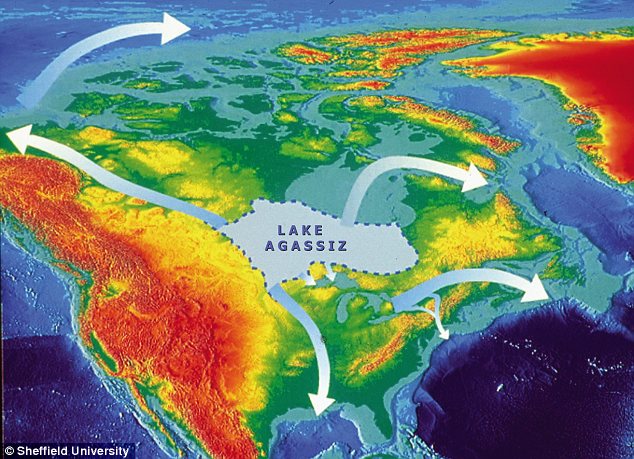
The present landforms of central Canada show evidence for several outflow directions at different times, Including to the northwest to reach the Arctic Ocean at the onset of the Younger Dryas. Until recently there was little detailed evidence for the flow volume and timing of its drainage around 8 to 9 ka. Providing the details in the context of the short-lived event around 8.2 ka requires accurate data over a mere 200 years able to reveal a change in sea level to a precision of better than a few tens of centimetre. Any site on the shores of the North Atlantic would do, provided it satisfies these criteria. Geographers from universities in York, Leeds, Sheffield and Oxford, UK selected the small estuary of the River Ythan in NE Scotland. There, a continuous sand unit just above fine-grained intertidal tidal muds marks the knife-sharp time datum of the Storegga tsunami (Rush, G. et al. 2023. The magnitude and source of meltwater forcing of the 8.2 ka climate event constrained by relative sea-level data from eastern Scotland. Quaternary Science Advances, v. 12, article 100119; DOI: 10.1016/j.qsa.2023.100119).
Cores of the intertidal sediments from beneath the present Ythan salt marsh contain plant remains that yielded precise radiocarbon dates at several stratigraphic levels from which to derive an age-depth model for the age range of interest. The buried sediments are also rich in marine microfossils (foraminifera and diatoms) that thrive in estuaries at a variety of depths. These enabled fluctuations in relative sea level during the build-up of the intertidal sediments to be constrained at unprecedented resolution and precision for a three thousand year period from 9.5 to 6.5 ka. The authors show that there were two episodes of rapid sea-level rise over that time: between 8.53 and 8.37 ka (~2.4 m at 13 mm yr-1) and 8.37 to 8.24 ka (~ 0.6 m at 4 mm yr-1) – these would have been global increases in sea level.
Despite its vast size, it turns out that Lake Agassiz would have been unable to result in sea-level rises of that magnitude so quickly merely through outflow. Rush et al. suggest that the huge and rapid addition of fresh water to the North Atlantic involved flow of lake water towards Hudson Bay, beneath the ice sheet, causing it to collapse and melt, followed by completion of Lake Agassiz’s emptying in the second stage. It took a long drawn-out ‘freshening’ of the North Atlantic surface water ultimately to shut down the Atlantic Meridional Overturning Circulation, thereby depriving high latitudes of its east-side warming effect by the Gulf Stream.
Sea level has been rising since the early 20th century mainly through the melting of Greenland’s ice cap together with a substantial amount of thermal expansion while global climate has been warming. Between 1901 and 2018 the rise has amounted to 15 to 25 cm at a rate of 1 to 2 mm yr-1. The AMOC is possibly weaker now than at any time during the last millennium (Zhu, C. et al. 2023. Likely accelerated weakening of Atlantic overturning circulation emerges in optimal salinity fingerprint. Nature Communications, v. 14, article 1245; DOI: 10.1038/s41467-023-36288-4). Yet increases in freshening of the northernmost parts of the North Atlantic are now being added to by annual increases in the melting of polar sea ice, which is salt-free. The AMOC may be approaching a tipping point, because warming is accelerating over Greenland at around 1.5°C each year: faster than most of the rest of the world. In 2021 it rained for the first time ever recorded at the ice cap’s summit (3.2 km above sea level). A ‘perturbation’ of the AMOC would add chaos to the dominantly linear view of global warming taken by climatologists. That could launch frigidity and drought at mid northern latitudes as it did eight millennia ago: the opposite of what is currently feared.
See also: Unlocking Ancient Climate Secrets – Melting Ice Likely Triggered Climate Change Over 8,000 Years Ago. Scitechdaily 16 September 2023.

 Earth-logs