What caused the Younger Dryas frigid spell: case closed?

Around 20 thousand years ago, the Earth began to emerge from the grip of the Last Glacial Maximum (LGM). Huge ice sheets had locked up so much water that sea level was then about 125 m lower than it is today. At 12,870 years ago the warming and sea-level rise were reversed for 1,170 years in the Northern Hemisphere: an episode of near-full glacial conditions known as the Younger Dryas (YD). The adjectives ‘sudden’ or ‘abrupt’ grossly understate the pace of initial cooling – 3°, 6° and 15° C in North America, Europe and Greenland, respectively. Isotopic evidence from Greenland ice cores suggest that the cooling took place over three years or less. Such a degree of precision stems from the continuous annual layering in the Greenland ice cap. As far as humans were concerned, this would have been catastrophic for hunter gatherers following game northwards in Eurasia and North America as conditions ameliorated during the seven thousand years since the LGM. The archaeological record, or rather the lack of one, for what are now temperate zones suggests humans either retreated south or were blotted out.

There is no counterpart for the YD in the end stages of early glacial episodes. Some authors have suggested that it was the outcome of an appropriately catastrophic geological event, such as a large meteorite strike, as proposed in 2007 (See: Whizz-bang view of Younger Dryas; July 2007). This hypothesis gained traction in 2013, at least for its authors, with the discovery of anomalously high concentrations of the noble metal platinum (Pt) and other platinum Group metals, such as iridium (Ir) at or around the start of the YD in the GISP2 ice core. New research on this anomaly (Green, C.E. et al 2025. A possible volcanic origin for the Greenland ice core Pt anomaly near the Bølling-Allerød/Younger Dryas boundary. PLOS One, v. 20, article  e0331811; DOI: 10.1371/journal.pone.0331811) offers a different scenario. Charlotte Green of Royal Holloway, University of London and colleagues from universities in the UK, Germany and Austria examine the timing of this Pt spike and its detailed geochemistry.

The ‘killer’ observation is that the anomaly occurs in ice that formed 45 years after the onset of the Younger Dryas and has a spread of about 14 years. Whatever kind of event released the platinum, it definitely did not somehow trigger the onset of the YD. Moreover, the anomaly was significantly deficient in iridium compared with a wide range of meteorites and terrestrial igneous rocks. It also differed markedly in other elements, such as lutetium and hafnium, and in all three elements in melt rocks and ejecta sediments associated with five proven impact structures. The closest match is to volcanic gas condensates from a recent eruption of a submarine volcano near Tonga

Both the GISP2 and NGRIP cores through the Greenland ice also record a large, 12-year long spike in sulfate of volcanic origin spread across the very start of the YD. That roughly matches the age of an explosive eruption, which formed the circular Laacher See in the Eifel volcanic field in Germany. That eruption is thought to have blasted 6.3 km3 of highly alkaline magma into the atmosphere: about the magnitude of the 1991 Pinatubo eruption, but insufficient to yield the size and duration of the sulfate spike that coincides with the start of the YD. The sulfate anomaly suggests a far larger, currently unknown eruption at 12,870 years ago. The Pt and Ir data from the Laacher See event rule it out as a source for the younger Pt anomaly in the GISP2 ice core. One possibility is a nearby Icelandic subglacial fissure eruption at that time.

So, as regards what started the Younger Dryas, there is support for a very large, but so-far unknown volcanic event, and an as yet unresolved, perturbation in the Atlantic Meridional Overturning Circulation (AMOC) resulting from drainage of a huge glacial lake in northern North America (see: The Younger Dryas and the Flood; June 2006), but no support whatever for an impact event. Climatology of the distant past is always likely to be difficult to pin down. That is because, as now, it involves linkages between a large number of variables: not only physical ones, but issues of biogeochemistry, the inner Earth, the rest of the solar system and even cosmology. That is, it is as complex as human affairs and their history. Common sense, linear thinking and the like, simply will not do.

See also: Scientists solve 12,800-year-old climate mystery hidden in Greenland ice. Science Daily, 20 March 2026

The Younger Dryas and volcanic eruptions

The issue of the Younger Dryas (YD) cold ‘hiccup’  between 12.9 to 11.7 thousand years (ka) ago during deglaciation and general warming has been the subject of at least 10 Earth-logs commentaries in the last 15 years (you can check them via the Palaeoclimatology logs). I make no apologies for what might seem to be verging on a personal obsession, because it isn’t. That 1200-year episode is bound up with major human migrations on all the northern continents: it may be more accurate to say ‘retreats’. Cooling to near-glacial climates was astonishingly rapid, on the order of a few decades at most. The YD was a shock, and without it the major human transition from foraging to agriculture might, arguably, have happened more than a millennium before it did. There is ample evidence that at 12.9 ka ocean water in the North Atlantic was freshened by a substantial input of meltwater from the decaying ice sheet on northern North America, which shut down the Gulf Stream (see: Tracking ocean circulation during the last glacial period, April 2005; The Younger Dryas and the Flood, June 2006). Such an event has many supporters. Less popular is that it was caused by some kind of extraterrestrial impact, based on various lines of evidence assembled by what amounts to a single consortium of enthusiasts. Even more ‘outlandish’ is a hypothesis that it all kicked off with radiation from a coincident supernova in the constellation Vela in the Southern sky, which is alleged to have resulted in cosmogenic 14C and 10Be anomalies at 12.9 ka. Another coincidence has been revealed by 12.9 ka-old volcanic ash in a sediment core from a circular volcanogenic lake or maar in Germany (see: Did the Younger Dryas start and end at the same times across Europe? January 2014). Being in a paper that sought to chart climate variations during the YD in a precisely calibrated and continuous core, the implications of that coincidence have not been explored fully, until now.

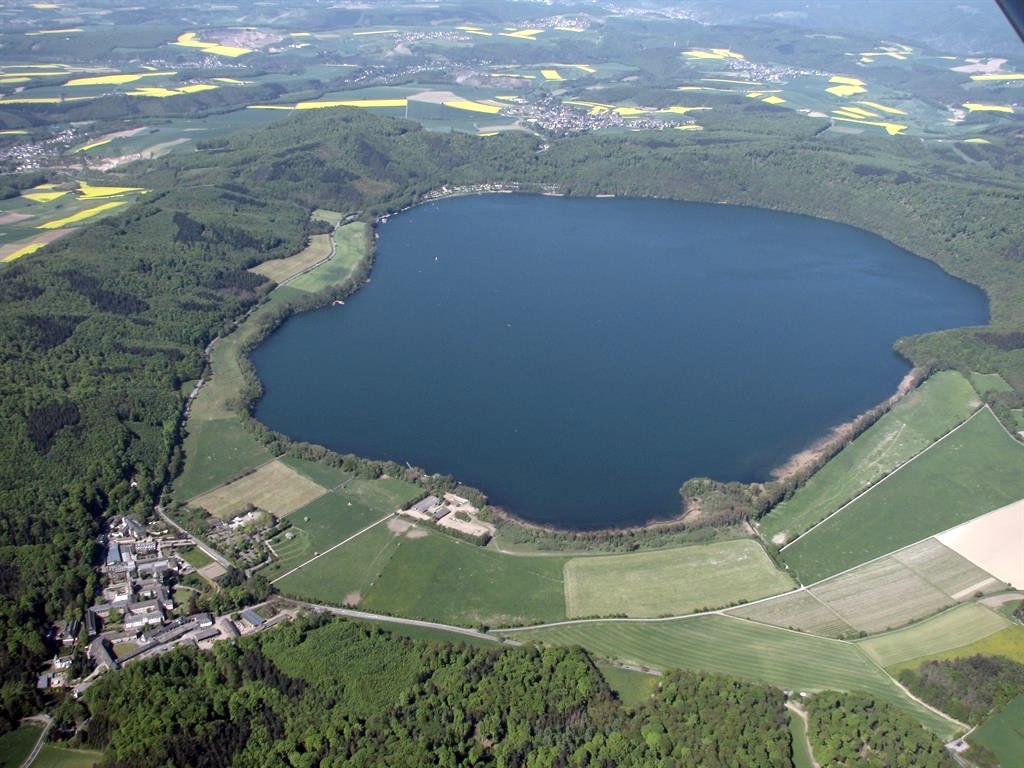
The Laacher See caldera lake in the recently active Eifel volcanic province in western Germany

A consortium of geochemists from three universities in Texas, USA has worked for some time on cave-floor sediments in Hall’s Cave, Texas as they span the YD. In particular, they sought an independent test of evidence for the highly publicised and controversial causal impact in the form of anomalous concentrations of the highly siderophile elements (HSE) osmium, iridium, platinum, palladium and rhenium (Sun, N. et al. 2020. Volcanic origin for Younger Dryas geochemical anomalies ca. 12,900 cal B.P.. Science Advances, v. 6, article eaax8587; DOI: 10.1126/sciadv.aax8587). There is a small HSE ‘spike’ at the 12.9 ka level, but there are three larger ones that precede it and one at about 11 ka. Two isotopes of the element osmium are often used to check the ultimate source of that element through the 187Os/188Os ratio, as can the relative proportions of the HSE elements compared with those in chondritic meteorites. The presence of spikes other than at the base of the YD does not disprove the extraterrestrial causal hypothesis, but the nature of those that bracket the mini-glacial time span not only casts doubt on it, they suggest a more plausible alternative. The 187Os/188Os data from each spike are ambiguous: they could either have arisen from partial melting of the mantle or from an extraterrestrial impact. But the relative HSE proportions point unerringly to the enriched layers having been inherited from volcanic gas aerosols. Two fit dated major eruptions of  the active volcanoes Mount Saint Helens (13.75 to 13.45 ka) and Glacier Peak (13.71 to 13.41 ka) in the Cascades province of western North America. Two others in the Aleutian and Kuril Arcs are also likely sources. The spike at the base of the YD exactly matches the catastrophic volcanic blast that excavated the Laacher See caldera in the Eifel region of western Germany, which ejected 6.3 km3 of sulfur-rich magma (containing 2 to 150 Mt of sulfur). Volcanic aerosols blasted into the stratosphere then may have dispersed throughout the Northern Hemisphere: a plausible mechanism for climatic cooling.

Sun et al. have not established the Laacher See explosion as the sole cause of the Younger Dryas. However, its coincidence with the shutdown of the Gulf Stream would have added a sudden cooling that may have amplified climatic effects of the disappearance of the North Atlantic’s main source of warm surface water. Effects of the Laacher See explosion may have been a tipping point, but it was one of several potential volcanic injections of highly reflective sulfate aerosols that closely precede and span the YD.

See also: Cooling of Earth caused by eruptions, not meteors (Science Daily, 31 July 2020)