Extraction of ancient human DNA from artefacts

The Denisova cave in southern Siberia is now famous for the evidence that it has provided for Neanderthals and Denisovans and their interbreeding based on DNA recovered from their bones, even a tiny finger bone of the latter. Indeed we would not know of the former existence of Denisovans without such a clue. Scientists at the Max Planck Institute for Evolutionary Anthropology in Leipzig, responsible for both breakthroughs, also pioneered the extraction of hominin DNA from soil in the cave. Now they have refined the intricate extraction of genetic material to such an extent that detailed hominin DNA sequences can be analysed from ornaments worn by ancient people, in much the same manner as applied in forensic studies of crime scenes (Essel, E. and 22 others 2023. Ancient human DNA recovered from a Palaeolithic pendant. Nature, early release 3 May 2023; DOI: 10.1038/s41586-023-06035-2).
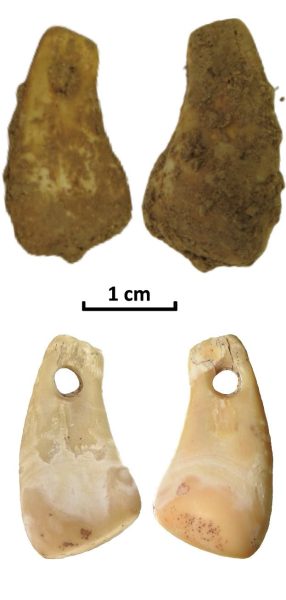
Elk-tooth pendant found at Denisova cave, before cleaning and DNA extraction (top) and after the ‘washing’ procedure (bottom). Credit: Essel et al., Fig 1.

Russian archaeologists who continue to work at Denisova cave found a pierced pendant made from the tooth of a Siberian elk or wapiti during the 2019 field season. It was sent to Leipzig, where the palaeogenetics team had been trying to extract the DNA of whoever had worn personal artefacts found in French and Bulgarian caves. Their efforts had been unsuccessful, but such an object from Denisova clearly spurred them on. When someone wears next to the skin objects made of porous materials their sweat and the DNA that it carries seeps into the pores. If the materials decay very slowly, as do bone and especially teeth, genetic material can, in principle be extracted. But crushing up important ancient objects is not an option: for such rarities the extraction has to be non-destructive. It can only be done by ‘washing’ it in reagents that do not themselves break down DNA. Elena Essel and her many colleagues experimented with many ‘brews’ of reagents and repeated immersion at steadily rising temperature (up to 90°C). This releases genetic material in a stepwise fashion, allowing separation of contaminants in the host sediment from that which had penetrated into the tooth’s pores from whoever made the pendant and the wearer, and the animal from which it came

 Analysis of the recovered material yielded elk mtDNA, which was compared with that from four other ancient elks of known ages. This suggested that the elk had lived between 19 and 25 ka ago, thereby indirectly dating the time when the pendant was made and worn. A surprisingly large amount human DNA showed that the wearer was a female who was genetically allied with ancient anatomically modern humans who lived further east in Siberia at about that time.

Obviously this astonishing result opens up a wide vista for archaeology, though not from Palaeolithic burials, which are extremely rare. But artefacts of various kinds are much more common that actual human remains. Because the technique is non-destructive museums may be more willing to make objects in their collections available for analysis. Maybe the approach will be restricted to porous bone or tooth ornaments worn for long periods by individuals. Yet stone tools that were handled continually could be a more important target, depending on the rock from which they were made and its porosity.

See also: Lesté-Lasserre, C.. DNA from 25,000-year-old tooth pendant reveals woman who wore it. New Scientist, 3 May 2023.

Chewing gum and the genetics of an ancient human

The sequencing of DNA has advanced to such a degree of precision and accuracy that minute traces of tissue, hair, saliva, sweat, semen and other bodily solids and fluids found at crime scenes are able to point to whomever was present. That is, provided that those persons’ DNA is known either from samples taken from suspects or resides in police records. In the case of individuals unknown to the authorities, archived DNA sequences from members of almost all ethnic groups can be used to ‘profile’ those present at a crime. Likely skin and hair pigmentation, and even eye colour, emerge from segments that contain the genes responsible.

One of the oddest demonstrations of the efficacy of DNA sequencing from minute samples used a wad of chewed birch resin. Such gums are still chewed widely for a number of reasons: to stave off thirst or hunger; to benefit from antiseptic compounds in the resin and to soften a useful gluing material – resin derived by heating birch bark is a particularly good natural adhesive . Today we are most familiar with chicle resin from Central America, the base for most commercial chewing gum, but a whole range of such mastics are chewed on every inhabited continent, birch gum still being used by Native North Americans: it happens to be quite sweet. The chewed wad in this case was from a Neolithic site at Syltholm on the Baltic coast of southern Denmark (Jensen, T.Z.T. and 21 others 2019. A 5700 year-old human genome and oral microbiome from chewed birch pitch. Nature Communications v. 10, Article 5520; DOI: 10.1038/s41467-019-13549-9). The sample contained enough ancient human DNA to reconstruct a full genome, and also yielded fragments from a recent meal – duck with hazelnuts – and from several oral bacteria and viruses, including a herpes variety that is a cause of glandular fever. The sample also shows that the carrier did not have the gene associated with lactase persistence that allows adults to digest milk.

An artist’s impression of the gum chewing young woman from southern Denmark (credit: Tom Bjorklund)

The chewer was female and had both dark skin and hair, together with blue eyes; similar to a Mesolithic male found in a cave in Cheddar Gorge in SW England whose petrous ear bone yielded DNA. By no means all fossil human bones still carry enough DNA for full sequencing, and are in any case rare. Chewed resin is much more commonly found and its potential awaits wider exploitation, particularly as much older wads have been found. Specifically, the Danish woman’s DNA reveals that she did not carry any ancestry from European Neolithic farmers whose DNA is well known from numerous burials. It was previously thought that farmers migrating westward from Anatolia in modern Turkey either replaced or absorbed the earlier Europeans. By 5700 years ago farming communities were widespread in western Europe, having arrived almost two thousand years earlier. The blue-eyed, dark Danish woman was probably a member of a surviving group of earlier hunter gatherers who followed the retreat of glacial conditions at the end of the Younger Dryas ice re-advance about 11,500 years ago. The Syltholm site seems to have been occupied for hundreds of generations. Clearly, the community had not evolved pale skin since its arrival, as suggested by a once popular theory that dark skin at high latitudes is unable to produce sufficient vitamin-D for good health. That notion has been superseded by knowledge that diets rich in meat, nuts and fungi provide sufficient vitamin-D. Pale skins may have evolved more recently as people came to rely on a diet dominated by cereals that are a poor source of vitamin-D.