The onset of weathering in the late Archaean and stabilisation of the continents

Distribution of exposed Archaean cratons. The blue Proterozoic areas may, in part be underlain by cratons. (Credit: Groves, D.I. & Santosh, M. DOI:10.1016/j.gr.2020.06.008)

About 50% of continental crust is of Archaean age (2.5 to 4.0 Ga) in huge blocks above lithosphere more than 150 km thick. Younger continental lithosphere is significantly thinner – as low as 40 km. Since the end of the Archaean Eon these blocks have remained tectonically stable and only show signs of extensional, brittle fracture that have been exploited by basaltic dyke swarms. Such crystalline monstrosities have remained rigid for 2.5 billion years. They are termed cratons from the Greek word κράτο (kratos) for ‘might’ or ‘strength’. Numbers of cratons have been pushed together by later tectonics to form continental ‘cores’, separated from one another by highly deformed ‘mobile belts’ formed by younger collisional orogenies. Africa and South America have 4 cratons each, Eurasia 6 or 7, the other continents all have one

Considering how much cratons have been stressed by later tectonic forces, their implacable rigidity might seem surprising. This rigidity is thought to be due to cratons’ unusually low amounts of the main heat-producing elements (HPE) potassium, uranium and thorium, the decay of whose radioactive isotopes produces surface heat flow. Cratons have the lowest surface heat flow on the planet, so in bulk they must have low HPE content. This stems from the nature of cratons’ deepest parts: almost anhydrous, once igneous rocks of intermediate average composition known as granulites. They formed by metamorphism of earlier crustal rocks at depths of up to 70km, which drove out most of their original HPEs and water. The upper cratonic crust has much the same complement of HPEs as that of more recent continental crust. This bulk depletion of cratons has maintained unusually low temperatures in their deep continental crust. That has been immune from partial melting and thus ductile deformation since it formed.
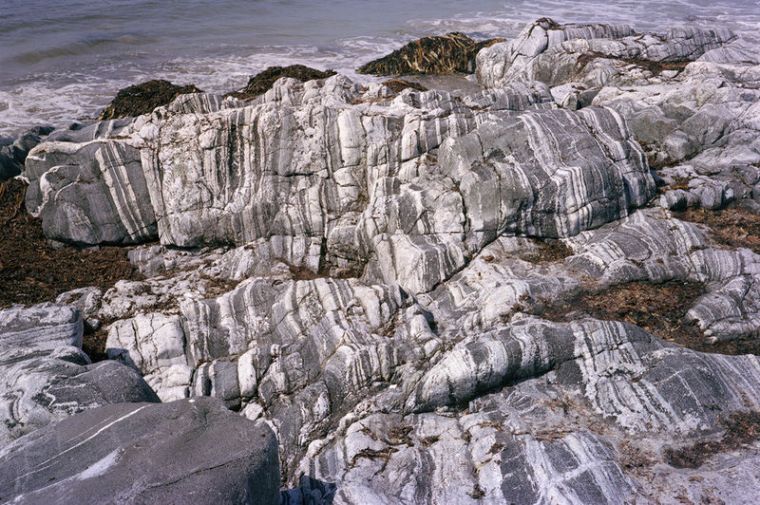
Three billion year-old TTG gneiss in the Outer Hebrides, Scotland. (Credit: British Geological Survey)

Jesse Reimink and Andrew Smye of Pennsylvania State University, USA have considered the geochemistry and history of the world’s cratons to address the long-standing issue of their stability and longevity (Reimink, J.R. & Smye, A.J. 2024. Subaerial weathering drove stabilization of continents. Nature, v. 629, online article; DOI: 10.1038/s41586-024-07307-1). Their main focus is on how the Archaean lower crust lost most of it HPEs, and where they went. During much of the Archaean continental crust formed by partial melting of hydrated basaltic rocks at shallow depths. That generated sodium-rich silicic magmas from which the dominant grey tonalite-trondhjemite-granodiorite (TTG) gneisses of Archaean crust formed by extreme ductile deformation. Though TTGs originally contained sufficient heat-producing capacity to make them ductile during the early Archaean there is little evidence that they underwent extensive partial melting themselves. But they did after 3.0 Ga to produce swarms of granite plutons in the upper Archaean crust.

Complementing the late-Archaean granite ‘swarm’ are deep-crustal granulites with low HPE contents, which mainly formed around the same time. The granulites contain highly metamorphosed sedimentary rocks, which seem to have been sliced into the Archaean crust during its ductile deformation phase. Some of them have compositions that suggest that they are derived from clay-rich shales, their proportion reaching about 30% of all granulite-facies metasediments. Clay minerals are the products of chemical weathering of silicon- and aluminium-rich igneous rocks exposed to the atmosphere. When they form, they host K, U and Th. Also, their composition and high initial water contents are conducive to partial melting under high-temperature conditions, to become a source of granitic magmas. Crustal weathering is key to Reimink and Smye’s hypothesis for the development of cratons in the late Archaean.

There is growing evidence that high Archaean heat flow through oceanic lithosphere – the mantle contained more undecayed HPE isotopes than now – reduced its density. As a result Archaean oceanic basins were considerably shallower than they became in later times. Because of the lower volume of the basins during the Archaean, seawater extended across much of the continental surface. For most of the Archaean Eon Earth was a ‘waterworld’, with little subaerial weathering of its TTG upper crust. As the volume of exposed continental crust increased so did surface weathering to form clay minerals that selectively absorbed HPEs. Over time shales became tectonically incorporated deep into the thickening Archaean continental crust to form a zone with increased heat producing capacity and a higher water content. Once deep enough and heated by their own content of HPE they began partially melting to yield voluminous granitic magmas to which they contributed their load of HPEs. Being lower in density than the bulk of TTG crust the granite melts would have risen to reach the upper crust. They also took in HPEs from the deep TTG crust itself. According to Reimink and Smye this would have concentrated continental heat production in the upper crust, leaving the deeper crust drier, less able to melt and assume ductile properties, and thus to create the cratons.

The authors believe that such a redistribution of heat production in the ancient continental crust did not need any major change in global tectonics. All it required was decreasing oceanic heat flow to create deeper and more voluminous ocean basins, allowing more continental surface to emerge above sea level and dynamic burial of sedimentary products of subaerial weathering. They conclude: “The geological record can then be cast in terms of a pre-emergence (TTG-dominated) and post-emergence (granite-dominated) planet.” That seems very neat … but it seems unlikely that samples can be drilled from the depths where the ‘action’ took place. Geologists depend on exposures of Archaean middle to deep crust brought to the surface by fortuitous later tectonics.

Subduction and continental collision in the Himalaya

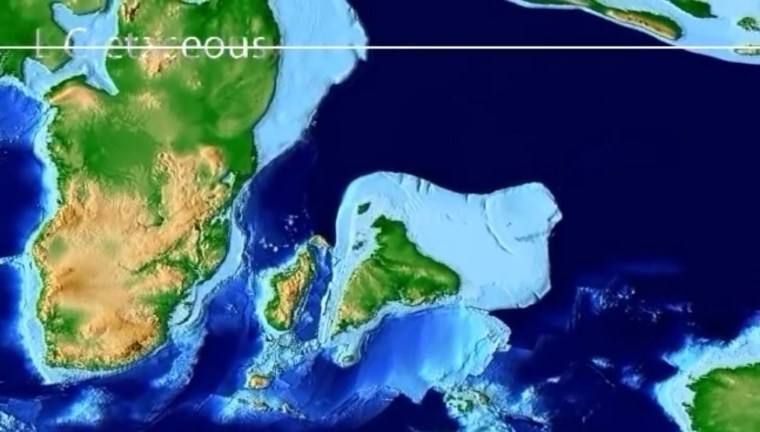
The Indian subcontinent after it separated from Madagascar in the Late Cretaceous to move northwards to its destined collision with Eurasia and the formation of the Himalaya. (Credit: Frame from an animation ©Christopher Scotese)

During the Early Cretaceous (~140 Ma ago) India, Madagascar, Antarctica and Australia parted company with Africa after 400 Ma of unity as components of the Gondwana supercontinent. By 120 Ma Antarctica and Australia split from India and Madagascar, and the Indian Ocean began to form. India moved northwards , leaving Madagascar in its wake after about 70 Ma ago. By 50 Ma the subcontinent began to collide with Eurasia, its northward motion driving before it crustal materials that eventually formed the Himalaya. This highly complex process is wonderfully documented in an animation made in 2015 by Christopher Scotese, Emeritus Professor in the Department of Earth and Environmental Sciences, Northwestern University, USA. At the start of its journey India moved northwards at a slow rate of about 5 cm per year. After 80 Ma it speeded up dramatically to 15 cm per year, about twice as fast as any modern continental drift and a pace that lasted for over 30 Ma until collision began. How could that, in a geological sense, sudden and sustained acceleration have been induced? It would have required a change in the slab-pull force that is the primary driver of plate tectonics, suggesting an increase in the amount of subduction in the Tethys Ocean that formerly lay between India and Eurasia, probably at two, now hidden destructive plate margins.

A group of geoscientists from Canada, the US and Pakistan has documented that collision in terms of the record of metamorphism experienced beneath the Himalaya as slab after slab of once near-surface rocks were driven beneath the rising orogen (Soret, M. et al. 2021. How Himalayan collision stems from subduction. Geology, v. 49, p. 894-898; DOI: 10.1130/G48803.1). The Western Himalaya has trapped a deformed and tilted magmatic rock sequence of an island arc – the Kohistan Arc – between  the Eurasian plate and a zone of crustal thickening and shortening that was thrust southward over the ancient metamorphic basement of India itself. That crust was mantled by a variety of younger sediments deposited on the Tethyan continental shelf of the northern Indian plate which became involved in the process of crustal thickening. The Kohistan Arc probably formed above one of the destructive margins that consumed the oceanic lithosphere of the now vanished Tethys Ocean. Two distinct types of rock make up the slabs stacked-up by thrusting.

The uppermost, which also forms the highest part of the Western Himalaya in the form of Nanga Parbat (at 8,126 metres the world’s ninth highest mountain) comprises rocks thought to represent Tethyan oceanic lithosphere subducted perhaps at the second destructive margin. Their mineral assemblages, especially those of eclogites, indicate that they have been metamorphosed under pressures corresponding to depths of up to 100 km, but at low temperatures along a geothermal gradient of about 7°C km-1, i.e. in a low heat-flow environment. These ultra-high pressure (UHP) metamorphic rocks formed at the start of the India-Eurasia collision. The sequence of sedimentary slabs now overridden by the UHP slab were metamorphosed at around the same time, but under very different conditions. Their burial reached only about 35 km – the normal thickness of the continental crust – and a temperature of about 600°C on a 30°C km-1 geothermal gradient. Detailed mineralogy of the UHP slab reveals that as it was driven over the metasediments it evolved to the same geothermal conditions.

Matthew Soret and his colleagues explain how this marked metamorphic duality may have arisen in rocks that are now part of the same huge thrust complex. Their results are consistent with slicing together of oceanic lithosphere in a subduction zone to form a tectonic wedge of UHP mineral assemblages at the same time as continental shelf sediments were metamorphosed under more normal geothermal conditions. This was happening just as India came into contact with Eurasia. When crustal thickening began in earnest through the inter-slicing of the two assemblages, pressure on the UHP rocks fell rapidly as a result of their being thrust over the dominantly metasedimentary shelf sequence. It also moved into a zone of normal heat flow, first heating up equally quickly and then following a path of decreasing pressure and temperature as erosion pared away the newly thickened crust. Both assemblages now became part of the same metamorphic regime. In this way a subduction system evolved to become incorporated in an orogenic zone as two continents collided; a complex process that finds parallels in other orogens such as the Alps.

Changing conditions of metamorphism since the Archaean

Metamorphic petrologists have known since their branch of geology emerged that the intensity or ‘grade’ of metamorphism varies with position in an orogenic belt. This is easily visualised by the sequence mudstone-shale-slate-phyllite-schist-gneiss that results from a clay-rich starting material as metamorphic grade increases. Very roughly speaking, the sequence reflects burial, heat and pressure, and must have been controlled by temperature increasing with depth and pressure: the geothermal gradient. In turn, that depends on internal heat production, geothermal heat flow and the way in which heat is transferred through the deep crust: by thermal conduction or mechanical convection. A particular rock composition gives rise to different metamorphic mineral assemblages under different temperature and pressure conditions.

George Barrow was the first to recognise this in the Southern Highlands of Scotland as a series of zones marked by different index minerals. For instance, in once clay-rich sediments he recognised a succession of new minerals in the sequence chlorite; biotite; garnet; staurolite; kyanite; sillimanite in rocks of progressively higher metamorphic grade. Barrow found that once basaltic lavas interleaved with the sediments displayed zones with different characteristic minerals. Other metamorphic terrains, however, revealed different index minerals. Experimental mineralogy eventually showed that Barrow’s zones and others reflected a wide range of chemical reactions between minerals that reach equilibrium over different combinations of pressure and temperature. This enabled geologists to distinguish between metamorphism that had occurred under conditions of high-pressure and low-temperature, low-P and high-T and intermediate conditions (see diagram). This suggested that metamorphic rocks can form in areas with different heat flow and geothermal gradients. Geochemical means of assessing the actual temperatures and pressures at which particular rocks had reached mineralogical equilibrium, known as ‘thermobarometry’, now enable such variations to be assessed quantitatively.

The latest division in pressure-temperature space of different styles of metamorphism (colours) and the main mineral equilibria (dashed lines) that define them

It has long been suspected that the average T/P conditions revealed by metamorphic rocks have varied over geological time, as well as from place to place at any one time. A recent paper has analysed thermobarometric data from the earliest Archaean to recent times (Brown, M. et al. 2020, Evolution of geodynamics since the Archean: Significant change at the dawn of the Phanerozoic: Geology, v. 48, p. 488–492; DOI: 10.1130/G47417.1) They conclude that from the Archaean to the start of the Neoproterozoic the average P/T ratio was more than twice as high as it was in the following billion years. At about 2 Ga they suggests a relatively sudden decrease that correlates with what they regard as the first major assembly of continental crust: the Columbia (Nuna) supercontinent. The Mesoproterozoic Era, occupied by the disassembly of Columbia and the eventual creation of the Rodinia supercontinent, retained a high mean T/P. That began to decline with the break-up of Rodinia and a succession of tectonic cycles of ocean opening and closing during the Neoproterozoic and the Phanerozoic. This phase of truly modern plate textonics saw first the assembly of Gondwana and then the all-encompassing Pangaea, followed by its break up as we witness today. There are other correlations with the T/P variations, but they need not detain us.

The raw metamorphic data (564 points spanning 3.5 Ga) are by no means evenly spaced in time, and four dense clusters of points show a very wide spread of T/P – up to 2 orders of magnitude. Yet the authors have used locally weighted scat­terplot smoothing (LOWESS) to reduce this to a smoothed curve with a zone of uncertainty that is a great deal narrower than the actual spread of data. Frankly, I do not believe the impression of systematic change that this approach has produced, though I am not a statistician. To a lesser extent than me, it seems that neither does Peter Cawood, who comments on the paper in the same issue of Geology: more clearly than do the authors themselves.

Peter Cawood’s ‘take’ on the relationship between tectonic development and other important variables in the Earth-system with the estimate by Brown et al. of the mean metamorphic T/P (‘thermobaric’) variation through Earth history

Cawood’s view is that it was all due to a steady fall in mantle temperature and related broad changes in tectonic processes. But metamorphic rocks form in only the outermost 100 km of the Earth. The post-800 Ma examples include a much greater proportion of those formed under high- and ultrahigh pressures – blueschists and various kinds of eclogite – than do the earlier metamorphic belts. This weights the post-800 Ma record to lower mean T/P. Such rocks form in subduction zones and their high density might seem to doom them to complete resorption into the deep mantle. Yet large chunks now end up embedded in continents, interleaved with less extreme materials. Cawood suggests, as do others, that cooling of the mantle has enabled deeper break-off of subducted slabs to meet their end at the core-mantle boundary. The retained low T/P lithosphere since 800 Ma may have been sliced into the continents by increased underthrusting during continent-continent collisions that dominate the more modern orogenic-metamorphic belts.

See also:  Cawood, P.A. 2020 Earth Matters: A tempo to our planet’s evolution: Geology, v. 48, p. 525–526; DOI: 10.1130/focus052020.1