

About 50% of continental crust is of Archaean age (2.5 to 4.0 Ga) in huge blocks above lithosphere more than 150 km thick. Younger continental lithosphere is significantly thinner – as low as 40 km. Since the end of the Archaean Eon these blocks have remained tectonically stable and only show signs of extensional, brittle fracture that have been exploited by basaltic dyke swarms. Such crystalline monstrosities have remained rigid for 2.5 billion years. They are termed cratons from the Greek word κράτο (kratos) for ‘might’ or ‘strength’. Numbers of cratons have been pushed together by later tectonics to form continental ‘cores’, separated from one another by highly deformed ‘mobile belts’ formed by younger collisional orogenies. Africa and South America have 4 cratons each, Eurasia 6 or 7, the other continents all have one
Considering how much cratons have been stressed by later tectonic forces, their implacable rigidity might seem surprising. This rigidity is thought to be due to cratons’ unusually low amounts of the main heat-producing elements (HPE) potassium, uranium and thorium, the decay of whose radioactive isotopes produces surface heat flow. Cratons have the lowest surface heat flow on the planet, so in bulk they must have low HPE content. This stems from the nature of cratons’ deepest parts: almost anhydrous, once igneous rocks of intermediate average composition known as granulites. They formed by metamorphism of earlier crustal rocks at depths of up to 70km, which drove out most of their original HPEs and water. The upper cratonic crust has much the same complement of HPEs as that of more recent continental crust. This bulk depletion of cratons has maintained unusually low temperatures in their deep continental crust. That has been immune from partial melting and thus ductile deformation since it formed.
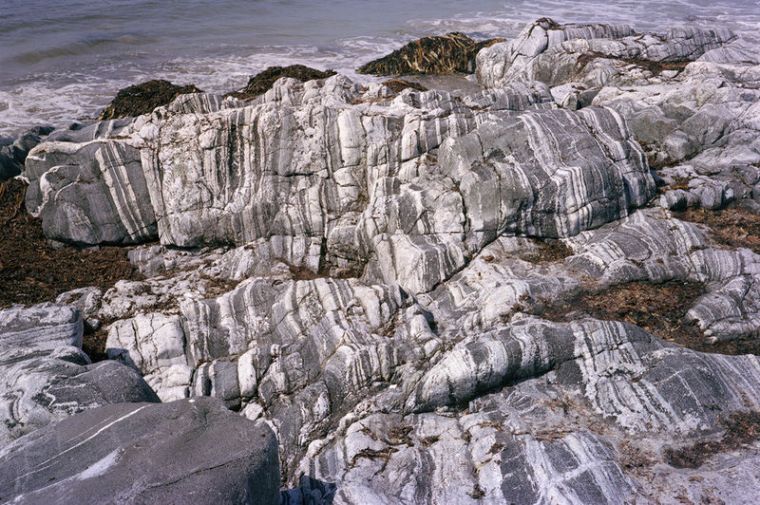
Jesse Reimink and Andrew Smye of Pennsylvania State University, USA have considered the geochemistry and history of the world’s cratons to address the long-standing issue of their stability and longevity (Reimink, J.R. & Smye, A.J. 2024. Subaerial weathering drove stabilization of continents. Nature, v. 629, online article; DOI: 10.1038/s41586-024-07307-1). Their main focus is on how the Archaean lower crust lost most of it HPEs, and where they went. During much of the Archaean continental crust formed by partial melting of hydrated basaltic rocks at shallow depths. That generated sodium-rich silicic magmas from which the dominant grey tonalite-trondhjemite-granodiorite (TTG) gneisses of Archaean crust formed by extreme ductile deformation. Though TTGs originally contained sufficient heat-producing capacity to make them ductile during the early Archaean there is little evidence that they underwent extensive partial melting themselves. But they did after 3.0 Ga to produce swarms of granite plutons in the upper Archaean crust.
Complementing the late-Archaean granite ‘swarm’ are deep-crustal granulites with low HPE contents, which mainly formed around the same time. The granulites contain highly metamorphosed sedimentary rocks, which seem to have been sliced into the Archaean crust during its ductile deformation phase. Some of them have compositions that suggest that they are derived from clay-rich shales, their proportion reaching about 30% of all granulite-facies metasediments. Clay minerals are the products of chemical weathering of silicon- and aluminium-rich igneous rocks exposed to the atmosphere. When they form, they host K, U and Th. Also, their composition and high initial water contents are conducive to partial melting under high-temperature conditions, to become a source of granitic magmas. Crustal weathering is key to Reimink and Smye’s hypothesis for the development of cratons in the late Archaean.
There is growing evidence that high Archaean heat flow through oceanic lithosphere – the mantle contained more undecayed HPE isotopes than now – reduced its density. As a result Archaean oceanic basins were considerably shallower than they became in later times. Because of the lower volume of the basins during the Archaean, seawater extended across much of the continental surface. For most of the Archaean Eon Earth was a ‘waterworld’, with little subaerial weathering of its TTG upper crust. As the volume of exposed continental crust increased so did surface weathering to form clay minerals that selectively absorbed HPEs. Over time shales became tectonically incorporated deep into the thickening Archaean continental crust to form a zone with increased heat producing capacity and a higher water content. Once deep enough and heated by their own content of HPE they began partially melting to yield voluminous granitic magmas to which they contributed their load of HPEs. Being lower in density than the bulk of TTG crust the granite melts would have risen to reach the upper crust. They also took in HPEs from the deep TTG crust itself. According to Reimink and Smye this would have concentrated continental heat production in the upper crust, leaving the deeper crust drier, less able to melt and assume ductile properties, and thus to create the cratons.
The authors believe that such a redistribution of heat production in the ancient continental crust did not need any major change in global tectonics. All it required was decreasing oceanic heat flow to create deeper and more voluminous ocean basins, allowing more continental surface to emerge above sea level and dynamic burial of sedimentary products of subaerial weathering. They conclude: “The geological record can then be cast in terms of a pre-emergence (TTG-dominated) and post-emergence (granite-dominated) planet.” That seems very neat … but it seems unlikely that samples can be drilled from the depths where the ‘action’ took place. Geologists depend on exposures of Archaean middle to deep crust brought to the surface by fortuitous later tectonics.

 Earth-logs